Division of Viral Diseases, Center for Laboratory Control of Infectious Diseases, Korea Centers for Disease Control and Prevention, Cheongju-si, South Korea.
Virol J. 2020 Jul 6;17(1):94. doi: 10.1186/s12985-020-01375-1.
The emergence of influenza viruses resistant to anti-influenza drugs is a threat to global public health. The Korea Centers for Disease Control and Prevention operates the Korea Influenza and Respiratory Viruses Surveillance System (KINRESS) to monitor epidemics of influenza and Severe Acute Respiratory Infection (SARI) to identify mutated influenza viruses affecting drug resistance, pathogenesis, and transmission.
Oropharyngeal swab samples were collected from KINRESS and SARI during the 2018-2019 season. The specimens confirmed influenza virus using real-time RT-PCR on inoculated MDCK cells. HA and NA sequences of the influenza viruses were analyzed for phylogeny and mutations. Neuraminidase inhibition and hemagglutination inhibition assays were utilized to characterize the isolates.
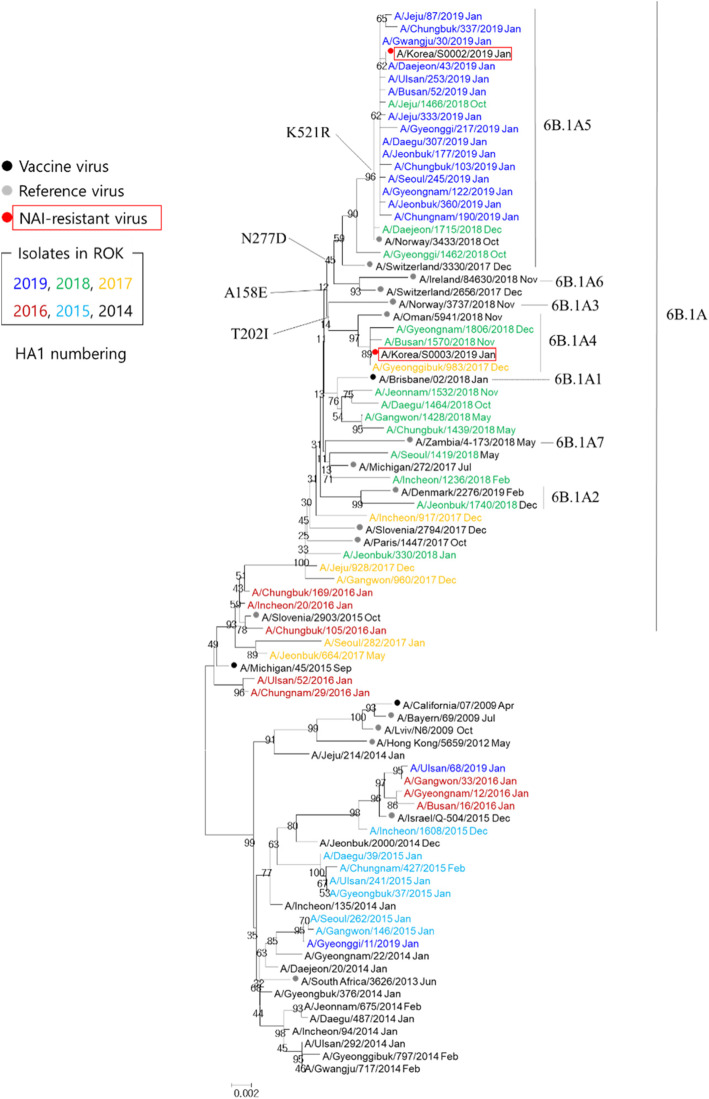
Two A(H1N1)pdm09 isolates harboring an H275Y substitution in the neuraminidase sequence were detected in patients with acute hematologic cancer. They had prolonged respiratory symptoms, with the virus present in the respiratory tract despite oseltamivir and peramivir treatment. Through the neuraminidase inhibition assay, both viruses were found to be resistant to oseltamivir and peramivir, but not to zanamivir. Although hemagglutinin and neuraminidase phylogenetic analyses suggested that the 2 A(H1N1)pdm09 isolates were not identical, their antigenicity was similar to that of the 2018-19 influenza vaccine virus.
Our data indicate the utility of monitoring influenza-infected immunocompromised patients in general hospitals for the early detection of emerging neuraminidase inhibitor-resistant viruses and maintaining continuous laboratory surveillance of patients with influenza-like illness in sentinel clinics to monitor the spread of such new variants. Finally, characterization of the virus can inform the risk assessment for future epidemics and pandemics caused by drug-resistant influenza viruses.
抗流感药物耐药流感病毒的出现对全球公共卫生构成威胁。韩国疾病管理本部运营韩国流感和呼吸道病毒监测系统(KINRESS),以监测流感和严重急性呼吸道感染(SARI)的流行情况,以识别影响药物耐药性、发病机制和传播的突变流感病毒。
在 2018-2019 季节,通过 KINRESS 和 SARI 采集咽拭子样本。使用接种 MDCK 细胞的实时 RT-PCR 对标本进行流感病毒检测。对流感病毒的 HA 和 NA 序列进行分析以了解其进化和突变情况。利用神经氨酸酶抑制和血凝抑制试验来对分离株进行特征分析。
在患有急性血液系统癌症的患者中检测到两株携带神经氨酸酶序列中 H275Y 取代的 A(H1N1)pdm09 分离株。它们具有延长的呼吸道症状,尽管使用奥司他韦和帕拉米韦治疗,但呼吸道中仍存在病毒。通过神经氨酸酶抑制试验发现,两株病毒均对奥司他韦和帕拉米韦耐药,但对扎那米韦敏感。尽管血凝素和神经氨酸酶系统发育分析表明,这两株 A(H1N1)pdm09 分离株不完全相同,但它们的抗原性与 2018-19 年流感疫苗病毒相似。
我们的数据表明,对综合医院中感染流感的免疫功能低下患者进行监测有助于及早发现新出现的神经氨酸酶抑制剂耐药病毒,并对哨点诊所中出现流感样症状的患者进行持续的实验室监测,以监测此类新变体的传播。最后,对病毒的特征分析可以为未来由耐药流感病毒引起的流行和大流行的风险评估提供信息。