Department of Animal Science, Universidade Federal de Viçosa, Viçosa, Minas Gerais, Brazil.
Animal Nutrition Group, Wageningen University and Research, Wageningen, The Netherlands.
PLoS One. 2020 Jul 7;15(7):e0235619. doi: 10.1371/journal.pone.0235619. eCollection 2020.
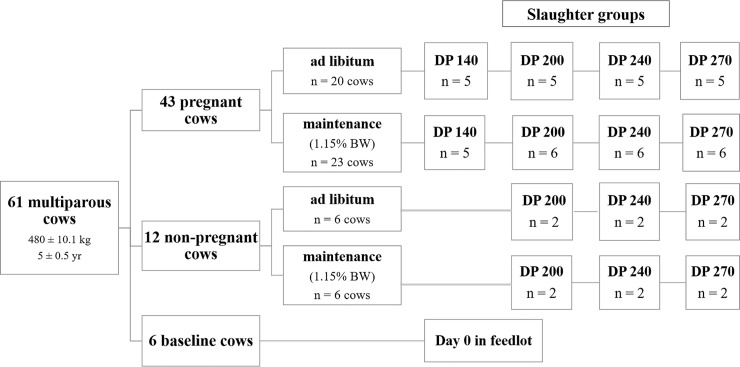
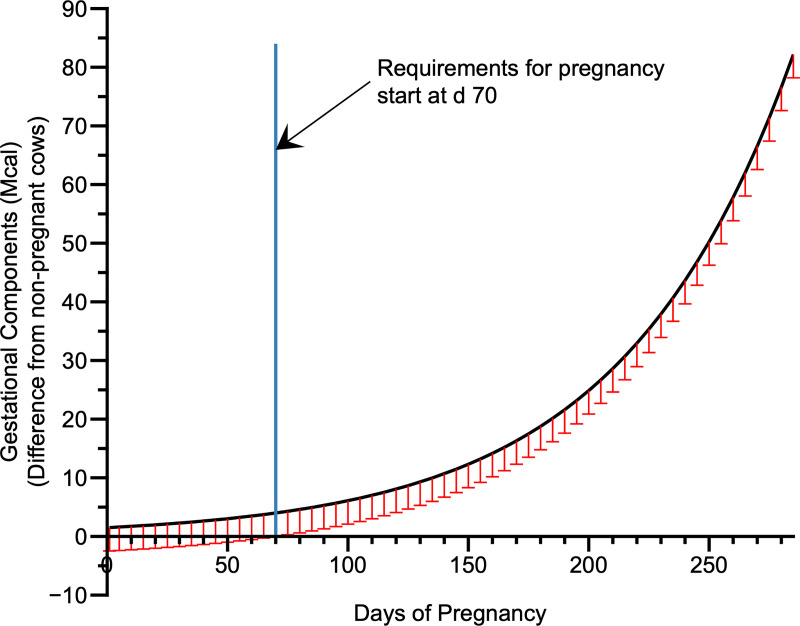
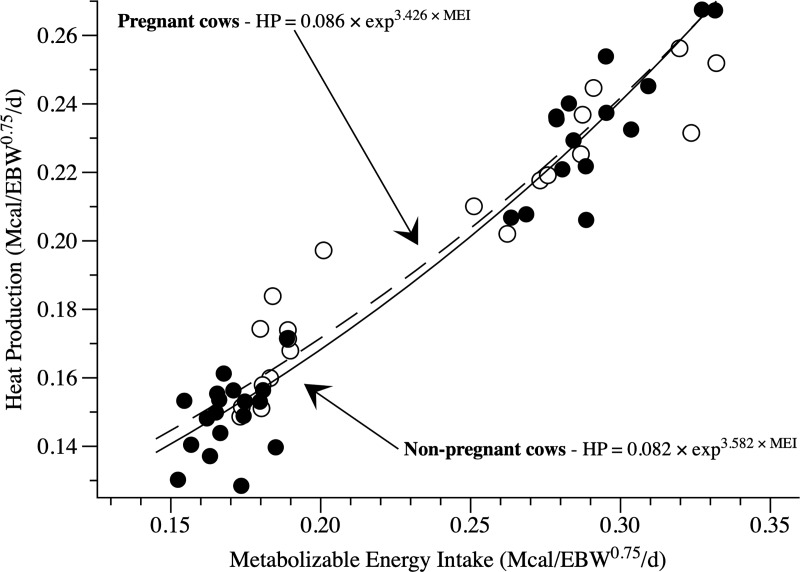
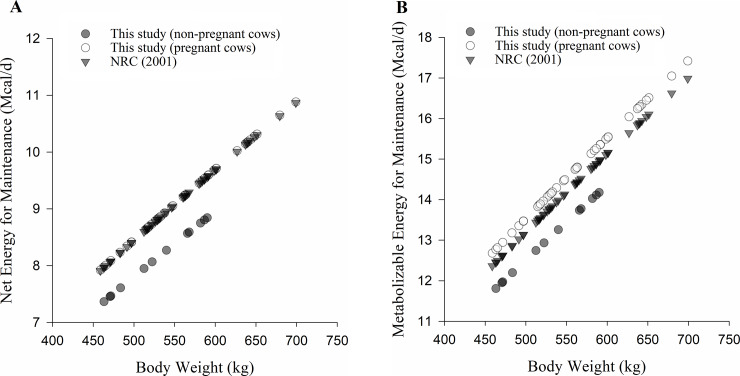
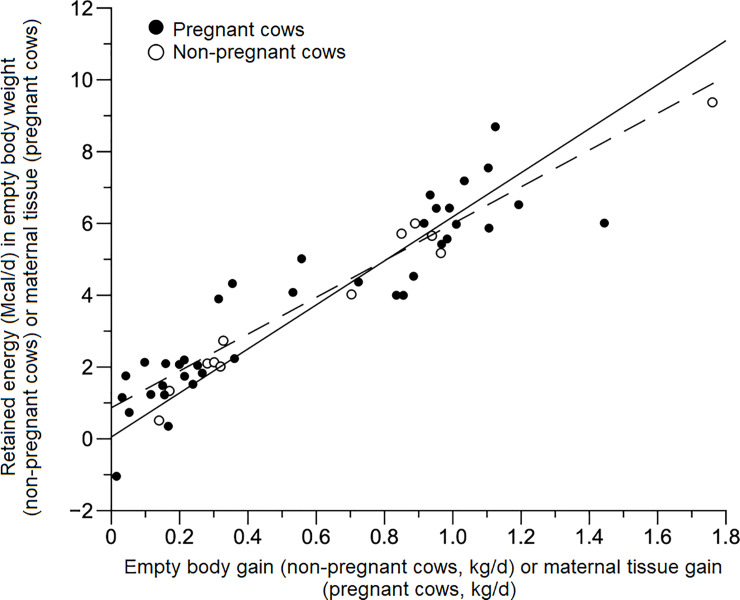
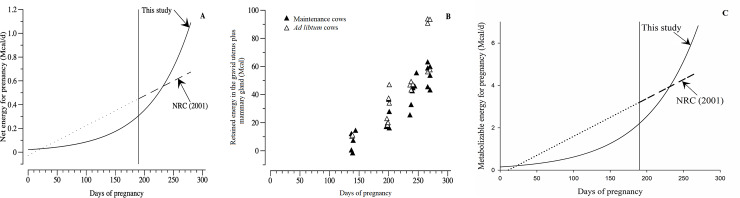
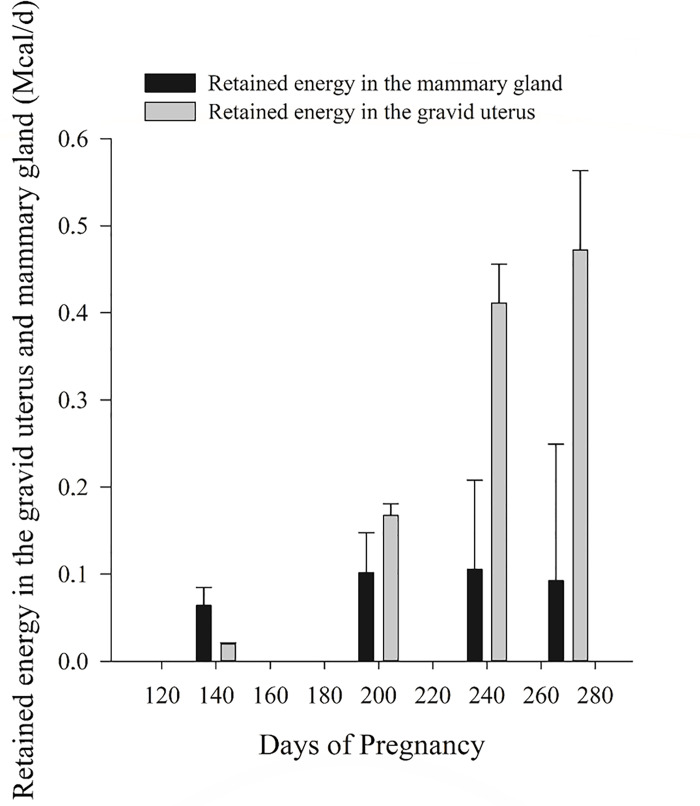
This study aimed to estimate energy requirements of pregnant Holstein × Gyr cows. Different planes of nutrition were established by two feeding regimens: ad libitum or maintenance. Sixty-two nonlactating cows with average body weight of 480 ± 10.1 kg and an age of 5 ± 0.5 years were used. Cows were divided into three groups: pregnant (n = 44), non-pregnant (n = 12), and baseline reference (n = 6). The 56 pregnant and non-pregnant cows were randomly allocated into a feeding regimen: ad libitum or maintenance. To evaluate the effects of days of pregnancy, pregnant and non-pregnant animals were slaughtered at 140, 200, 240, and 270 days of pregnancy. Energy requirements for maintenance differed between pregnant and non-pregnant cows, thus two equations were developed. Net energy and metabolizable energy requirements for maintenance of non-pregnant cows were 82 kcal/kg empty body weight0.75/day and 132 kcal/kg empty body weight0.75/day, respectively. The efficiency of use of metabolizable energy for maintenance of non-pregnant cows was 62.4%. Net energy and metabolizable energy for maintenance of pregnant cows were 86 kcal/kg empty body weight0.75/day and 137 kcal/kg empty body weight0.75/day, respectively. Efficiency of use of metabolizable energy for maintenance of pregnant cows was 62.5%. The efficiency of use of metabolizable energy for gain was 41.9%. The efficiency of use of metabolizable energy for pregnancy was 14.1%. Furthermore, net energy requirement for pregnancy was different from zero from day 70 of pregnancy onwards. In conclusion, net energy and metabolizable energy requirements for maintenance of non-pregnant cows are different from pregnant cows. Furthermore, we believe that the proposed non-linear equations to estimate net energy requirements for pregnancy are more adequate than current NRC equation, and should be recommended for Holstein × Gyr cows.
本研究旨在估算荷斯坦×吉尔怀孕奶牛的能量需求。通过两种饲养方案(自由采食或维持)建立不同的营养水平。62 头非泌乳奶牛,平均体重 480±10.1kg,年龄 5±0.5 岁,用于本研究。奶牛分为三组:怀孕组(n=44)、非怀孕组(n=12)和基础参考组(n=6)。56 头怀孕和非怀孕奶牛随机分配到一种饲养方案:自由采食或维持。为了评估妊娠天数的影响,在妊娠 140、200、240 和 270 天对怀孕和非怀孕动物进行屠宰。维持需要的净能和可代谢能在怀孕和非怀孕奶牛之间有所不同,因此开发了两个方程。非怀孕奶牛维持的净能和可代谢能需求分别为 82 千卡/公斤空腹体重 0.75/天和 132 千卡/公斤空腹体重 0.75/天,非怀孕奶牛维持的可代谢能利用效率为 62.4%。怀孕奶牛维持的净能和可代谢能需求分别为 86 千卡/公斤空腹体重 0.75/天和 137 千卡/公斤空腹体重 0.75/天,怀孕奶牛维持的可代谢能利用效率为 62.5%。可代谢能用于增重的效率为 41.9%。可代谢能用于妊娠的效率为 14.1%。此外,从妊娠第 70 天开始,妊娠的净能需求与零不同。总之,非怀孕奶牛维持的净能和可代谢能需求与怀孕奶牛不同。此外,我们认为,用于估计妊娠净能需求的拟议非线性方程比当前 NRC 方程更合适,应推荐用于荷斯坦×吉尔奶牛。