Kenéz Ákos, Kulcsár Anna, Kluge Franziska, Benbelkacem Idir, Hansen Kathrin, Locher Lena, Meyer Ulrich, Rehage Jürgen, Dänicke Sven, Huber Korinna
Department of Physiology, University of Veterinary Medicine, Hannover, Germany.
Department of Physiology and Biochemistry, Faculty of Veterinary Science, Szent István University, Budapest, Hungary.
PLoS One. 2015 May 15;10(5):e0127208. doi: 10.1371/journal.pone.0127208. eCollection 2015.
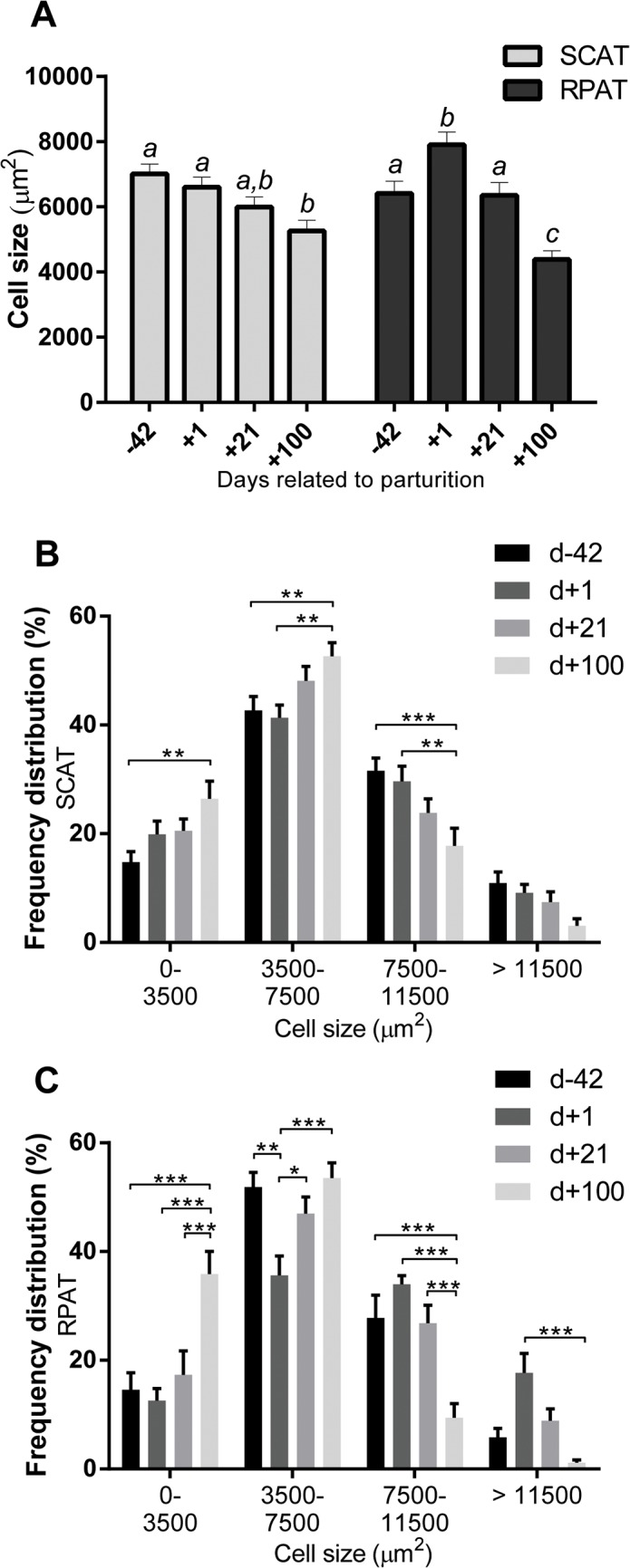
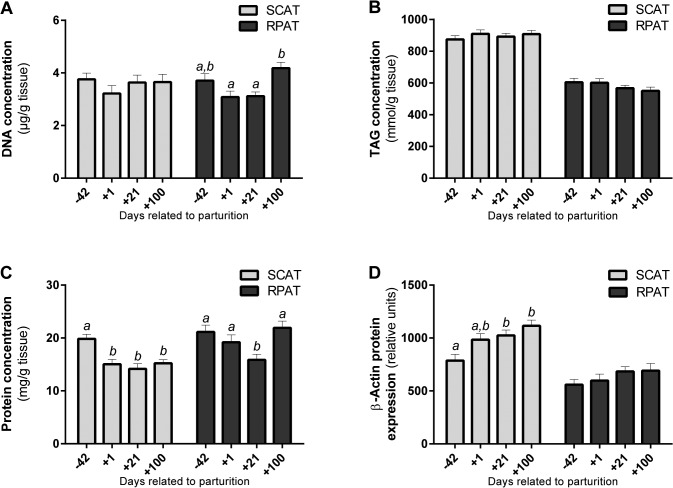
Dairy cows mobilize large amounts of body fat during early lactation to overcome negative energy balance which typically arises in this period. As an adaptation process, adipose tissues of cows undergo extensive remodeling during late pregnancy and early lactation. The objective of the present study was to characterize this remodeling to get a better understanding of adaptation processes in adipose tissues, affected by changing metabolic conditions including lipid mobilization and refilling as a function of energy status. This was done by determining adipocyte size in histological sections of subcutaneous and retroperitoneal adipose tissue biopsy samples collected from German Holstein cows at 42 days prepartum, and 1, 21, and 100 days postpartum. Characterization of cell size changes was extended by the analysis of DNA, triacylglycerol, and protein content per gram tissue, and β-actin protein expression in the same samples. In both adipose tissue depots cell size was becoming smaller during the course of the study, suggesting a decrease in cellular triacylglycerol content. Results of DNA, triacylglycerol, and protein content, and β-actin protein expression could only partially explain the observed differences in cell size. The retroperitoneal adipose tissue exhibited a greater extent of time-related differences in cell size, DNA, and protein content, suggesting greater dynamics and metabolic flexibility for this abdominal depot compared to the investigated subcutaneous depot.
奶牛在泌乳早期会动员大量体脂以克服这一时期通常出现的能量负平衡。作为一种适应过程,奶牛的脂肪组织在妊娠后期和泌乳早期会经历广泛的重塑。本研究的目的是对这种重塑进行表征,以便更好地理解脂肪组织中的适应过程,这些过程受包括脂质动员和根据能量状态重新填充在内的代谢条件变化的影响。这是通过测定从德国荷斯坦奶牛在产前42天、产后1天、21天和100天采集的皮下和腹膜后脂肪组织活检样本的组织学切片中的脂肪细胞大小来实现的。通过分析每克组织中的DNA、三酰甘油和蛋白质含量以及同一样本中的β-肌动蛋白蛋白表达,对细胞大小变化的表征进行了扩展。在整个研究过程中,两个脂肪组织库中的细胞大小都在变小,这表明细胞内三酰甘油含量在减少。DNA、三酰甘油和蛋白质含量以及β-肌动蛋白蛋白表达的结果只能部分解释观察到的细胞大小差异。腹膜后脂肪组织在细胞大小、DNA和蛋白质含量方面表现出更大程度的时间相关差异,这表明与所研究的皮下脂肪库相比,这个腹部脂肪库具有更大的动态性和代谢灵活性。