Heilongjiang Key Laboratory for Laboratory Animals and Comparative Medicine, College of Veterinary Medicine, Northeast Agricultural University, Harbin, Heilongjiang 150030, China.
College of Veterinary Medicine, Northeast Agricultural University, Harbin, Heilongjiang 150030, China.
Nutrients. 2020 Jul 3;12(7):1988. doi: 10.3390/nu12071988.
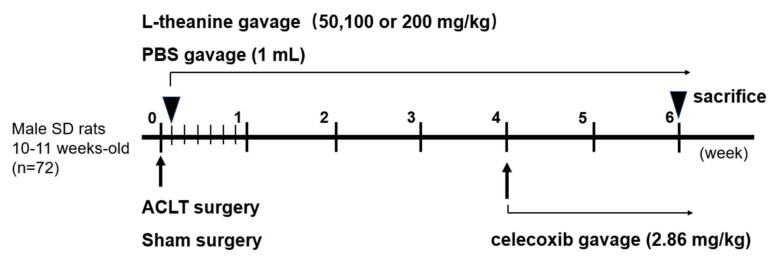
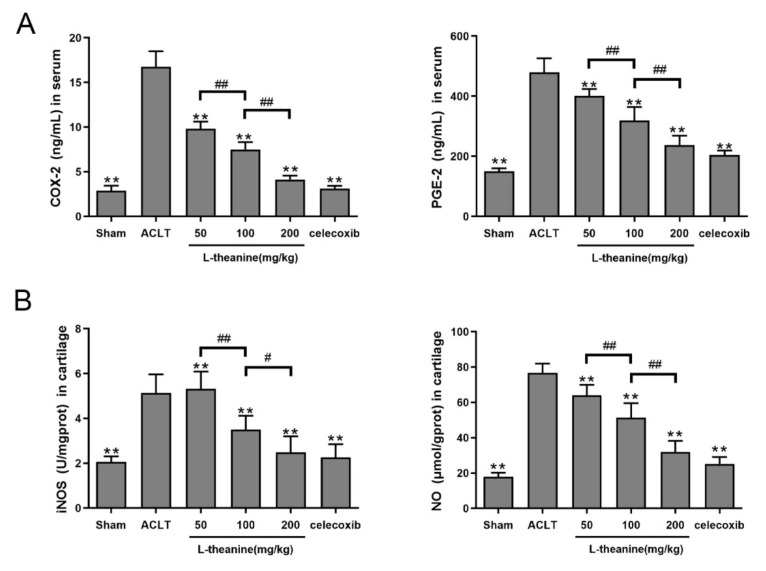
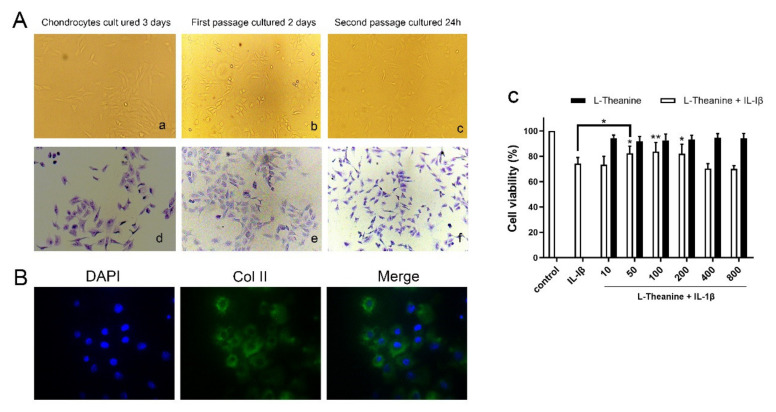
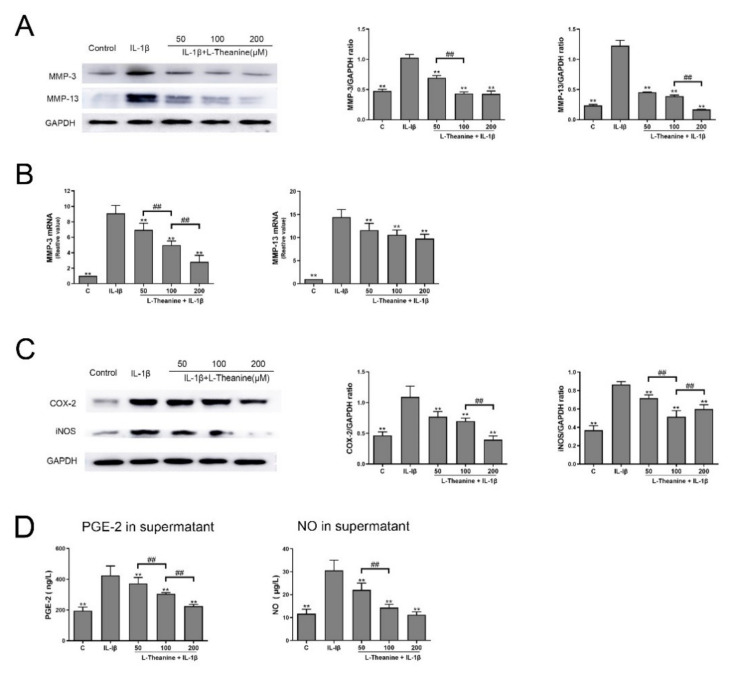
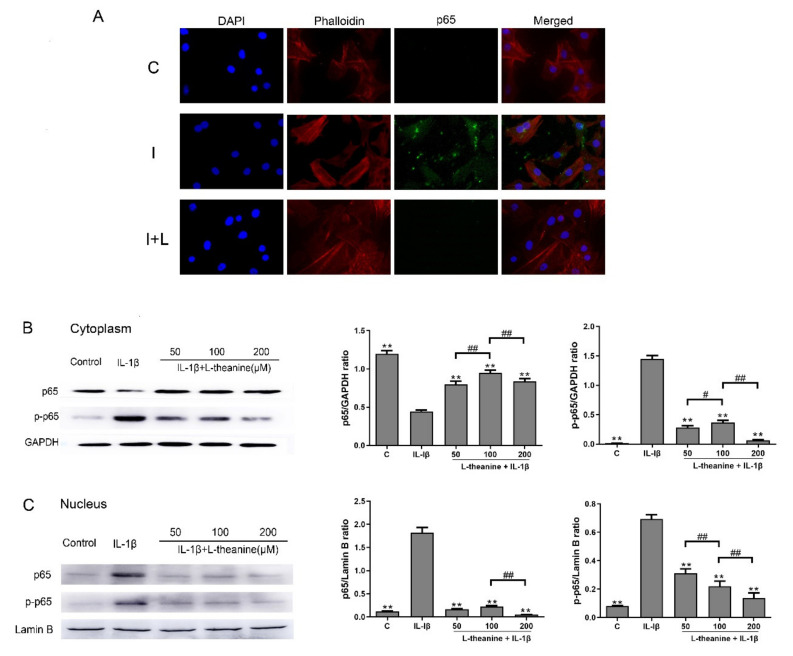
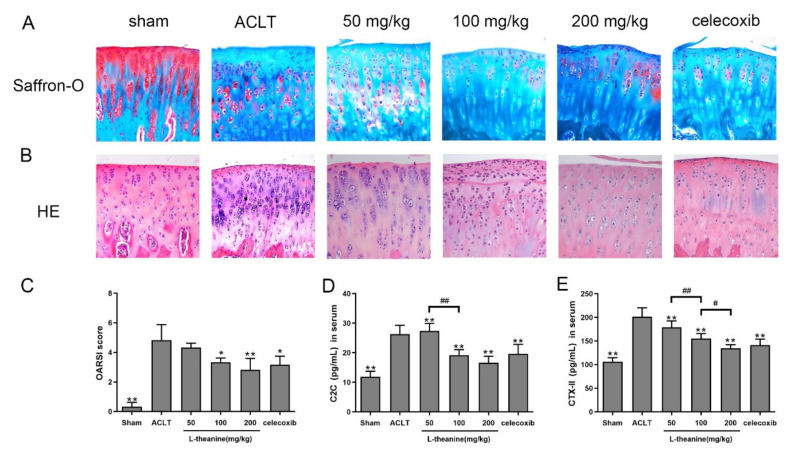
The etiology of osteoarthritis (OA) is multifactorial, with no effective disease-modifying-drugs. L-theanine has been reported to inhibit inflammatory responses in some diseases and this study aimed to investigate the effect of L-theanine on Interleukin-1(IL-1)β-stimulated chondrocytes, and in an injury-induced OA rat model. Primary chondrocytes were stimulated by IL-1β (10 ng/mL) for 24 h and then co-cultured with L-theanine for 24 h. The effects of L-theanine on IL-1β-stimulated expression of pro-inflammatory cytokines and hydrolytic enzyme were analyzed using Western blotting, quantitative polymerase chain reaction (q-PCR) and enzyme-linked immunosorbent assay (ELISA) kits. An immunofluorescence assay was used to detect nuclear factor kappa B (NF-κB) phosphorylation. OA was induced by anterior cruciate ligament transection (ACLT) surgery in rats and celecoxib was used as a positive control. OA severity was measured using the Osteoarthritis Research Society International (OARSI) grading system to describe histological changes. The results showed that L-theanine decreased the expression of pro-inflammatory mediators, including cyclooxygenase-2 (COX-2), prostaglandin E2 (PGE-2), inducible nitric oxide synthase (iNOS), and nitric oxide (NO), both in vivo and in vitro. L-theanine treatment inhibited IL-1β-induced upregulation of matrix metalloproteinases (MMP)-3 and MMP-13, as well as inhibited NF-κB p65 activation. In vivo animal model showed that L-theanine administration (200 mg/kg) significantly alleviated OA lesions and decreased OARSI score. Our data indicated that L-theanine decreased inflammatory cytokines and protected extracellular matrix degradation through inhibition of the NF-κB pathway, and L-theanine may be considered a promising therapeutic strategy in OA prevention.
骨关节炎(OA)的病因是多因素的,目前尚无有效的疾病修饰药物。已有研究报道,L-茶氨酸可抑制某些疾病中的炎症反应,本研究旨在探讨 L-茶氨酸对白细胞介素-1β(IL-1β)刺激的软骨细胞的作用,以及在损伤诱导的 OA 大鼠模型中的作用。将原代软骨细胞用 IL-1β(10ng/mL)刺激 24 小时,然后与 L-茶氨酸共培养 24 小时。采用 Western blot、实时定量聚合酶链反应(q-PCR)和酶联免疫吸附试验(ELISA)试剂盒分析 L-茶氨酸对 IL-1β刺激的促炎细胞因子和水解酶表达的影响。采用免疫荧光法检测核因子κB(NF-κB)磷酸化。通过前交叉韧带切断术(ACLT)手术诱导大鼠 OA,并用塞来昔布作为阳性对照。采用骨关节炎研究协会国际(OARSI)分级系统评估 OA 严重程度,以描述组织学变化。结果表明,L-茶氨酸可降低体内外促炎介质(包括环氧化酶-2(COX-2)、前列腺素 E2(PGE-2)、诱导型一氧化氮合酶(iNOS)和一氧化氮(NO))的表达。L-茶氨酸处理可抑制 IL-1β诱导的基质金属蛋白酶(MMP)-3 和 MMP-13 的上调,并抑制 NF-κB p65 的激活。体内动物模型表明,L-茶氨酸给药(200mg/kg)可显著减轻 OA 病变并降低 OARSI 评分。我们的数据表明,L-茶氨酸通过抑制 NF-κB 通路降低炎症细胞因子并保护细胞外基质降解,L-茶氨酸可能被视为 OA 预防的一种有前途的治疗策略。