School of Pharmacy, College of Medicine, National Cheng Kung University, Tainan 70101, Taiwan.
Department of Physiology, College of Medicine, National Cheng Kung University, Tainan 70101, Taiwan.
Molecules. 2020 Jul 4;25(13):3062. doi: 10.3390/molecules25133062.
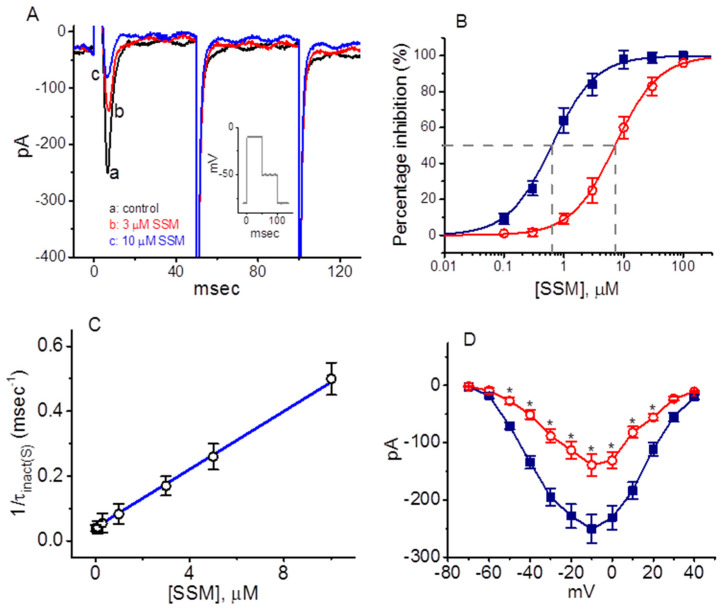
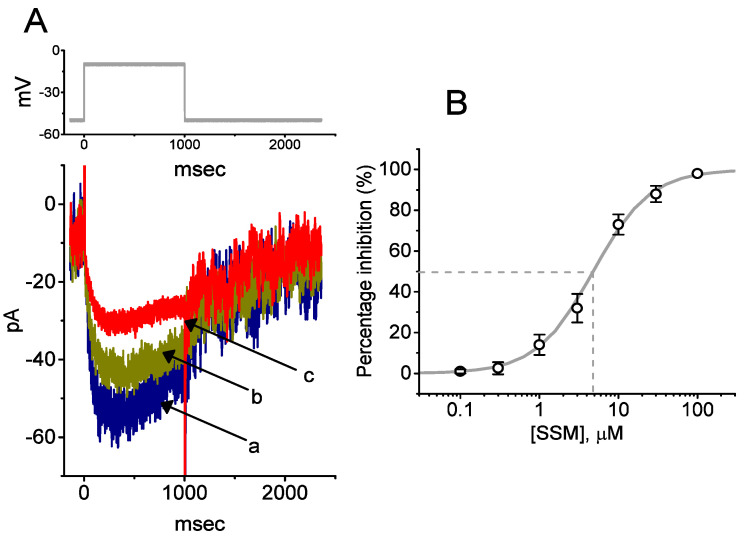
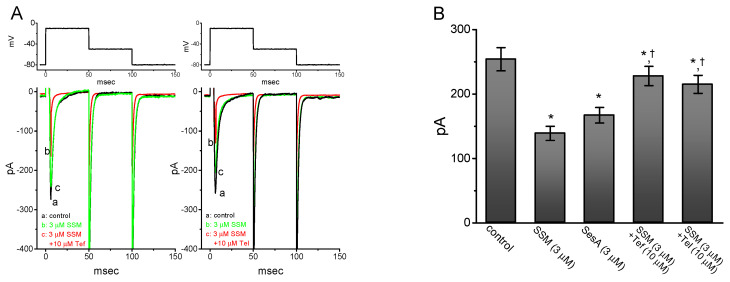
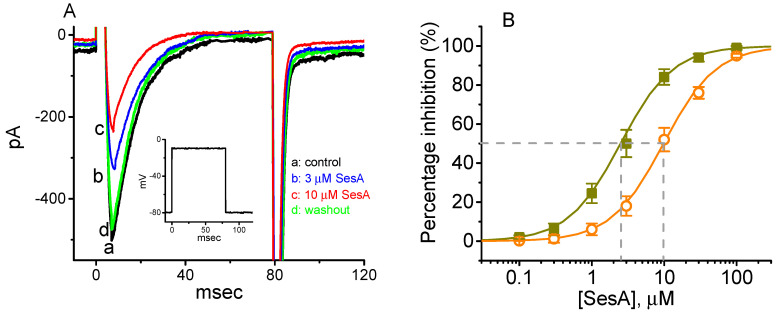
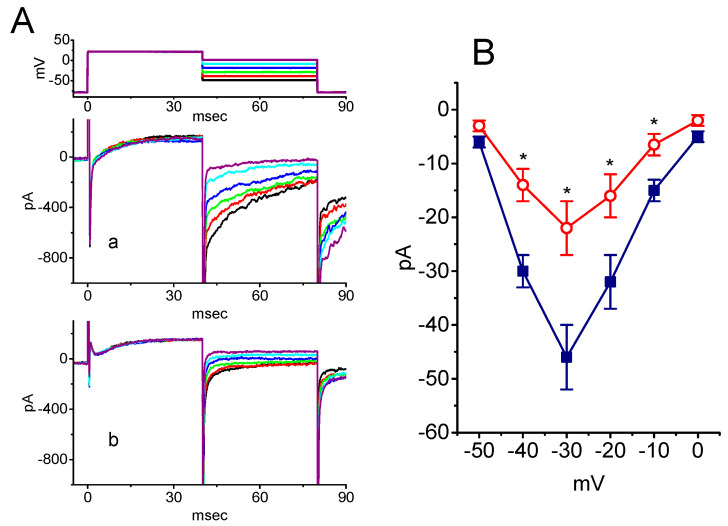
Sesamin (SSM) and sesamolin (SesA) are the two major furofuran lignans of sesame oil and they have been previously noticed to exert various biological actions. However, their modulatory actions on different types of ionic currents in electrically excitable cells remain largely unresolved. The present experiments were undertaken to explore the possible perturbations of SSM and SesA on different types of ionic currents, e.g., voltage-gated Na currents (), -mediated K currents (), M-type K currents (), delayed-rectifier K currents () and hyperpolarization-activated cation currents () identified from pituitary tumor (GH) cells. The exposure to SSM or SesA depressed the transient and late components of with different potencies. The IC value of SSM needed to lessen the peak or sustained was calculated to be 7.2 or 0.6 μM, while that of SesA was 9.8 or 2.5 μM, respectively. The dissociation constant of SSM-perturbed inhibition on , based on the first-order reaction scheme, was measured to be 0.93 μM, a value very similar to the IC for its depressant action on sustained . The addition of SSM was also effective at suppressing the amplitude of resurgent . The addition of SSM could concentration-dependently inhibit the amplitude with an IC value of 4.8 μM. SSM at a concentration of 30 μM could suppress the amplitude of , while at 10 μM, it mildly decreased the amplitude. However, the addition of neither SSM (10 μM) nor SesA (10 μM) altered the amplitude or kinetics of in response to long-lasting hyperpolarization. Additionally, in this study, a modified Markovian model designed for -encoded (or Na1.6) channels was implemented to evaluate the plausible modifications of SSM on the gating kinetics of Na channels. The model demonstrated herein was well suited to predict that the SSM-mediated decrease in peak , followed by increased current inactivation, which could largely account for its favorable decrease in the probability of the open-blocked over open state of Na channels. Collectively, our study provides evidence that highlights the notion that SSM or SesA could block multiple ion currents, such as and , and suggests that these actions are potentially important and may participate in the functional activities of various electrically excitable cells in vivo.
芝麻素(SSM)和芝麻林素(SesA)是芝麻油中的两种主要呋喃木脂素,它们先前已被注意到具有多种生物学作用。然而,它们对可兴奋细胞中不同类型离子电流的调节作用在很大程度上仍未得到解决。本实验旨在探讨 SSM 和 SesA 对不同类型离子电流(如电压门控 Na 电流()、-介导的 K 电流()、M 型 K 电流()、延迟整流 K 电流()和超极化激活阳离子电流())的可能干扰作用,这些电流已从垂体瘤(GH)细胞中得到鉴定。暴露于 SSM 或 SesA 会以不同的效力抑制瞬态和晚期成分。计算出 SSM 减轻峰值或持续的所需 IC 值为 7.2 或 0.6 μM,而 SesA 为 9.8 或 2.5 μM。基于一级反应方案,测量到 SSM 对干扰抑制的解离常数为 0.93 μM,该值与 SSM 对持续的抑制作用的 IC 非常相似。SSM 的加入也能有效地抑制 resurgent 的幅度。SSM 的浓度依赖性抑制 幅度,IC 值为 4.8 μM。浓度为 30 μM 的 SSM 可抑制 幅度,而 10 μM 时,轻度降低 幅度。然而,10 μM 的 SSM(10 μM)或 SesA(10 μM)的加入均不改变对长时间超极化反应的或动力学的幅度。此外,在这项研究中,设计了一个用于编码(或 Na1.6)通道的改进的马尔可夫模型,以评估 SSM 对 Na 通道门控动力学的可能修饰。本文提出的模型非常适合预测 SSM 介导的峰值的减少,随后电流失活增加,这在很大程度上解释了它对 Na 通道开放-阻断状态的概率的有利降低。总的来说,我们的研究提供了证据,强调了 SSM 或 SesA 可能阻断多种离子电流(如和)的观点,并表明这些作用可能很重要,并可能参与体内各种可兴奋细胞的功能活动。