Pedregal-Mallo Daniel, Hermida-Prado Francisco, Granda-Díaz Rocío, Montoro-Jiménez Irene, Allonca Eva, Pozo-Agundo Esperanza, Álvarez-Fernández Mónica, Álvarez-Marcos César, García-Pedrero Juana M, Rodrigo Juan Pablo
Department of Otolaryngology, Hospital Universitario Central de Asturias, 33011 Oviedo, Spain.
Department of Head and Neck Cancer, Instituto de Investigación Sanitaria del Principado de Asturias (ISPA), 33011 Oviedo, Spain.
Cancers (Basel). 2020 Jul 4;12(7):1794. doi: 10.3390/cancers12071794.
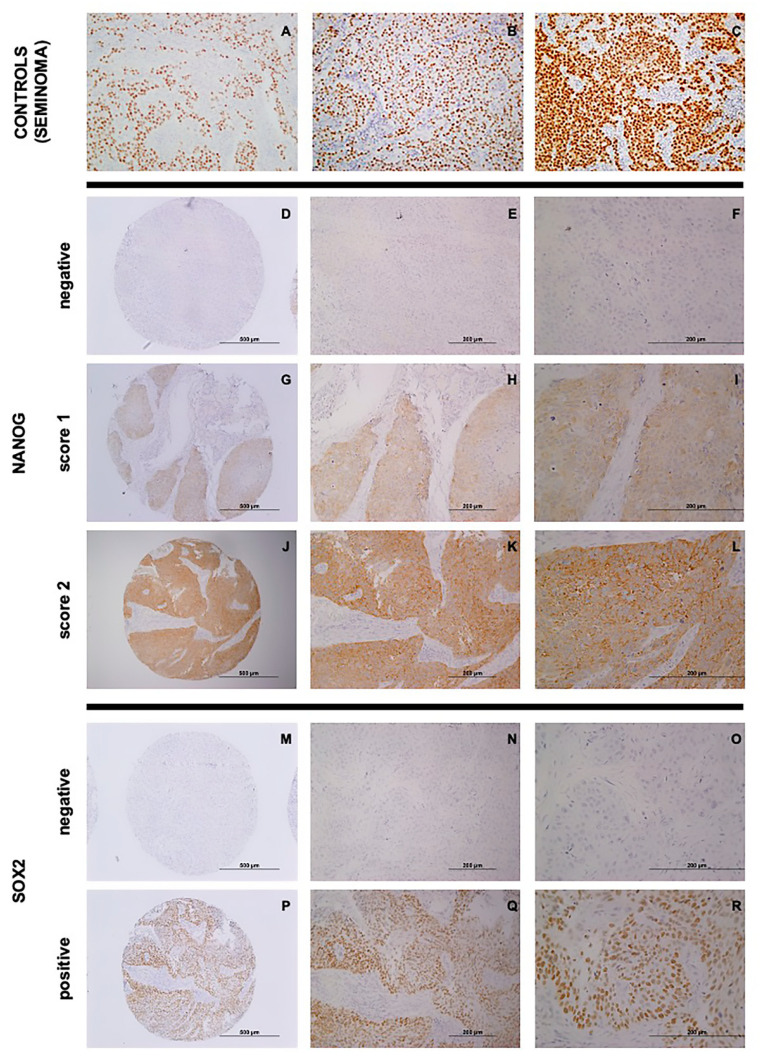
Cancer stem cells (CSCs) play major roles in tumor initiation, progression, and resistance to cancer therapy. Several CSC markers have been studied in head and neck squamous cell carcinomas (HNSCC), including the pluripotency factors NANOG, SOX2, and OCT4; however, their clinical significance is still unclear. NANOG, SOX2, and OCT4 expression was evaluated by immunochemistry in 348 surgically-treated HNSCC, and correlated with clinicopathological parameters and patient outcomes. mRNA expression was further analyzed in 530 (TCGA) HNSCC. NANOG protein expression was detected in 250 (72%) cases, more frequently in patients with lymph node metastasis ( = 0.003), and was an independent predictor of better survival in multivariate analysis. While OCT4 expression was undetectable, SOX2 expression was observed in 105 (30%) cases, and strongly correlated with NANOG expression. Combined expression of both proteins showed the highest survival rates, and double-negative cases the worst survival. Strikingly, the impact of NANOG and SOX2 on outcome varied depending on tumor site and lymph node infiltration, specifically showing prognostic significance in pharyngeal tumors. Correlation between NANOG and SOX2 at mRNA and protein was specifically observed in node positive (N+) patients, and consistently correlated with better survival rates. According to our findings, NANOG protein expression is frequent in HNSCC, thereby emerging as an independent predictor of better prognosis in pharyngeal tumors. Moreover, this study uncovers a differential impact of NANOG and SOX2 expression on HNSCC prognosis, depending on tumor site and lymph node infiltration, which could facilitate high-risk patient stratification.
癌症干细胞(CSCs)在肿瘤的起始、进展及对癌症治疗的抵抗中发挥着主要作用。人们已经对头颈部鳞状细胞癌(HNSCC)中的几种CSC标志物进行了研究,包括多能性因子NANOG、SOX2和OCT4;然而,它们的临床意义仍不明确。通过免疫化学方法对348例接受手术治疗的HNSCC患者进行了NANOG、SOX2和OCT4表达评估,并将其与临床病理参数及患者预后相关联。对530例(TCGA)HNSCC患者的mRNA表达进行了进一步分析。在250例(72%)病例中检测到NANOG蛋白表达,在有淋巴结转移的患者中更常见(P = 0.003),并且在多变量分析中是更好生存的独立预测因子。虽然未检测到OCT4表达,但在105例(30%)病例中观察到SOX2表达,且与NANOG表达密切相关。两种蛋白的联合表达显示出最高的生存率,而双阴性病例的生存率最差。引人注目的是,NANOG和SOX2对预后的影响因肿瘤部位和淋巴结浸润情况而异,特别是在咽肿瘤中显示出预后意义。在淋巴结阳性(N+)患者中特别观察到NANOG和SOX2在mRNA和蛋白水平的相关性,并且始终与更好的生存率相关。根据我们的研究结果,NANOG蛋白表达在HNSCC中很常见,因此成为咽肿瘤更好预后的独立预测因子。此外,本研究揭示了NANOG和SOX2表达对HNSCC预后的不同影响,这取决于肿瘤部位和淋巴结浸润情况,这可能有助于对高危患者进行分层。