Imai Kenji, Takai Koji, Miwa Takao, Taguchi Daisuke, Hanai Tatsunori, Suetsugu Atsushi, Shiraki Makoto, Shimizu Masahito
Department of Gastroenterology/Internal Medicine, Gifu University Graduate School of Medicine, 1-1 Yanagido, Gifu 501-1194, Japan.
Cancers (Basel). 2020 Jul 4;12(7):1795. doi: 10.3390/cancers12071795.
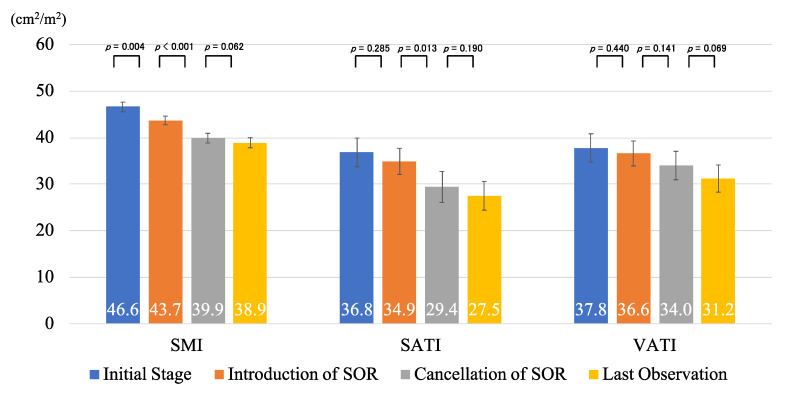
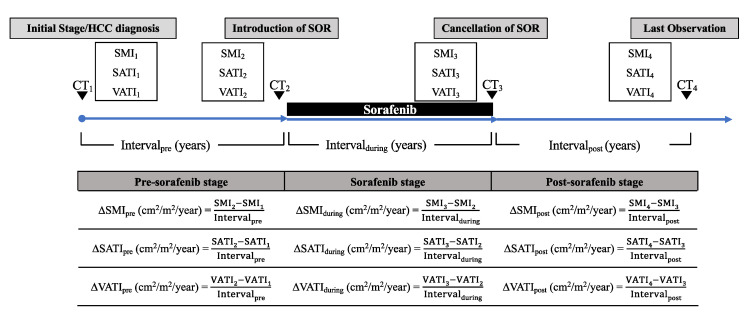
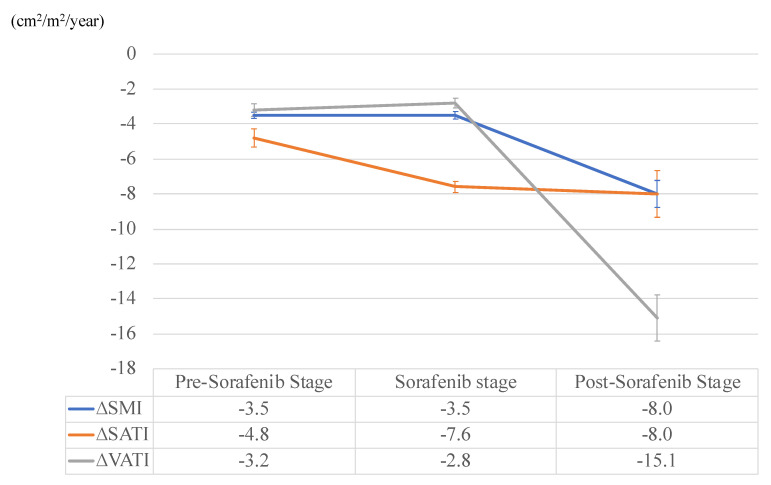
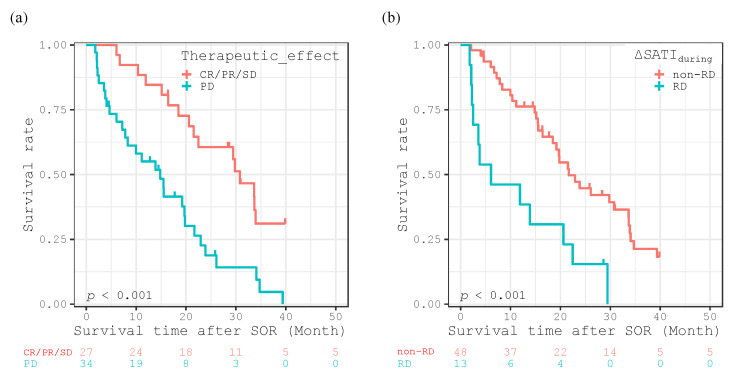
The aim of this study was to assess the annualized changes in body composition, including skeletal muscle, subcutaneous adipose tissue (SAT), and visceral adipose tissue (VAT) before, during, and after sorafenib treatment in patients with hepatocellular carcinoma (HCC). This retrospective study evaluated 61 HCC patients treated with sorafenib. Annualized changes (Δ; cm/m/year) in skeletal muscle index (SMI), SAT index (SATI), and VAT index (VATI), which were defined as the cross-sectional areas (cm) of those areas on computed tomography normalized by the square of one's height (m), before (), during (), and after () sorafenib treatment, were calculated. Patients within the 20th percentile cutoffs for these indices were classified into the rapid depletion group and the effects of these values on survival were analyzed using the Kaplan-Meier analysis and Cox proportional-hazards model. Annualized depletion rates of SMI (ΔSMI: -3.5, ΔSMI: -3.5, ΔSMI: -8.0) and VATI (ΔVATI: -3.2, ΔVATI: -2.8, ΔVATI: -15.1) accelerated after the cancellation of sorafenib, whereas that of SATI (ΔSATI: -4.8, ΔSATI; -7.6, ΔSATI; -8.0) had already accelerated during sorafenib treatment. Patients with rapid depletion of ΔSATI experienced significantly worse survival rates ( < 0.001), and it was an independent predictor of survival ( = 0.009), together with therapeutic effect ( < 0.001). Rapid depletion of SAT during sorafenib treatment can be used to predict survival in patients with HCC.
本研究旨在评估肝细胞癌(HCC)患者在索拉非尼治疗前、治疗期间和治疗后身体成分(包括骨骼肌、皮下脂肪组织(SAT)和内脏脂肪组织(VAT))的年化变化。这项回顾性研究评估了61例接受索拉非尼治疗的HCC患者。计算了索拉非尼治疗前()、治疗期间()和治疗后()骨骼肌指数(SMI)、SAT指数(SATI)和VAT指数(VATI)的年化变化(Δ;cm/m/年),这些指数定义为计算机断层扫描上这些区域的横截面积(cm)除以身高(m)的平方。将这些指数处于第20百分位数临界值以内的患者分为快速消耗组,并使用Kaplan-Meier分析和Cox比例风险模型分析这些值对生存的影响。索拉非尼停药后,SMI(ΔSMI:-3.5,ΔSMI:-3.5,ΔSMI:-8.0)和VATI(ΔVATI:-3.2,ΔVATI:-2.8,ΔVATI:-15.1)的年化消耗率加快,而SATI(ΔSATI:-4.8,ΔSATI;-7.6,ΔSATI;-8.0)的年化消耗率在索拉非尼治疗期间就已经加快。ΔSATI快速消耗的患者生存率显著更差(<0.001),并且它是生存的独立预测因素(=0.009),与治疗效果一起(<0.001)。索拉非尼治疗期间SAT的快速消耗可用于预测HCC患者的生存情况。