Kobayashi Takamasa, Kawai Hirokazu, Nakano Oki, Abe Satoshi, Kamimura Hiroteru, Sakamaki Akira, Kamimura Kenya, Tsuchiya Atsunori, Takamura Masaaki, Yamagiwa Satoshi, Terai Shuji
Division of Gastroenterology and Hepatology, Niigata University Graduate School of Medical and Dental Sciences, Niigata, Japan,
Cancer Manag Res. 2018 Jul 25;10:2231-2239. doi: 10.2147/CMAR.S167417. eCollection 2018.
Prognosis of patients with hepatocellular carcinoma (HCC) who undergo transcatheter intra-arterial therapies, including transcatheter arterial chemoembolization and transcatheter arterial infusion chemotherapy, is affected by many clinical factors including liver function and tumor progression. However, the effect of body composition such as skeletal muscle and visceral and subcutaneous adipose tissues (VAT and SAT, respectively) on the prognosis of these patients remains unclear. We investigated the prognostic value of body composition in HCC patients treated with transcatheter intra-arterial therapies.
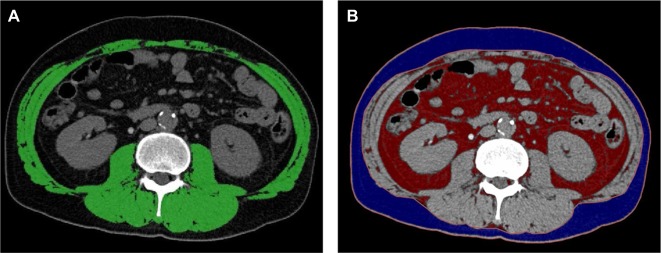
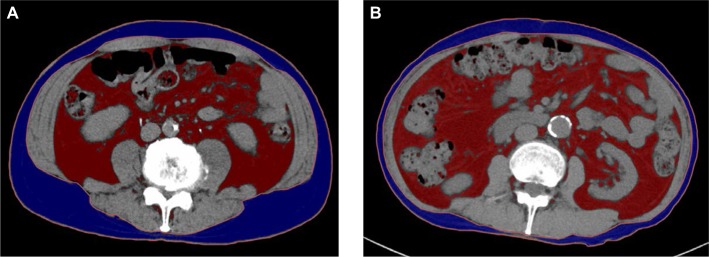
This study retrospectively evaluated 100 HCC patients treated with transcatheter intra-arterial therapies between 2005 and 2015. Areas of skeletal muscle, VAT, and SAT were measured on computed tomography images at third lumbar vertebra level and normalized by the height squared to calculate the skeletal muscle index, VAT index, and SAT index (SATI). The visceral to subcutaneous adipose tissue area ratio was also calculated. Overall survival (OS) was compared between high- and low-index groups for each body composition. Furthermore, prognostic significance was assessed by univariate and multivariate analyses using Cox proportional hazards models.
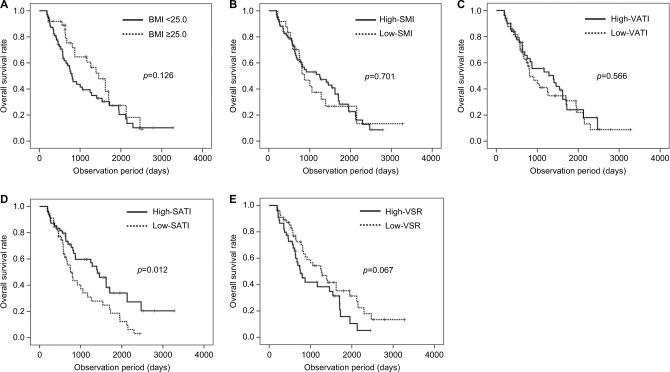
Among the body composition indexes, only SATI could significantly differentiate OS (=0.012). Multivariate analysis showed that SATI (low- vs. high-SATI: HR, 2.065; 95% CI, 1.187-3.593; =0.010), serum albumin (<3.5 vs. ≥3.5 g/dL; HR, 2.007; 95% CI, 1.037-3.886; =0.039), serum alpha-fetoprotein (<20 vs. ≥20 ng/mL; HR, 0.311; 95% CI, 0.179-0.540; <0.001), and Modified Response Evaluation Criteria in Solid Tumors assessment (complete response+partial response+stable disease vs. progressive disease; HR, 0.392; 95% CI, 0.221-0.696; =0.001) were indicated as independent prognostic factors for OS.
High SAT volume is associated with better survival outcomes in HCC patients treated with transcatheter intra-arterial therapies. Elucidation of the mechanisms regulating SAT volume may offer a new therapeutic strategy for these patients.
接受经导管动脉内治疗(包括经导管动脉化疗栓塞和经导管动脉灌注化疗)的肝细胞癌(HCC)患者的预后受多种临床因素影响,包括肝功能和肿瘤进展。然而,骨骼肌、内脏和皮下脂肪组织(分别为VAT和SAT)等身体组成对这些患者预后的影响仍不清楚。我们研究了身体组成在接受经导管动脉内治疗的HCC患者中的预后价值。
本研究回顾性评估了2005年至2015年间接受经导管动脉内治疗的100例HCC患者。在第三腰椎水平的计算机断层扫描图像上测量骨骼肌、VAT和SAT的面积,并通过身高平方进行标准化,以计算骨骼肌指数、VAT指数和SAT指数(SATI)。还计算了内脏与皮下脂肪组织面积比。比较了每种身体组成的高指数组和低指数组之间的总生存期(OS)。此外,使用Cox比例风险模型通过单因素和多因素分析评估预后意义。
在身体组成指标中,只有SATI能够显著区分OS(=0.012)。多因素分析显示,SATI(低SATI与高SATI:HR,2.065;95%CI,1.187-3.593;=0.010)、血清白蛋白(<3.5与≥3.5g/dL;HR,2.007;95%CI,1.037-3.886;=0.039)、血清甲胎蛋白(<20与≥20ng/mL;HR,0.311;95%CI,0.179-0.540;<0.001)以及实体瘤改良疗效评价标准评估(完全缓解+部分缓解+病情稳定与病情进展;HR,0.392;95%CI,0.221-0.696;=0.001)被表明是OS的独立预后因素。
在接受经导管动脉内治疗的HCC患者中,高SAT体积与更好的生存结果相关。阐明调节SAT体积的机制可能为这些患者提供一种新的治疗策略。