Oylumlu Mustafa, Oylumlu Muhammed, Arslan Bayram, Polat Nihat, Özbek Mehmet, Demir Muhammed, Yildiz Abdulkadir, Toprak Nizamettin
Department of Cardiology, School of Medicine, Dicle University, Diyarbakır, Turkey.
Department of Cardiology, Kastamonu Anatolian Hospital, Kastamonu, Turkey.
Postepy Kardiol Interwencyjnej. 2020 Jun;16(2):170-176. doi: 10.5114/aic.2020.95859. Epub 2020 Jun 23.
Atherosclerosis is a chronic inflammatory process and inflammation is an important component of acute coronary syndrome (ACS). Platelet-to-lymphocyte ratio (PLR) is a useful parameter showing the degree of the inflammatory response.
To explore the association between PLR and long-term mortality in patients with ACS.
A total of 538 patients who had a diagnosis of ACS between January 2012 and August 2013 were followed up to 60 months. On admission, blood sampling to calculate PLR and detailed clinical data were obtained.
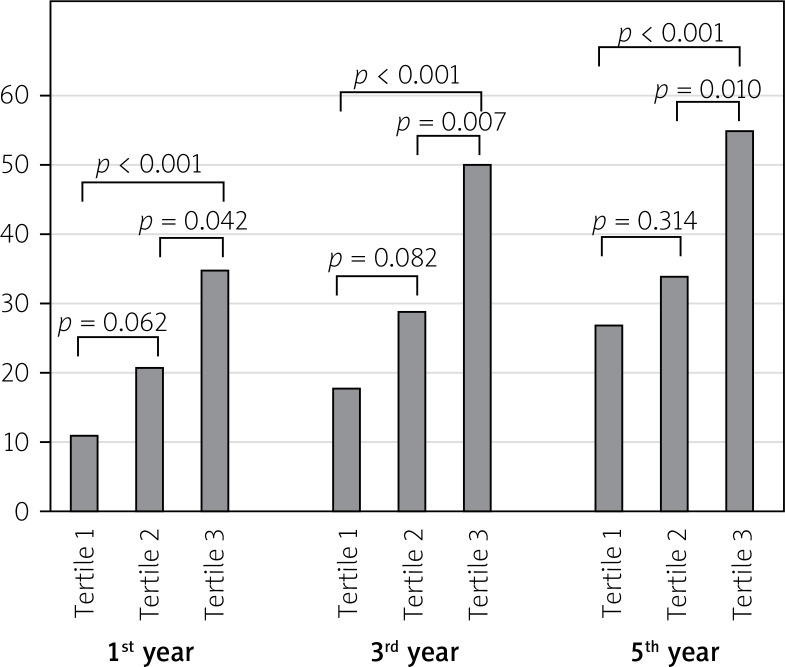
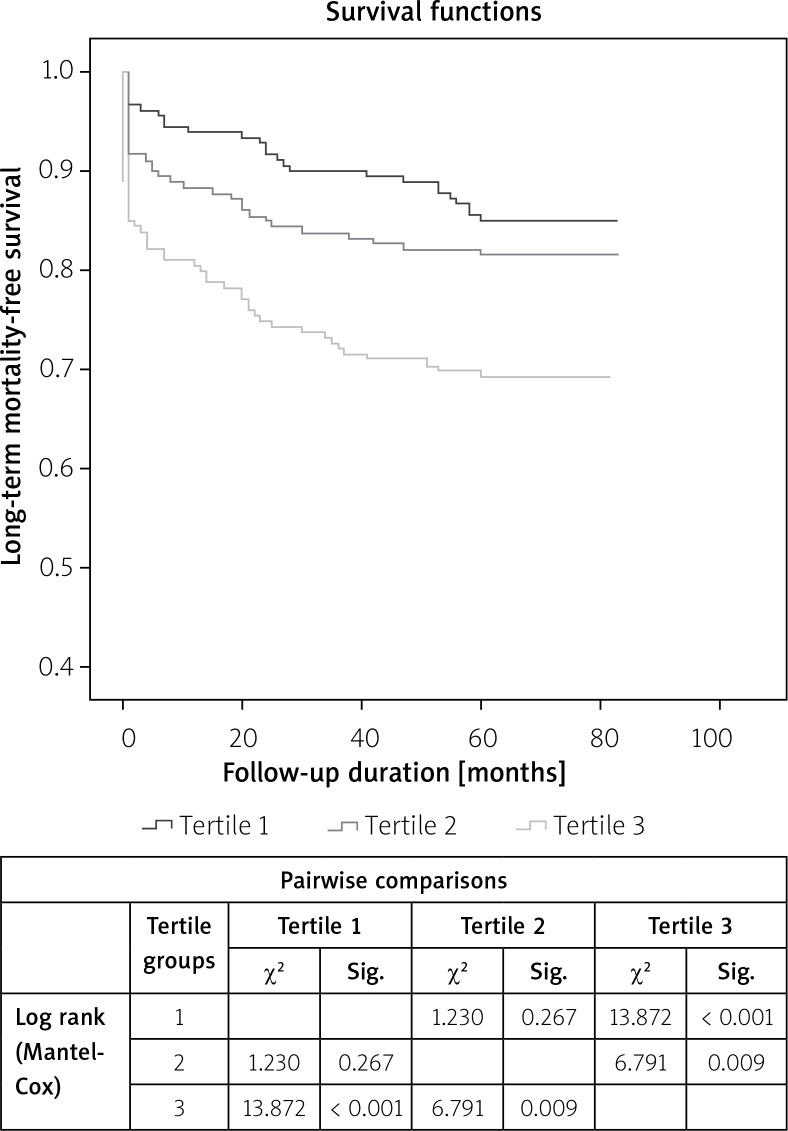
In total, 538 patients with a mean age of 61.5 ±13.1 years (69% male) were enrolled in the study. Median follow-up was 79 months (IQR: 74-83 months). Patients were divided into 3 tertiles based on PLR levels. Five-year mortality of the patients was significantly higher among patients in the upper PLR tertile when compared with the lower and middle PLR tertile groups (55 (30.7%) vs. 27 (15.0%) and 34 (19.0%); < 0.001, = 0.010 respectively). In the Cox regression analysis, a high level of PLR was an independent predictor of 5-year mortality (OR = 1.005, 95% CI: 1.001-1.008, = 0.004). Kaplan-Meier analysis according to the long-term mortality-free survival revealed the higher occurrence of mortality in the third PLR tertile group compared to the first ( < 0.001) and second tertiles ( = 0.009).
PLR, which is an easily calculated and universally available marker, may be useful in long-term risk classification of patients presenting with ACS.
动脉粥样硬化是一种慢性炎症过程,炎症是急性冠状动脉综合征(ACS)的重要组成部分。血小板与淋巴细胞比值(PLR)是反映炎症反应程度的一个有用参数。
探讨PLR与ACS患者长期死亡率之间的关联。
对2012年1月至2013年8月期间诊断为ACS的538例患者进行了60个月的随访。入院时,采集血样以计算PLR并获取详细的临床数据。
本研究共纳入538例患者,平均年龄61.5±13.1岁(男性占69%)。中位随访时间为79个月(四分位间距:74 - 83个月)。根据PLR水平将患者分为三个三分位数组。与低PLR三分位数组和中PLR三分位数组相比,高PLR三分位数组患者的五年死亡率显著更高(55例(30.7%) vs. 27例(15.0%)和34例(19.0%);P<0.001,P = 0.010)。在Cox回归分析中,高水平的PLR是5年死亡率的独立预测因素(OR = 1.005,95%置信区间:1.001 - 1.008,P = 0.004)。根据长期无死亡生存情况进行的Kaplan-Meier分析显示,与第一三分位数组(P<0.001)和第二三分位数组(P = 0.009)相比,第三PLR三分位数组的死亡率更高。
PLR是一种易于计算且普遍可用的标志物,可能有助于对ACS患者进行长期风险分类。