Ferrigno Stephen, Cheyette Samuel J, Piantadosi Steven T, Cantlon Jessica F
Harvard University, Cambridge, MA, USA.
University of California, Berkeley, Berkeley, CA, USA.
Sci Adv. 2020 Jun 26;6(26):eaaz1002. doi: 10.1126/sciadv.aaz1002. eCollection 2020 Jun.
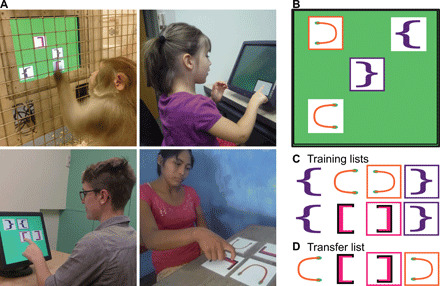
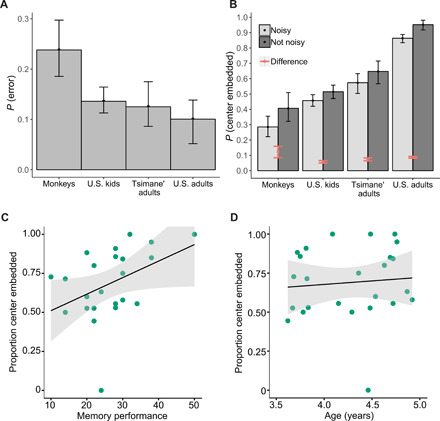
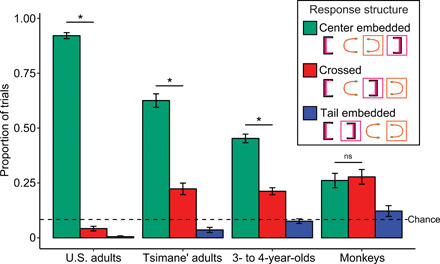
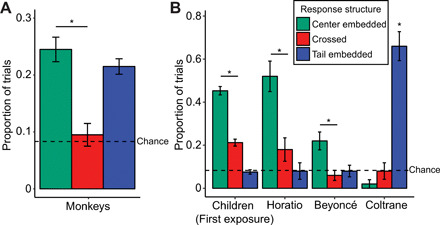
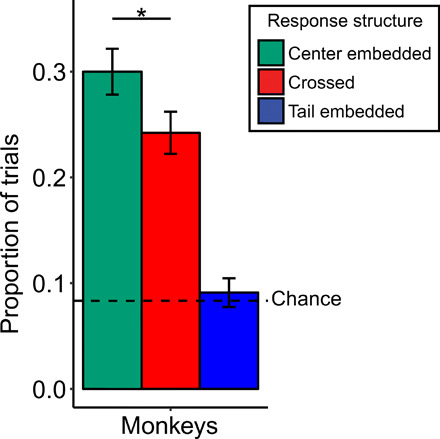
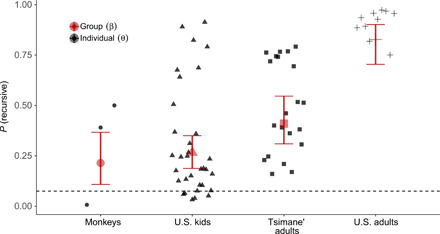
The question of what computational capacities, if any, differ between humans and nonhuman animals has been at the core of foundational debates in cognitive psychology, anthropology, linguistics, and animal behavior. The capacity to form nested hierarchical representations is hypothesized to be essential to uniquely human thought, but its origins in evolution, development, and culture are controversial. We used a nonlinguistic sequence generation task to test whether subjects generalize sequential groupings of items to a center-embedded, recursive structure. Children (3 to 5 years old), U.S. adults, and adults from a Bolivian indigenous group spontaneously induced recursive structures from ambiguous training data. In contrast, monkeys did so only with additional exposure. We quantify these patterns using a Bayesian mixture model over logically possible strategies. Our results show that recursive hierarchical strategies are robust in human thought, both early in development and across cultures, but the capacity itself is not unique to humans.
人类与非人类动物之间是否存在计算能力差异(若存在,具体是哪些差异)这一问题,一直是认知心理学、人类学、语言学和动物行为学基础辩论的核心。形成嵌套层次表征的能力被认为是人类独特思维的关键,但它在进化、发展和文化中的起源存在争议。我们使用了一个非语言序列生成任务来测试受试者是否能将项目的顺序分组推广到中心嵌入的递归结构。儿童(3至5岁)、美国成年人以及来自玻利维亚一个土著群体的成年人能够从模糊的训练数据中自发地归纳出递归结构。相比之下,猴子只有在额外接触后才能做到。我们使用贝叶斯混合模型对逻辑上可能的策略来量化这些模式。我们的结果表明,递归层次策略在人类思维中很稳健,无论是在发展早期还是跨文化情境中,但这种能力本身并非人类所独有。