Huang Renbin, Qin Rundong, Hu Qiurong, Zhu Zheng, Liu YuKai, Luo Tian, Li Jing
Department of Allergy and Clinical Immunology, State Key Laboratory of Respiratory Disease, The First Affiliated Hospital of Guangzhou Medical University, Guangzhou, China.
Allergy Asthma Immunol Res. 2020 Sep;12(5):844-858. doi: 10.4168/aair.2020.12.5.844.
It remains unknown whether allergen-specific immunotherapy (AIT) could attenuate airway inflammatory response triggered by allergen exposure.
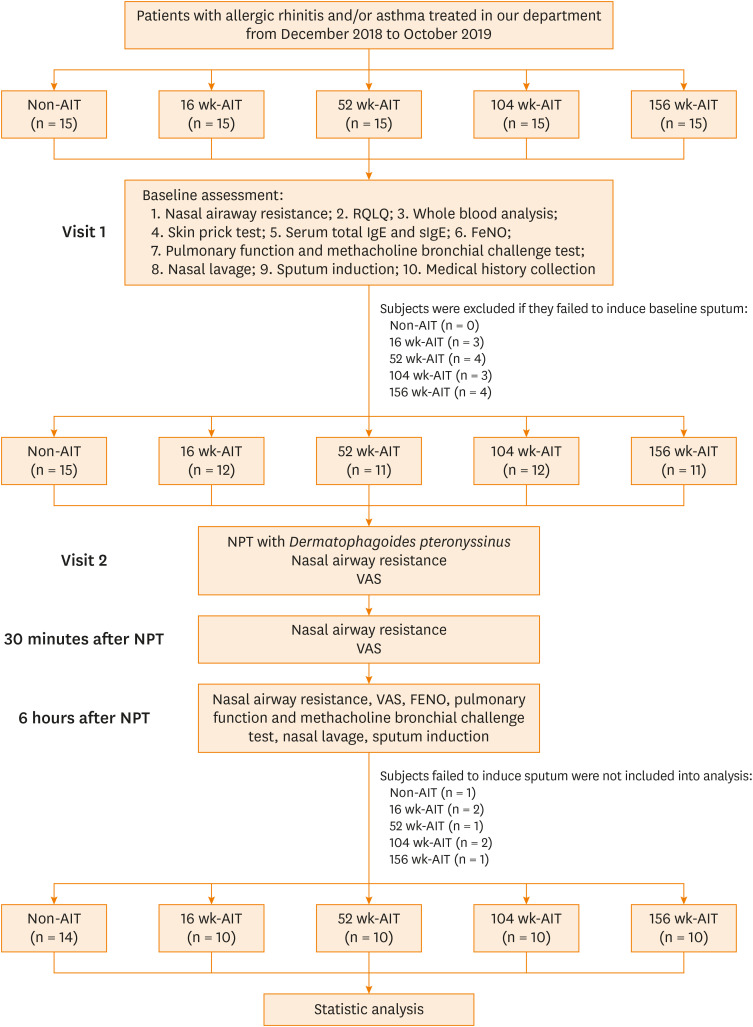
We performed () nasal provocation tests (NPTs) in allergic rhinitis (AR) and/or asthma patients without AIT (non-AIT), or at 16, 52, 104, or 156 weeks after AIT. Rhinitis and asthma visual analog scale (VAS; VAS of nasal symptoms [VAS-NS], VAS of asthma symptoms), the rhinoconjunctivitis quality of life questionnaire (RQLQ), nasal lavage, sputum induction, fractional exhaled nitric oxide (FeNO), nasal airway resistance, pulmonary function, and airway hyperresponsiveness were performed before and after NPT.
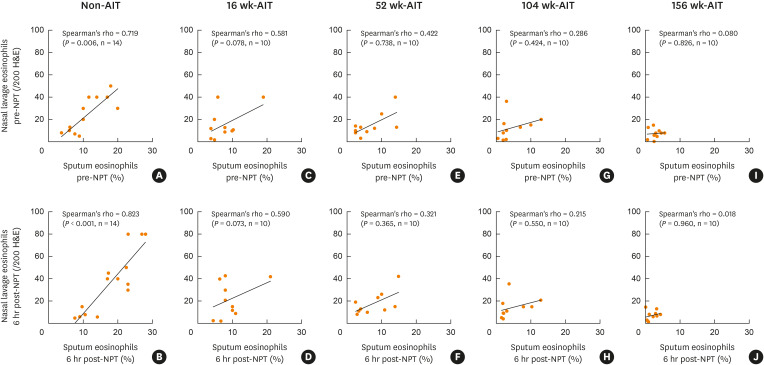
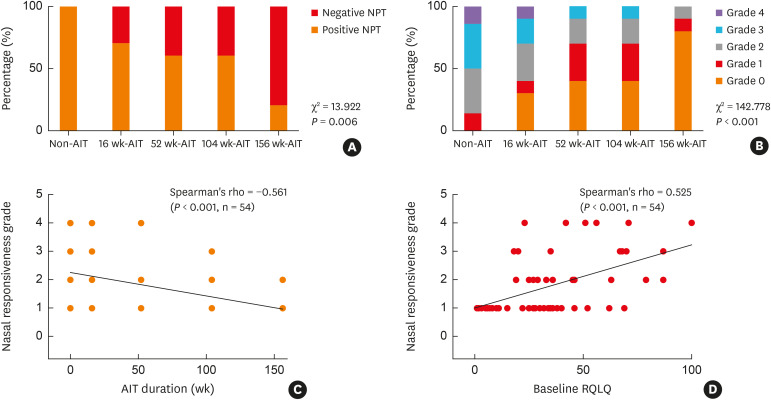
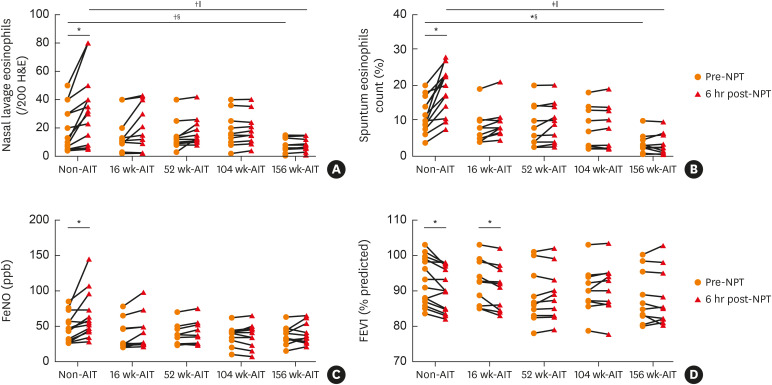
Non-AIT subjects demonstrated significantly higher VAS-NS before and after NPT compared to AIT subjects ( < 0.05). NPT response was positive in 14 (100%) non-AIT, 7 (70%) 16 weeks-AIT, 6 (60%) 52 weeks-AIT, 6 (60%) 104 weeks-AIT, and 2 (20%) 156 weeks-AIT subjects. The NPT grade significantly correlated with AIT duration and baseline RQLQ score ( =- 0.561, < 0.001 and = 0.525, < 0.001, respectively). Sputum and nasal lavage eosinophil count, and FeNO in non-AIT subjects were significantly increased 6 hours after NPT ( < 0.05). AIT subjects did not change their sputum or nasal lavage eosinophil count before and after NPT. Subjects with 156 weeks-AIT demonstrated significantly lower levels of sputum and nasal lavage eosinophil count before and after NPT when compared with non-AIT patients ( < 0.05). Sputum eosinophil counts positively correlated with nasal lavage eosinophil counts at baseline and 6 hours after NPT ( = 0.719, P = 0.006 and = 0.823, < 0.001, respectively) in non-AIT patients.
Our results show that AIT can attenuate both upper and lower airway immune response to nasal allergen exposure in patients with AR and/or asthma.
变应原特异性免疫疗法(AIT)是否能减轻变应原暴露引发的气道炎症反应仍不清楚。
我们对未接受AIT(非AIT组)的变应性鼻炎(AR)和/或哮喘患者,或在AIT后16、52、104或156周的患者进行了()次鼻激发试验(NPT)。在NPT前后进行鼻炎和哮喘视觉模拟量表(VAS;鼻症状VAS [VAS-NS]、哮喘症状VAS)、鼻结膜炎生活质量问卷(RQLQ)、鼻腔灌洗、痰液诱导、呼出一氧化氮分数(FeNO)、鼻气道阻力、肺功能和气道高反应性检查。
与AIT组相比,非AIT组患者在NPT前后的VAS-NS显著更高(<0.05)。14例(100%)非AIT组、7例(70%)16周AIT组、6例(60%)52周AIT组、6例(60%)104周AIT组和2例(20%)156周AIT组患者的NPT反应为阳性。NPT分级与AIT持续时间和基线RQLQ评分显著相关(分别为=-0.561,<0.001和=0.525,<0.001)。非AIT组患者在NPT后6小时痰液和鼻腔灌洗嗜酸性粒细胞计数以及FeNO显著增加(<0.05)。AIT组患者在NPT前后痰液或鼻腔灌洗嗜酸性粒细胞计数未发生变化。与非AIT组患者相比,156周AIT组患者在NPT前后痰液和鼻腔灌洗嗜酸性粒细胞计数水平显著降低(<0.05)。在非AIT组患者中,基线时和NPT后6小时痰液嗜酸性粒细胞计数与鼻腔灌洗嗜酸性粒细胞计数呈正相关(分别为=0.719,P = 0.006和=0.823,<0.001)。
我们的结果表明,AIT可减轻AR和/或哮喘患者上、下气道对鼻变应原暴露的免疫反应。