Nogami Kazutaka, Nagao Mizuho, Takase Takafumi, Yasuda Yasuaki, Yamada Shingo, Matsunaga Mayumi, Hoshi Miyuki, Hamada Kana, Kuwabara Yu, Tsugawa Takeshi, Fujisawa Takao
Department of Pediatrics, Sapporo Medical University School of Medicine, Sapporo-shi 060-8543, Japan.
Allergy Center and Department of Clinical Research, Mie National Hospital, Tsu 514-0125, Japan.
Children (Basel). 2022 Apr 1;9(4):487. doi: 10.3390/children9040487.
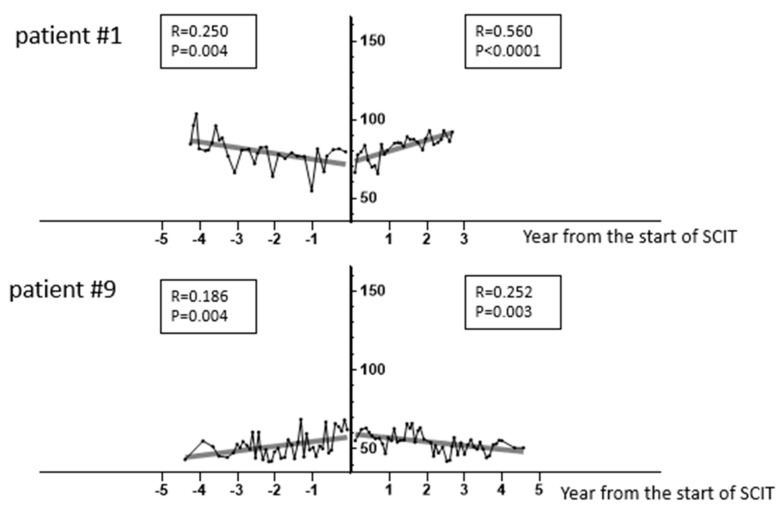
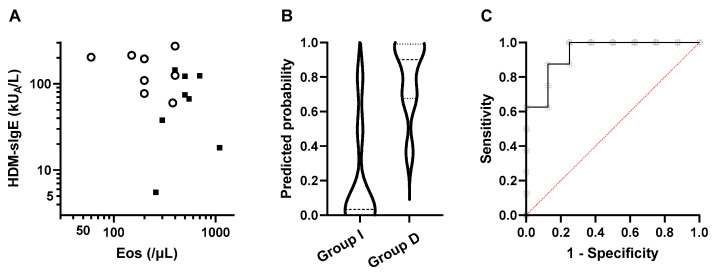
Background: Allergen-specific immunotherapy is currently the only disease-modifying treatment for allergic asthma, and it has been shown to improve control of asthma while reducing both drug use and asthma exacerbations. However, its effects on lung function—especially its long-term effects—remain controversial. We aimed to identify factors associated with a possible beneficial effect of allergen-specific immunotherapy on lung function in asthma by retrospectively evaluating the long-term changes in lung function in children with asthma who received house dust mite subcutaneous immunotherapy (HDM-SCIT). Methods: We enrolled children with asthma who had undergone HDM-SCIT for more than 1 year. Clinical information and lung function measurements were retrieved from the electronic chart system. To characterize the trajectory of lung function change, we performed linear regression analysis to evaluate the maximal expiratory flow at 50% of the forced vital capacity during two periods: before and during HDM-SCIT. Slopes from a least-squares regression line for the two periods, i.e., S1 before HDM-SCIT and S2 during HDM-SCIT, were compared. The subjects were then classified into two groups: an improving group (Group I) defined as S2 − S1 > 0, and a declining group (Group D) defined as S2 − S1 < 0. The clinical factors at the start of HDM-SCIT were compared between the two groups. Results: A total of 16 patients were analyzed. Eight patients were classified into each of Group I and Group D. The mean ages were 10.5 and 11.8 years, and the mean treatment periods were 4.1 and 3.9 years. Group I had a significantly lower blood eosinophil count and a significantly higher HDM-specific IgE level than Group D. Logistic regression showed a strong relationship between those two markers and the lung function trajectory. Conclusion: Control of the blood eosinophil count in highly HDM-sensitized patients may increase the beneficial effect of HDM-SCIT on lung function.
变应原特异性免疫疗法是目前唯一可改变过敏性哮喘病情的治疗方法,已证实其可改善哮喘控制情况,同时减少药物使用及哮喘急性发作。然而,其对肺功能的影响,尤其是长期影响,仍存在争议。我们旨在通过回顾性评估接受屋尘螨皮下免疫疗法(HDM - SCIT)的哮喘儿童的肺功能长期变化,来确定与变应原特异性免疫疗法对哮喘肺功能可能产生有益影响相关的因素。方法:我们纳入了接受HDM - SCIT超过1年的哮喘儿童。从电子病历系统中获取临床信息和肺功能测量数据。为了描述肺功能变化轨迹,我们进行线性回归分析,以评估在HDM - SCIT前和HDM - SCIT期间两个时间段内用力肺活量50%时的最大呼气流量。比较两个时间段的最小二乘回归线斜率,即HDM - SCIT前的S1和HDM - SCIT期间的S2。然后将受试者分为两组:改善组(I组)定义为S2 - S1 > 0,下降组(D组)定义为S2 - S1 < 0。比较两组在HDM - SCIT开始时的临床因素。结果:共分析了16例患者。I组和D组各有8例患者。平均年龄分别为10.5岁和11.8岁,平均治疗时间分别为4.1年和3.9年。I组的血嗜酸性粒细胞计数显著低于D组,HDM特异性IgE水平显著高于D组。逻辑回归显示这两个指标与肺功能轨迹之间存在密切关系。结论:在高HDM致敏患者中控制血嗜酸性粒细胞计数可能会增强HDM - SCIT对肺功能的有益作用。