Wang Zhengxia, Ji Ningfei, Chen Zhongqi, Sun Zhixiao, Wu Chaojie, Yu Wenqing, Hu Fan, Huang Mao, Zhang Mingshun
Department of Respiratory and Critical Care Medicine, The First Affiliated Hospital of Nanjing Medical University, Nanjing, China.
Department of Infectious Disease, Taizhou People's Hospital, Taizhou, China.
Allergy Asthma Immunol Res. 2020 Sep;12(5):859-876. doi: 10.4168/aair.2020.12.5.859.
CD4⁺T cells are essential in the pathogenesis of allergic asthma. We have previously demonstrated that microRNA-1165-3p (miR-1165-3p) was significantly reduced in T-helper type (Th) 2 cells and that miR-1165-3p was a surrogate marker for atopic asthma. Little is known about the mechanisms of miR-1165-3p in the regulation of Th2-dominated allergic inflammation. We aimed to investigate the associations between Th2 differentiation and miR-1165b-3p in asthma as well as the possible mechanisms.
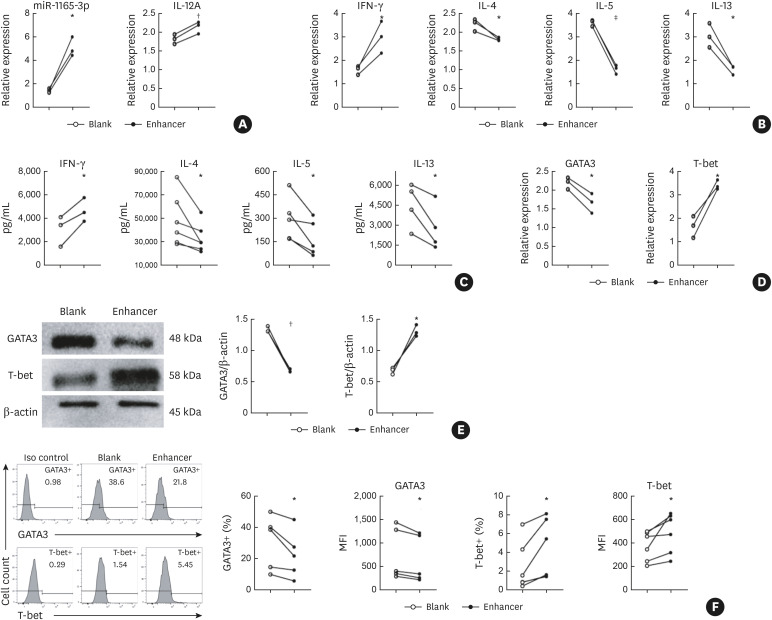
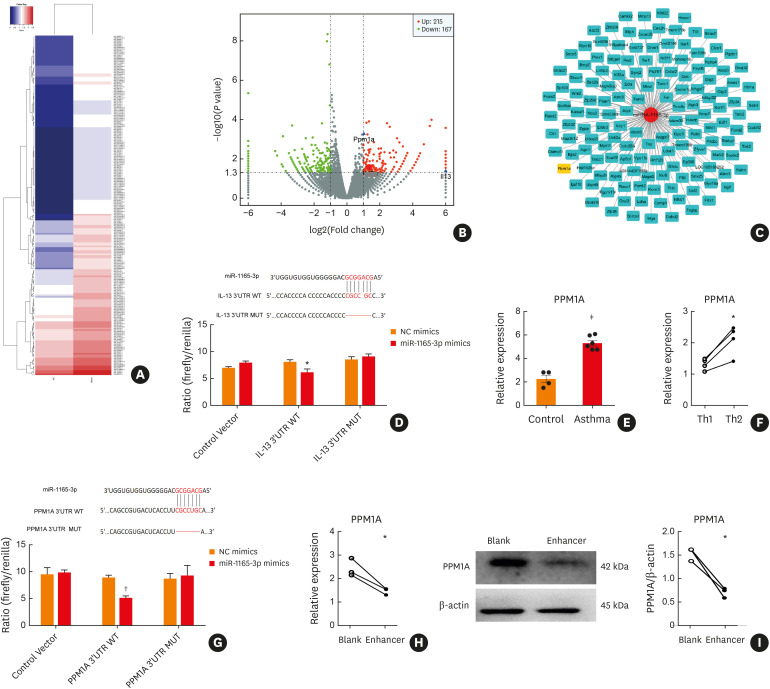
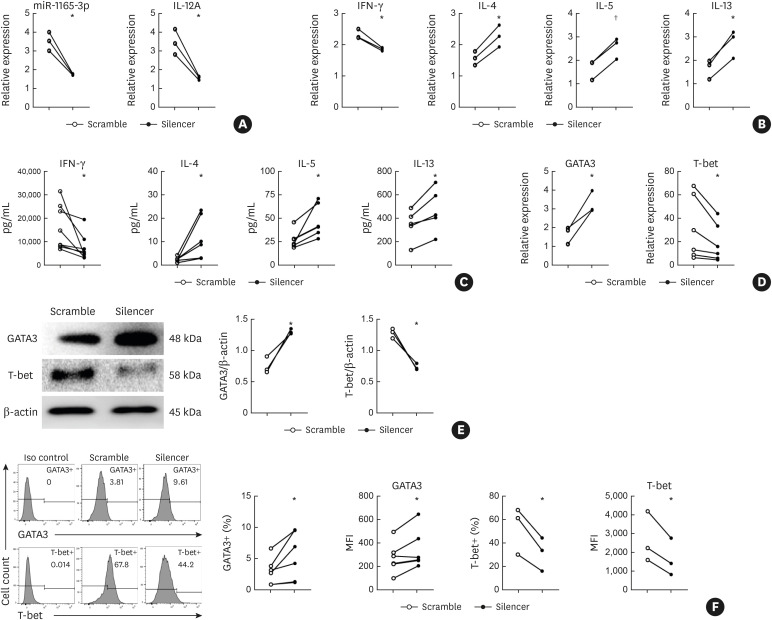
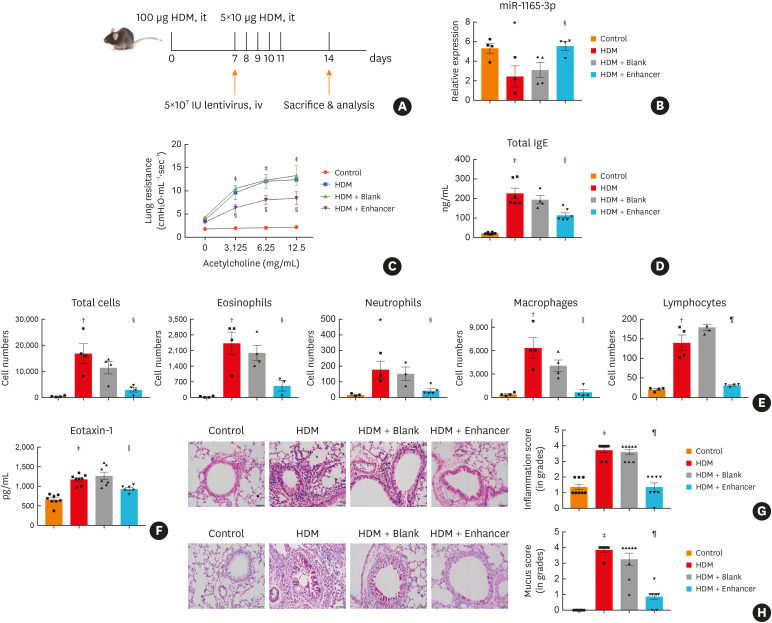
CD4⁺ naïve T cells were differentiated into Th1 or Th2 cells . MiR-1165-3p was up-regulated or down-regulated using lentiviral systems during Th1/Th2 differentiation. , the lentiviral particles with the miR-1165-3p enhancer were administered by tail vein injection on the first day of a house dust mite -induced allergic airway inflammation model. Allergic inflammation and Th1/Th2 differentiation were routinely monitored. To investigate the potential targets of miR-1165-3p, biotin-microRNA pull-down products were sequenced, and the candidates were further verified with a dual-luciferase reporter assay. The roles of a target protein phosphatase, Mg/Mn-dependent 1A (PPM1A), in Th2 cell differentiation and allergic asthma were further explored. Plasma PPM1A was determined by ELISA in 18 subjects with asthma and 20 controls.
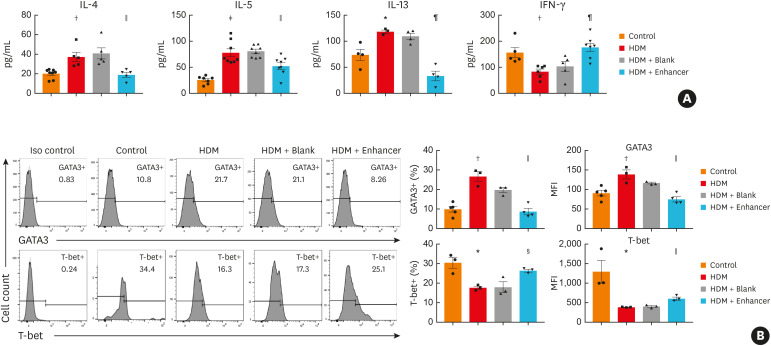
The lentivirus encoding miR-1165-3p suppressed Th2-cell differentiation . In contrast, miR-1165-3p silencing promoted Th2-cell development. In the HDM-induced model of allergic airway inflammation, miR-1165-3p up-regulation was accompanied by reduced airway hyper-responsiveness, serum immunoglobulin E, airway inflammation and Th2-cell polarization. IL-13 and PPM1A were the direct targets of miR-1165-3p. The expression of IL-13 or PPM1A was inversely correlated with that of miR-1165-3p. PPM1A regulated the signal transducer and activator of transcription and AKT signaling pathways during Th2 differentiation. Moreover, plasma PPM1A was significantly increased in asthmatic patients.
MiR-1165-3p negatively may regulate Th2-cell differentiation by targeting IL-13 and PPM1A in allergic airway inflammation.
CD4⁺T细胞在过敏性哮喘的发病机制中至关重要。我们之前已经证明,微小RNA-1165-3p(miR-1165-3p)在2型辅助性T(Th)细胞中显著减少,且miR-1165-3p是特应性哮喘的替代标志物。关于miR-1165-3p在Th2主导的过敏性炎症调节中的机制知之甚少。我们旨在研究哮喘中Th2分化与miR-1165b-3p之间的关联以及可能的机制。
将CD4⁺初始T细胞分化为Th1或Th2细胞。在Th1/Th2分化过程中,使用慢病毒系统上调或下调miR-1165-3p。在屋尘螨诱导的过敏性气道炎症模型的第一天,通过尾静脉注射给予携带miR-1165-3p增强子的慢病毒颗粒。常规监测过敏性炎症和Th1/Th2分化情况。为了研究miR-1165-3p的潜在靶标,对生物素化微小RNA下拉产物进行测序,并通过双荧光素酶报告基因检测进一步验证候选靶标。进一步探讨靶蛋白磷酸酶镁/锰依赖性1A(PPM1A)在Th细胞2分化和过敏性哮喘中的作用。通过酶联免疫吸附测定法(ELISA)测定18例哮喘患者和20例对照者血浆中的PPM1A。
编码miR-1165-3p的慢病毒抑制Th2细胞分化。相反,miR-1165-3p沉默促进Th2细胞发育。在屋尘螨诱导的过敏性气道炎症模型中,miR-1165-3p上调伴随着气道高反应性降低、血清免疫球蛋白E降低、气道炎症减轻和Th2细胞极化减少。白细胞介素-13(IL-13)和PPM1A是miR-1165-3p的直接靶标。IL-13或PPM1A的表达与miR-1165-3p的表达呈负相关。PPM1A在Th2分化过程中调节信号转导和转录激活因子以及AKT信号通路。此外,哮喘患者血浆中的PPM1A显著升高。
在过敏性气道炎症中,miR-1165-3p可能通过靶向IL-13和PPM1A负向调节Th2细胞分化。