Vultaggio Alessandra, Nencini Francesca, Bormioli Susanna, Vivarelli Emanuele, Dies Laura, Rossi Oliviero, Parronchi Paola, Maggi Enrico, Matucci Andrea
Immunoallergology Unit, Careggi University Hospital, Florence, Italy.
Department of Clinical and Experimental Medicine, Unit of Internal Medicine, University of Florence, Florence, Italy.
Allergy Asthma Immunol Res. 2020 Sep;12(5):885-893. doi: 10.4168/aair.2020.12.5.885.
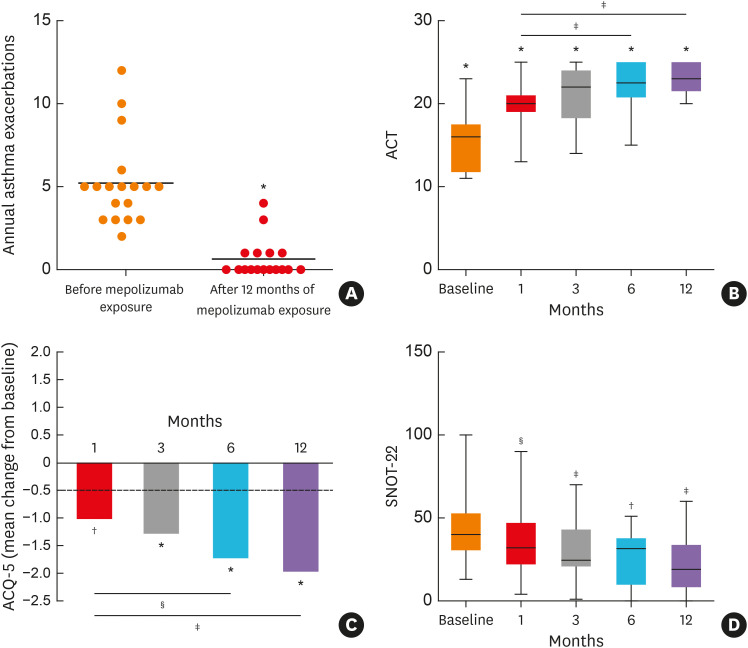
Eosinophilic granulomatosis with polyangiitis (EGPA) is a vasculitis characterized by multisystemic manifestations including asthma. Mepolizumab (300 mg/4 weeks) has recently been approved for EGPA. However, real-life data are scarce and report experiences with high doses of mepolizumab intravenously administered (750 mg/4 weeks). The aim of our study was to investigate in a real-life setting whether mepolizumab in EGPA patients at low doses would enable us 1) to control asthma symptoms, 2) to obtain oral corticosteroids (OCS) and/or immunosuppressors tapering and 3) to maintain clinical remission and avoid disease relapses. Mepolizumab (100 mg/4 weeks) was subcutaneously administered for 12 months in 18 EGPA patients with uncontrolled severe asthma. Symptoms, annual asthma exacerbation rates, OCS-sparing effects, lung function and eosinophil activation markers were monitored. The proportion of patients with clinical remission or relapse was also evaluated in month 12. A significant decrease in the annual rate of asthma exacerbations in association with significant changes in asthma control were observed. Specifically, 66.6% of the patients experienced no exacerbations during the mepolizumab treatment. Most patients (77.7%) were able to reduce the daily OCS dose by at least 50%. Four patients also stopped cyclosporine A during the study period. No EGPA relapse was observed and a large majority of the patients achieved clinical remission (94.3%). Clinical benefits were paralleled by reduction in blood eosinophils and serum levels of eosinophil activation markers. Low-dose mepolizumab showed clinically relevant benefits in exacerbation rates, asthma symptoms, OCS and immunosuppressive use in EGPA patients. These effects occurred without any EGPA relapse for extrapulmonary manifestations.
嗜酸性肉芽肿性多血管炎(EGPA)是一种以包括哮喘在内的多系统表现为特征的血管炎。美泊利珠单抗(300毫克/4周)最近已被批准用于EGPA。然而,真实世界的数据稀缺,且报告的是高剂量静脉注射美泊利珠单抗(750毫克/4周)的经验。我们研究的目的是在真实世界环境中调查低剂量美泊利珠单抗用于EGPA患者是否能使我们:1)控制哮喘症状;2)减少口服糖皮质激素(OCS)和/或免疫抑制剂用量;3)维持临床缓解并避免疾病复发。对18例严重哮喘未得到控制的EGPA患者皮下注射美泊利珠单抗(100毫克/4周),为期12个月。监测症状、年度哮喘发作率、OCS节省效果、肺功能和嗜酸性粒细胞活化标志物。在第12个月时还评估了临床缓解或复发患者的比例。观察到哮喘发作年率显著降低,同时哮喘控制情况有显著变化。具体而言,66.6%的患者在美泊利珠单抗治疗期间未出现发作。大多数患者(77.7%)能够将每日OCS剂量至少减少50%。4例患者在研究期间还停用了环孢素A。未观察到EGPA复发,绝大多数患者实现了临床缓解(94.3%)。临床获益伴随着血液嗜酸性粒细胞减少和嗜酸性粒细胞活化标志物血清水平降低。低剂量美泊利珠单抗在EGPA患者的发作率、哮喘症状、OCS和免疫抑制剂使用方面显示出临床相关益处。这些效果出现时,肺外表现未出现任何EGPA复发。