University of Graz, Institute of Chemistry, Department of Inorganic Chemistry, Schuberstraße 1, 8010, Graz, Austria.
Chemistry. 2020 Sep 25;26(54):12431-12444. doi: 10.1002/chem.202001127. Epub 2020 Sep 7.
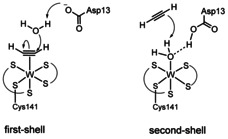
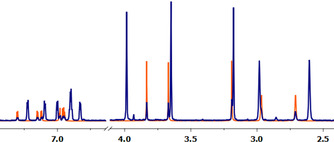
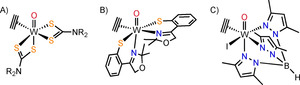
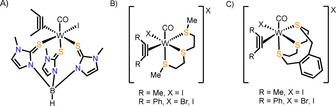
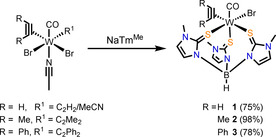
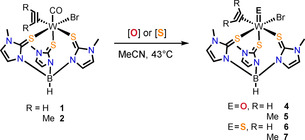
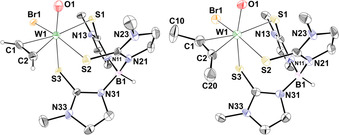
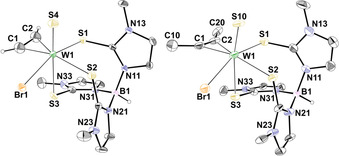
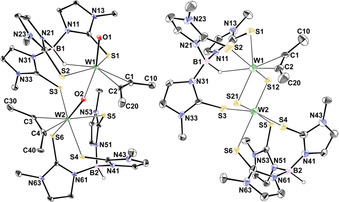
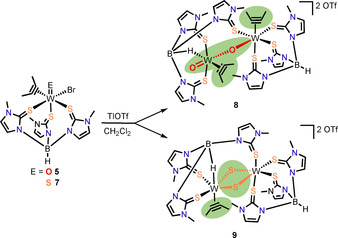
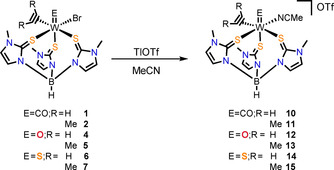
A series of W alkyne complexes with the sulfur-rich ligand hydridotris(2-mercapto-1-methylimidazolyl) borate) (Tm ) are presented as bio-inspired models to elucidate the mechanism of the tungstoenzyme acetylene hydratase (AH). The mono- and/or bis-alkyne precursors were reacted with NaTm and the resulting complexes [W(CO)(C R )(Tm )Br] (R=H 1, Me 2) oxidized to the target [WE(C R )(Tm )Br] (E=O, R=H 4, Me 5; E=S, R=H 6, Me 7) using pyridine-N-oxide and methylthiirane. Halide abstraction with TlOTf in MeCN gave the cationic complexes WE(C R )(MeCN)(Tm ) (E=CO, R=H 10, Me 11; E=O, R=H 12, Me 13; E=S, R=H 14, Me 15). Without MeCN, dinuclear complexes W O(μ-O)(C Me ) (Tm ) (8) and W (μ-S) (C Me )(Tm ) (9) could be isolated showing distinct differences between the oxido and sulfido system with the latter exhibiting only one molecule of C Me . This provides evidence that a fine balance of the softness at W is important for acetylene coordination. Upon dissolving complex 8 in acetonitrile complex 13 is reconstituted in contrast to 9. All complexes exhibit the desired stability toward water and the observed effective coordination of the scorpionate ligand avoids decomposition to disulfide, an often-occurring reaction in sulfur ligand chemistry. Hence, the data presented here point toward a mechanism with a direct coordination of acetylene in the active site and provide the basis for further model chemistry for acetylene hydratase.
一系列含有富硫配体氢三(2-巯基-1-甲基咪唑基)硼酸盐(Tm)的炔烃配合物被作为生物启发模型,以阐明钨酶乙炔水合酶(AH)的机理。单炔烃和/或二炔烃前体与 NaTm 反应,得到的配合物[W(CO)(CR)(Tm)Br](R=H 1,Me 2)被氧化为目标配合物[WE(CR)(Tm)Br](E=O,R=H 4,Me 5;E=S,R=H 6,Me 7),使用吡啶-N-氧化物和甲基硫代亚砜。在 MeCN 中用 TlOTf 进行卤化物消除反应得到阳离子配合物[WE(CR)(MeCN)(Tm)](OTf)(E=CO,R=H 10,Me 11;E=O,R=H 12,Me 13;E=S,R=H 14,Me 15)。没有 MeCN 时,可以分离得到双核配合物[WO(μ-O)(CMe)(Tm)](OTf)(8)和[W(μ-S)(CMe)(Tm)](OTf)(9),这表明氧化和硫代系统之间存在明显的差异,后者只含有一个 CMe 分子。这证明了 W 的柔软性的精细平衡对于乙炔配位很重要。当将配合物 8 溶解在乙腈中时,会重新形成配合物 13,而不是 9。所有配合物都表现出对水的理想稳定性,并且观察到的角鲨烯配体的有效配位避免了分解为二硫化物,这是硫配体化学中经常发生的反应。因此,这里呈现的数据表明存在一种直接在活性位点配位乙炔的机制,并为进一步的乙炔水合酶模型化学提供了基础。