Brumovský Miroslav, Filip Jan, Malina Ondřej, Oborná Jana, Sracek Ondra, Reichenauer Thomas G, Andrýsková Pavlína, Zbořil Radek
Regional Centre of Advanced Technologies and Materials, Palacký University Olomouc, Šlechtitelů 27, Olomouc 783 71, Czech Republic.
Department of Environmental Geosciences, Centre for Microbiology and Environmental Systems Science, University of Vienna, Althanstraße 14, UZA II, Vienna 1090, Austria.
ACS Appl Mater Interfaces. 2020 Aug 5;12(31):35424-35434. doi: 10.1021/acsami.0c08626. Epub 2020 Jul 22.
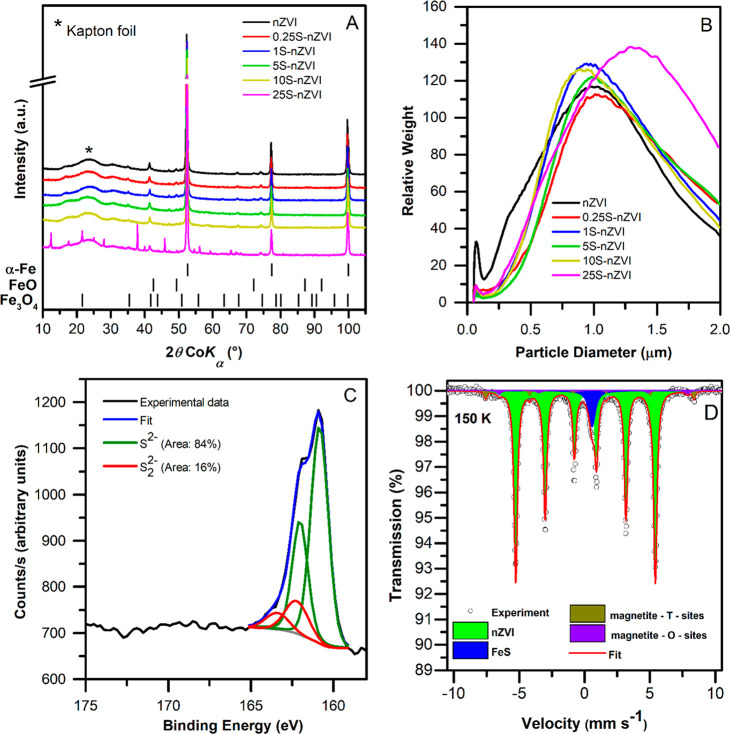
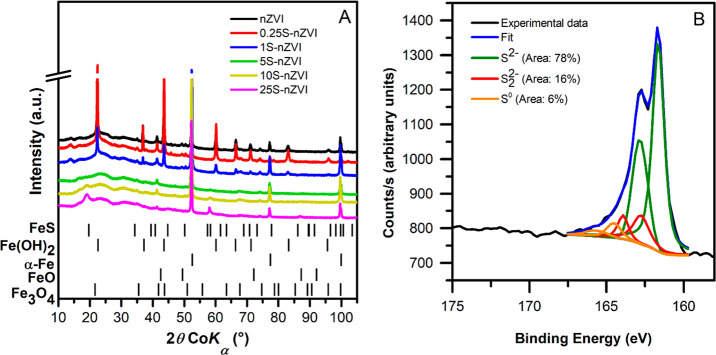
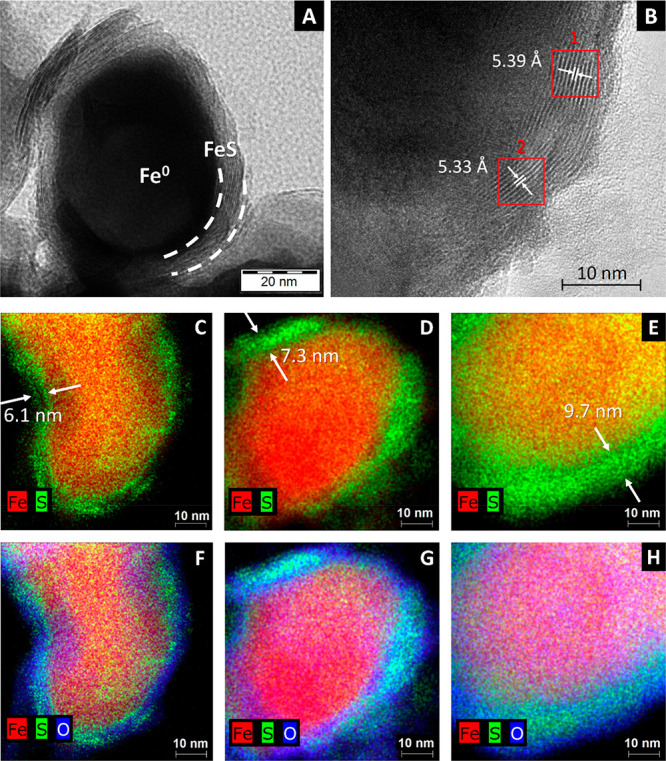
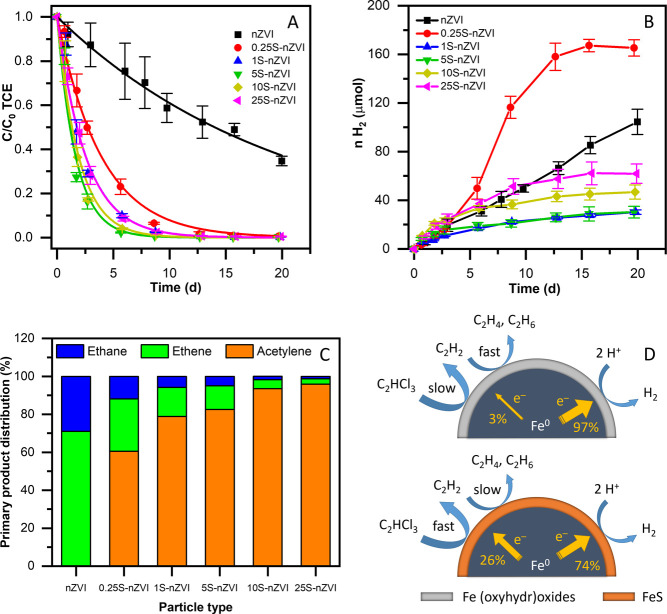
Zero-valent iron nanoparticles (nZVI) treated by reduced sulfur compounds (i.e., sulfidated nZVI, S-nZVI) have attracted increased attention as promising materials for environmental remediation. While the preparation of S-nZVI and its reactions with various groundwater contaminants such as trichloroethylene (TCE) were already a subject of several studies, nanoparticle synthesis procedures investigated so far were suited mainly for laboratory-scale preparation with only a limited possibility of easy and cost-effective large-scale production and FeS shell property control. This study presents a novel approach for synthesizing S-nZVI using commercially available nZVI particles that are treated with sodium sulfide in a concentrated slurry. This leads to S-nZVI particles that do not contain hazardous boron residues and can be easily prepared off-site. The resulting S-nZVI exhibits a core-shell structure where zero-valent iron is the dominant phase in the core, while the shell contains mostly amorphous iron sulfides. The average FeS shell thickness can be controlled by the applied sulfide concentration. Up to a 12-fold increase in the TCE removal and a 7-fold increase in the electron efficiency were observed upon amending nZVI with sulfide. Although the FeS shell thickness correlated with surface-area-normalized TCE removal rates, sulfidation negatively impacted the particle surface area, resulting in an optimal FeS shell thickness of approximately 7.3 nm. This corresponded to a particle S/Fe mass ratio of 0.0195. At all sulfide doses, the TCE degradation products were only fully dechlorinated hydrocarbons. Moreover, a nearly 100% chlorine balance was found at the end of the experiments, further confirming complete TCE degradation and the absence of chlorinated transformation products. The newly synthesized S-nZVI particles thus represent a promising remedial agent applicable at sites contaminated with TCE.
经还原态硫化合物处理的零价铁纳米颗粒(即硫化零价铁,S-nZVI)作为一种有前景的环境修复材料,已引起越来越多的关注。虽然S-nZVI的制备及其与三氯乙烯(TCE)等各种地下水污染物的反应已经是多项研究的主题,但迄今为止所研究的纳米颗粒合成程序主要适用于实验室规模的制备,大规模生产简便且经济高效的可能性有限,同时也难以控制FeS壳层的性质。本研究提出了一种新颖的方法,使用市售的nZVI颗粒在浓浆料中用硫化钠处理来合成S-nZVI。这会生成不含有害硼残留物且可在厂外轻松制备的S-nZVI颗粒。所得的S-nZVI呈现核壳结构,其中零价铁是核心中的主要相,而壳层主要包含无定形硫化铁。平均FeS壳层厚度可通过所施加的硫化物浓度来控制。在用硫化物改性nZVI后,观察到TCE去除率提高了12倍,电子效率提高了7倍。尽管FeS壳层厚度与比表面积归一化的TCE去除率相关,但硫化对颗粒表面积有负面影响,导致最佳FeS壳层厚度约为7.3 nm。这对应于颗粒的S/Fe质量比为0.0195。在所有硫化物剂量下,TCE降解产物仅为完全脱氯的烃类。此外,在实验结束时发现氯平衡接近100%,进一步证实了TCE的完全降解以及不存在氯化转化产物。因此,新合成的S-nZVI颗粒是一种有前景的修复剂,适用于受TCE污染的场地。