Sordo Lorena, Breheny Craig, Halls Vicky, Cotter Amy, Tørnqvist-Johnsen Camilla, Caney Sarah M A, Gunn-Moore Danièlle A
Royal (Dick) School of Veterinary Studies and the Roslin Institute, The University of Edinburgh, Easter Bush Veterinary Campus, Roslin, Midlothian EH25 9RG, UK.
International Cat Care, Place Farm, Tisbury, Wiltshire SP3 6LW, UK.
Vet Sci. 2020 Jul 6;7(3):85. doi: 10.3390/vetsci7030085.
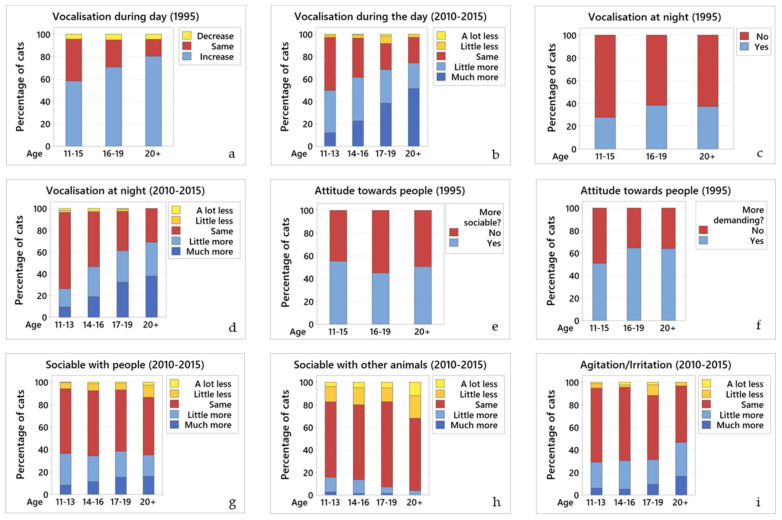
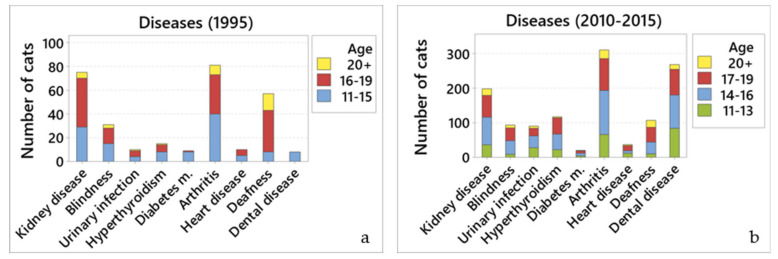
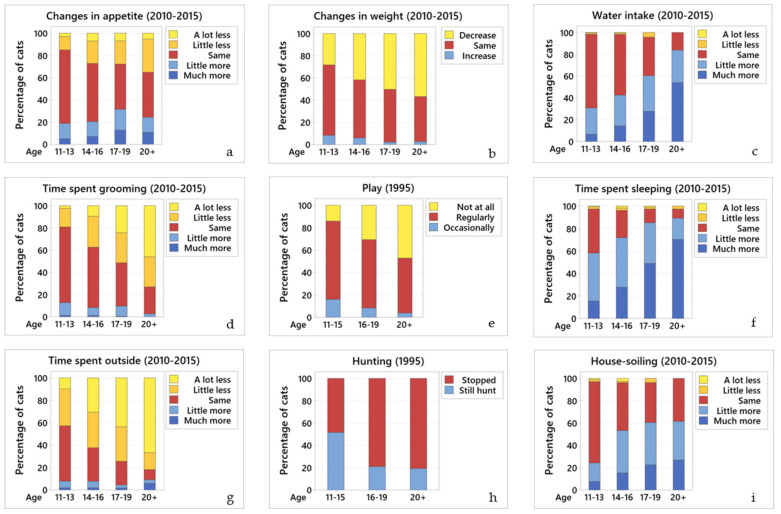
(1) Background: age-related changes in behaviour and health may be thought of as "normal" ageing; however, they can reflect under-diagnosed, potentially treatable, conditions. This paper describes the prevalence of age-related behavioural changes and disease in two UK cat populations at separate time-points. (2) Methods: owners of cats aged ≥11 years completed questionnaires in 1995 (cohort 1: = 1236), and from 2010-2015 (cohort 2: = 883). (3) Results: the most important behavioural changes in these cats were increased affection towards their owners (reported by 51.9% in 1995; 35.8% in 2010-2015), increased vocalisation (63.5%; 58.9%, respectively), particularly at night (32%; 43.6%), and house-soiling (29.3%; 55.8%). Most (79.4%; 81%) of the cats had visited a veterinary surgeon since becoming 11 years old. The main reasons, aside from vaccinations, were dental disease, renal disease and lower urinary tract disorders in 1995, and dental disease, renal disease and hyperthyroidism in 2010-2015. All major diagnoses were reported significantly more frequently in 2010-2015 than in 1995; behavioural changes were variably associated with these diseases. (4) Conclusion: elderly cats display age-related behavioural changes and develop diseases that may be under-diagnosed. Veterinarians need to ask owners about these behavioural changes, as they may signify manageable conditions rather than reflect "normal" ageing.
(1) 背景:行为和健康方面与年龄相关的变化可能被视为“正常”衰老;然而,它们可能反映出未被充分诊断、潜在可治疗的病症。本文描述了英国两个猫群在不同时间点与年龄相关的行为变化和疾病的患病率。(2) 方法:1995年,年龄≥11岁的猫的主人完成了问卷调查(队列1:=1236),以及2010 - 2015年(队列2:=883)。(3) 结果:这些猫最重要的行为变化是对主人的喜爱增加(1995年报告为51.9%;2010 - 2015年为35.8%)、发声增加(分别为63.5%;58.9%),尤其是在夜间(32%;43.6%),以及在家中排便(29.3%;55.8%)。大多数(79.4%;81%)的猫自11岁起就看过兽医。除疫苗接种外,1995年的主要原因是牙科疾病、肾脏疾病和下尿路疾病,2010 - 2015年是牙科疾病、肾脏疾病和甲状腺功能亢进。2010 - 2015年所有主要诊断的报告频率均显著高于1995年;行为变化与这些疾病存在不同程度的关联。(4) 结论:老年猫会出现与年龄相关的行为变化,并患上可能未被充分诊断的疾病。兽医需要询问主人这些行为变化,因为它们可能意味着可控制的状况,而非反映“正常”衰老。