Santaniello Antonio, Garzillo Susanne, Amato Alessia, Sansone Mario, Di Palma Annalisa, Di Maggio Annamaria, Fioretti Alessandro, Menna Lucia Francesca
Department of Veterinary Medicine and Animal Productions, Federico II University of Naples, 80134 Naples, Italy.
Department of Electrical Engineering and Information Technology, Federico II University of Naples, 80125 Naples, Italy.
Animals (Basel). 2020 Jul 6;10(7):1142. doi: 10.3390/ani10071142.
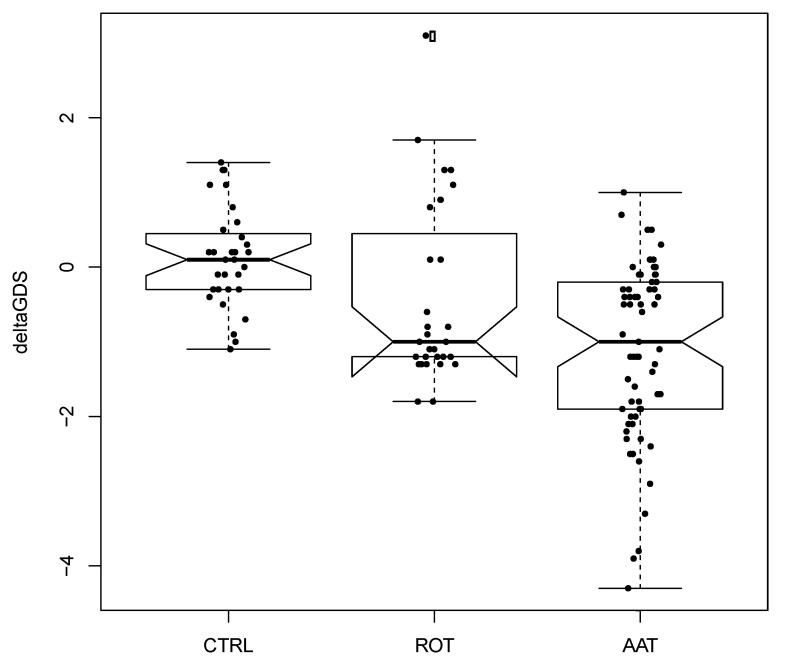
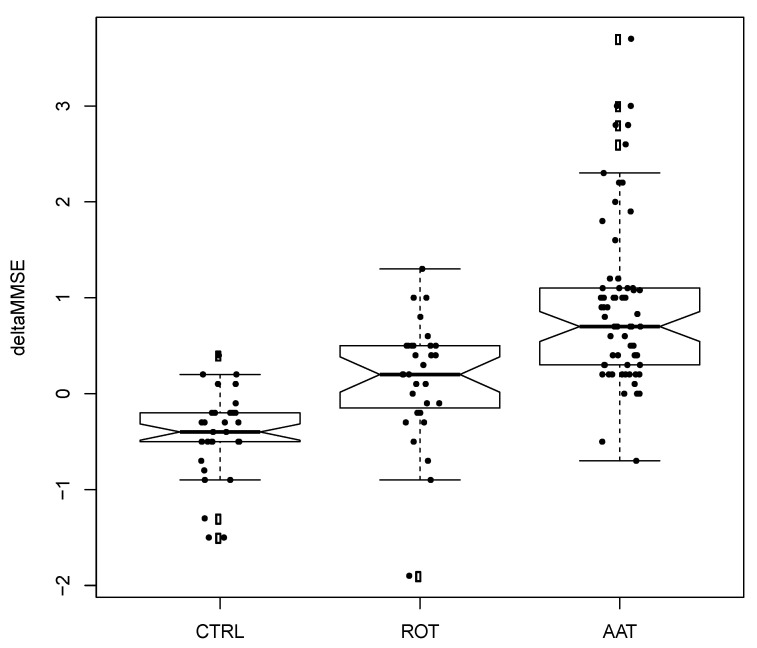
Recently, many efforts have been made to assess the effectiveness of non-pharmacological therapies as an alternative or supportive option to conventional approaches. Specifically, animal-assisted therapy (AAT) has recently raised a great interest and large research efforts. This work represents a retrospective study carried out over seven years (from 2012 to 2019) in 127 patients with mild-to-moderate Alzheimer's disease. The patients were divided into three groups: an experimental group that received AAT interventions adapted to the formal reality orientation therapy (ROT), a group receiving a formal ROT, and a control group that did not perform any of the previous therapies. All sessions, for all patient groups, were held weekly for a total period of six months. The evaluation of cognitive function was performed through the Mini Mental State Examination (MMSE), while the Geriatric Depression Scale (GDS) assessed the depressive state. Test administration to all patients was performed before the start of the first session (T) and after the last session (T). The results obtained showed an improvement in the values in the GDS and MMSE tests. The variations between the average MMSE values between T and T were 0.94 ± 0.9 (SD), 0.15 ± 0.62, and -0.42 ± 0.45 in the AAT group, ROT group, and control (CTRL) group, respectively. The variations between the average GDS values between T and T were -1.12 ± 1.17 (SD), -0.42 ± 1.21, and 0.12 ± 0.66 in the AAT group, ROT group, and CTRL group, respectively. Based on our findings, we can therefore affirm how the study carried out confirms the potential of AAT performed by Federico II Model of Healthcare Zooanthropology, and particularly its efficacy in the treatment of cognitive deficits deriving from Alzheimer's disease.
最近,人们做出了许多努力来评估非药物疗法作为传统方法的替代或支持选项的有效性。具体而言,动物辅助疗法(AAT)最近引起了极大的兴趣并引发了大量的研究工作。这项研究是一项回顾性研究,对127例轻度至中度阿尔茨海默病患者进行了为期七年(从2012年到2019年)的跟踪。患者被分为三组:一组接受了适应形式现实导向疗法(ROT)的AAT干预措施;一组接受形式ROT;还有一组是对照组,未进行上述任何一种疗法。所有患者组的所有疗程均每周进行一次,为期六个月。认知功能通过简易精神状态检查表(MMSE)进行评估,而老年抑郁量表(GDS)则用于评估抑郁状态。在第一次疗程开始前(T)和最后一次疗程后(T)对所有患者进行测试。获得的结果显示GDS和MMSE测试的值有所改善。AAT组、ROT组和对照组在T和T之间的平均MMSE值变化分别为0.94±0.9(标准差)、0.15±0.62和 -0.42±0.45。AAT组、ROT组和对照组在T和T之间的平均GDS值变化分别为 -1.12±1.17(标准差)、-0.42±1.21和0.12±0.66。基于我们的研究结果,我们可以肯定,这项研究证实了费德里科二世医疗动物人类学模型所实施的AAT的潜力,特别是其在治疗阿尔茨海默病引起的认知缺陷方面的疗效。