Health Policy and Health Services Research Group, Health Policy Research Unit, Consortium for Health Care and Social Services of Catalonia, Barcelona, Spain.
Department for Paediatrics, Obstetrics and Gynaecology, Preventive Medicine, Universitat Autònoma de Barcelona, Catalonia, Spain.
BMC Fam Pract. 2020 Jul 8;21(1):135. doi: 10.1186/s12875-020-01207-9.
Clinical coordination across care levels is a priority for health systems around the world, especially for those based on primary health care. The aim of this study is to analyse the degree of clinical information and clinical management coordination across healthcare levels in the Catalan national health system experienced by primary (PC) and secondary care (SC) doctors and explore the associated factors.
Cross-sectional study based on an online survey using the self-administered questionnaire COORDENA-CAT.
October-December 2017.
PC and SC (acute and long term) doctors of the Catalan national health system. Participation rate was 21%, with a sample of 3308 doctors.
cross-level clinical information coordination, clinical management coordination, and perception of cross-level coordination within the area. Explanatory variables: socio-demographic, employment characteristics, attitude towards job, type of area (according to type of hospital and management), interactional factors, organizational factors and knowledge of existing coordination mechanisms. Stratification variable: level of care. Descriptive and multivariate analysis by logistic regression.
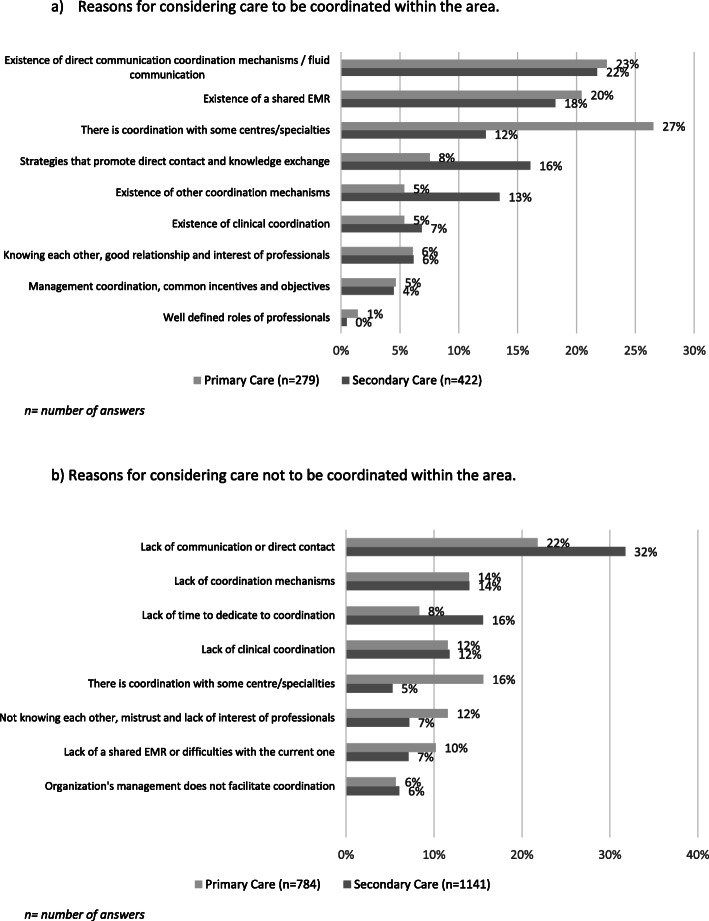
The degree of clinical coordination experienced across levels of care was high for both PC and SC doctors, although PC doctors experienced greater exchange and use of information and SC doctors experienced greater consistency of care. However, only 32.13% of PC and 35.72% of SC doctors found that patient care was coordinated across care levels within their area. In both levels of care, knowing the doctors of the other level, working in an area where the same entity manages SC and majority of PC, and holding joint clinical case conferences were factors positively associated with perceiving high levels of clinical coordination. Other associated factors were specific to the care level, such as being informed of a patient's discharge from hospital for PC doctors, or trusting in the clinical skills of the other care level for SC doctors.
Interactional and organizational factors are positively associated with perceiving high levels of clinical coordination. Introducing policies to enhance such factors can foster clinical coordination between different health care levels. The COORDENA questionnaire allows us to identify fields for improvement in clinical coordination.
临床协调在各级医疗保健中至关重要,这对基于初级卫生保健的全球卫生系统而言尤为重要。本研究旨在分析在加泰罗尼亚国家卫生系统中,初级保健(PC)和二级保健(SC)医生对跨医疗保健层级的临床信息和临床管理的协调程度,并探讨相关因素。
这是一项基于在线调查的横断面研究,使用自我管理问卷 COORDENA-CAT。
2017 年 10 月至 12 月。
加泰罗尼亚国家卫生系统的 PC 和 SC(急性和长期)医生。参与率为 21%,样本量为 3308 名医生。
跨层临床信息协调、临床管理协调以及对所在区域跨层协调的感知。解释变量:社会人口统计学、就业特征、对工作的态度、区域类型(根据医院和管理类型)、交互因素、组织因素和对现有协调机制的了解。分层变量:医疗保健级别。描述性和多变量分析采用逻辑回归。
PC 和 SC 医生在各级医疗保健中的临床协调程度都很高,尽管 PC 医生的信息交流和使用更多,而 SC 医生的护理一致性更高。然而,只有 32.13%的 PC 医生和 35.72%的 SC 医生认为他们所在区域的患者护理是跨层协调的。在这两个医疗保健级别中,了解其他级别的医生、在同一实体管理 SC 和大部分 PC 的区域工作、以及举行联合临床病例会议是与感知高水平临床协调相关的积极因素。其他相关因素则特定于医疗保健级别,例如 PC 医生会收到患者出院通知,或者 SC 医生会信任其他医疗保健级别的临床技能。
交互和组织因素与感知高水平的临床协调相关。引入增强此类因素的政策可以促进不同医疗保健层级之间的临床协调。COORDENA 问卷可帮助我们确定在临床协调方面需要改进的领域。