Department of Electrical and Computer Engineering, McGill University, Montreal, Quebec, Canada.
Carl R. Woese Institute for Genomic Biology, University of Illinois at Urbana-Champaign, Champaign, Illinois, USA.
Breast Cancer Res. 2020 Jul 8;22(1):74. doi: 10.1186/s13058-020-01304-8.
Cancer cells are known to display varying degrees of metastatic propensity, but the molecular basis underlying such heterogeneity remains unclear. Our aims in this study were to (i) elucidate prognostic subtypes in primary tumors based on an epithelial-to-mesenchymal-to-amoeboid transition (EMAT) continuum that captures the heterogeneity of metastatic propensity and (ii) to more comprehensively define biologically informed subtypes predictive of breast cancer metastasis and survival in lymph node-negative (LNN) patients.
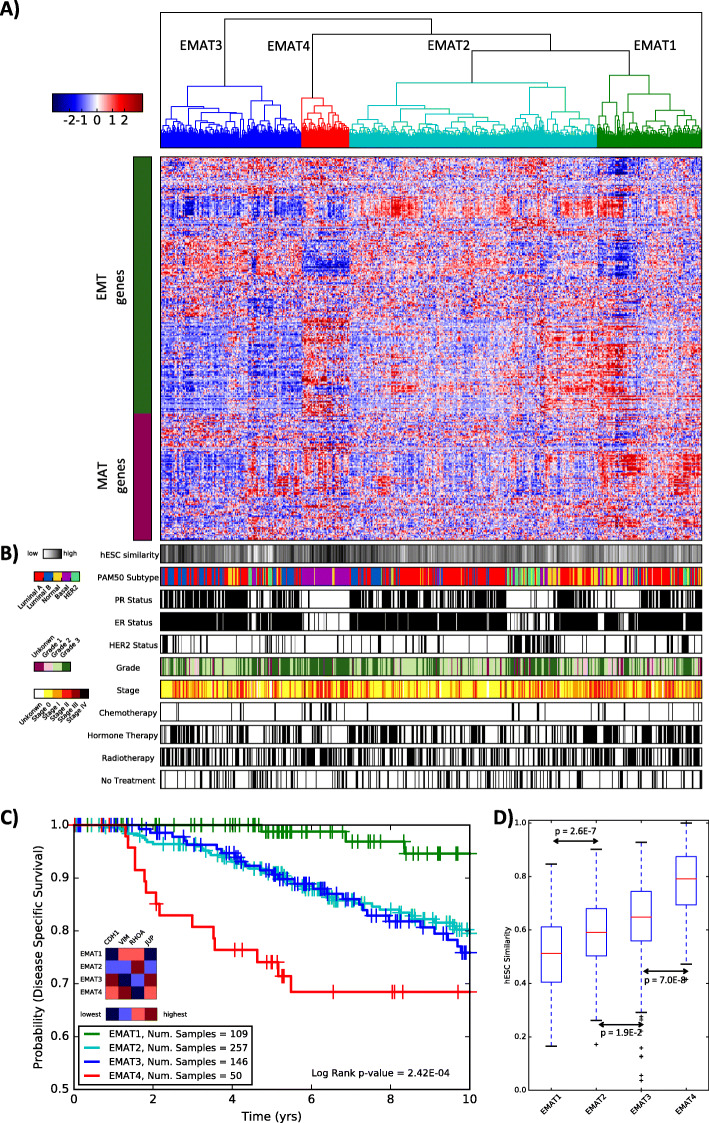
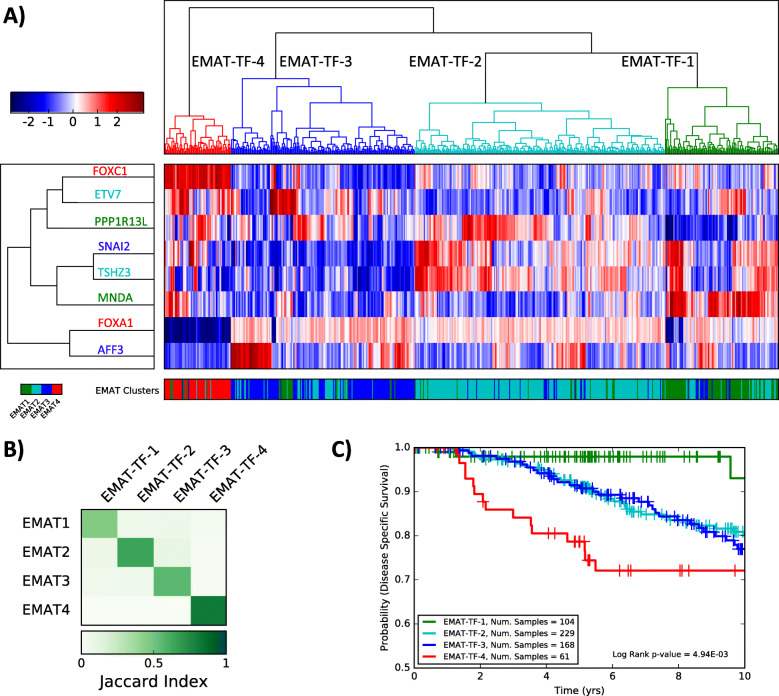
We constructed a novel metastasis biology-based gene signature (EMAT) derived exclusively from cancer cells induced to undergo either epithelial-to-mesenchymal transition (EMT) or mesenchymal-to-amoeboid transition (MAT) to gauge their metastatic potential. Genome-wide gene expression data obtained from 913 primary tumors of lymph node-negative breast cancer (LNNBC) patients were analyzed. EMAT gene signature-based prognostic stratification of patients was performed to identify biologically relevant subtypes associated with distinct metastatic propensity.
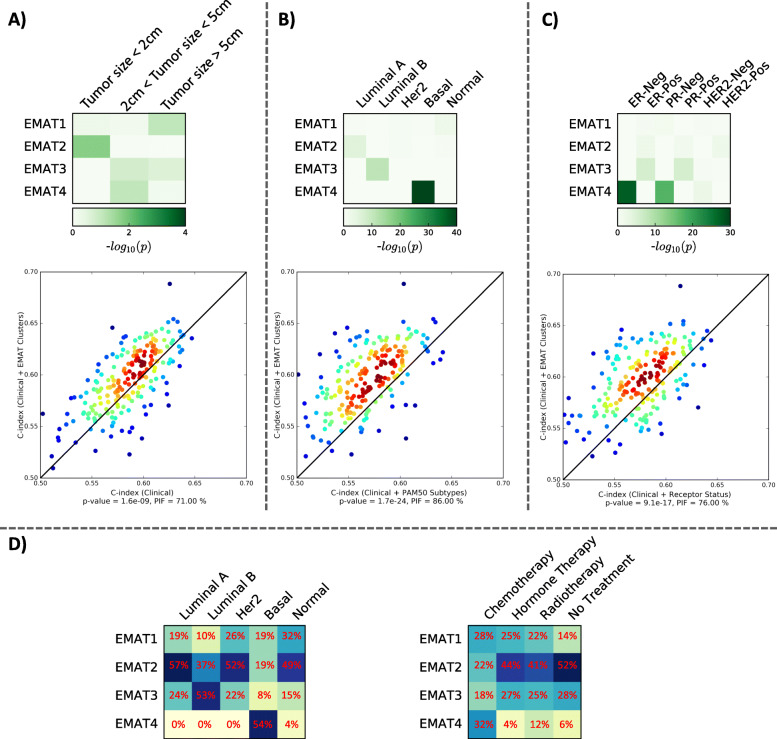
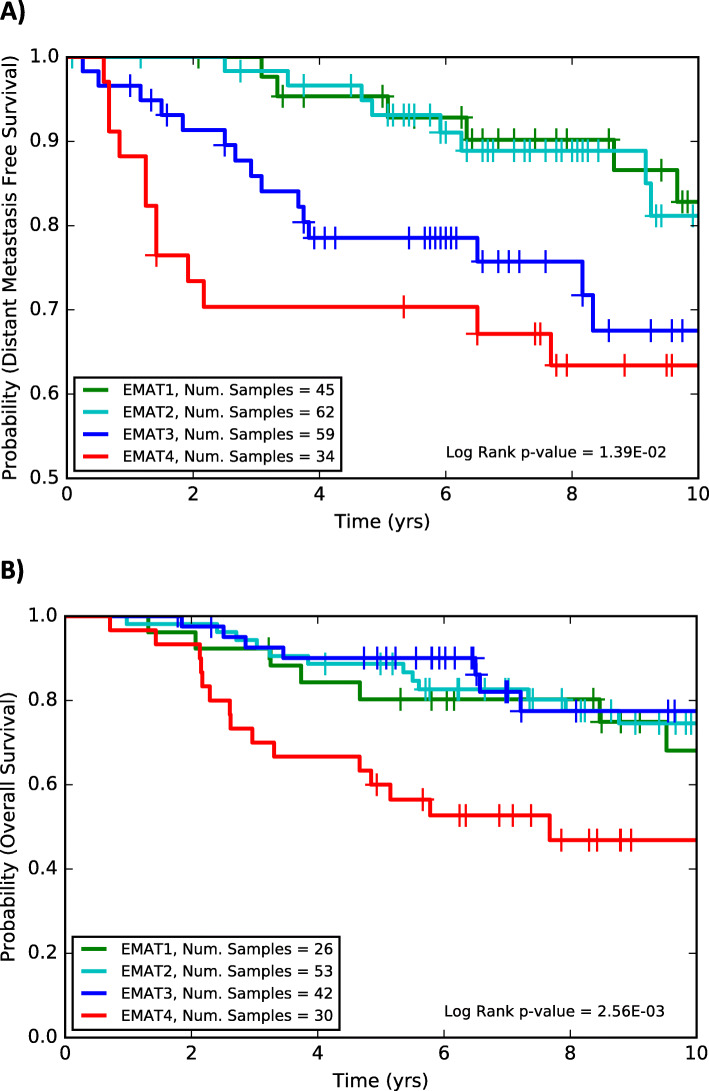
Delineated EMAT subtypes display a biologic range from less stem-like to more stem-like cell states and from less invasive to more invasive modes of cancer progression. Consideration of EMAT subtypes in combination with standard clinical parameters significantly improved survival prediction. EMAT subtypes outperformed prognosis accuracy of receptor or PAM50-based BC intrinsic subtypes even after adjusting for treatment variables in 3 independent, LNNBC cohorts including a treatment-naïve patient cohort.
EMAT classification is a biologically informed method that provides prognostic information beyond that which can be provided by traditional cancer staging or PAM50 molecular subtype status and may improve metastasis risk assessment in early stage, LNNBC patients, who may otherwise be perceived to be at low metastasis risk.
众所周知,癌细胞具有不同程度的转移倾向,但这种异质性的分子基础仍不清楚。我们在这项研究中的目的是:(i)根据上皮-间充质-阿米巴样转化(EMAT)连续体阐明原发性肿瘤中的预后亚型,该连续体捕获了转移倾向的异质性;(ii)更全面地定义具有生物学意义的亚型,预测淋巴结阴性(LNN)患者的乳腺癌转移和生存。
我们构建了一种新的基于转移生物学的基因特征(EMAT),该基因特征仅从诱导经历上皮-间充质转化(EMT)或间充质-阿米巴样转化(MAT)的癌细胞中获得,以评估其转移潜力。对 913 例淋巴结阴性乳腺癌(LNNBC)患者的 913 例原发性肿瘤的全基因组基因表达数据进行了分析。对患者进行基于 EMAT 基因特征的预后分层,以确定与不同转移倾向相关的具有生物学意义的亚型。
划定的 EMAT 亚型显示出从更具干细胞样到更具干细胞样的细胞状态和从侵袭性较弱到侵袭性较强的生物学范围。在考虑 EMAT 亚型的同时,结合标准临床参数,可以显著提高生存预测的准确性。即使在调整了 3 个独立的 LNNBC 队列(包括一个未经治疗的患者队列)中的治疗变量后,EMAT 亚型也优于受体或 PAM50 基于 BC 内在亚型的预后准确性。
EMAT 分类是一种基于生物学的方法,它提供了比传统癌症分期或 PAM50 分子亚型状态所能提供的更具预后信息,并且可能会改善早期 LNNBC 患者的转移风险评估,这些患者在其他方面可能被认为转移风险较低。