Department of Nutrition and Food Hygiene, Hubei Key Laboratory of Food Nutrition and Safety, School of Public Health, Tongji Medical College, Huazhong University of Science and Technology.
Ministry of Education Key Laboratory of Environment and Health, School of Public Health, Tongji Medical College, Huazhong University of Science and Technology.
J Atheroscler Thromb. 2021 Apr 1;28(4):320-328. doi: 10.5551/jat.55962. Epub 2020 Jul 9.
We aimed to investigate the relationship of trimethylamine N-oxide (TMAO) concentrations with ischemic stroke in a large-scale case-control study conducted among the hospital-based general population.
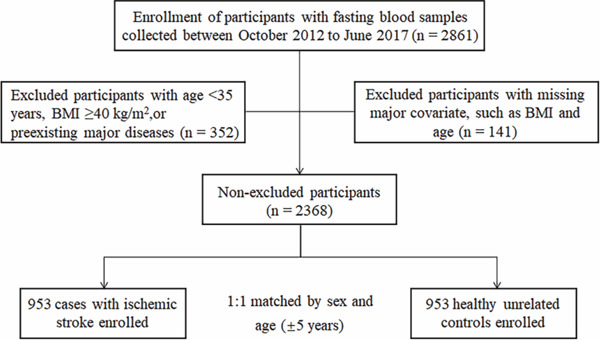
We recruited 953 case-control sex- and age-matched pairs, and cases were confined to first acute ischemic stroke in this study. Fasting plasma TMAO was measured using high-performance liquid chromatography-tandem mass spectroscopy. Conditional logistic regression analysis was conducted to calculate odds ratios (OR) for the association of plasma TMAO with ischemic stroke.
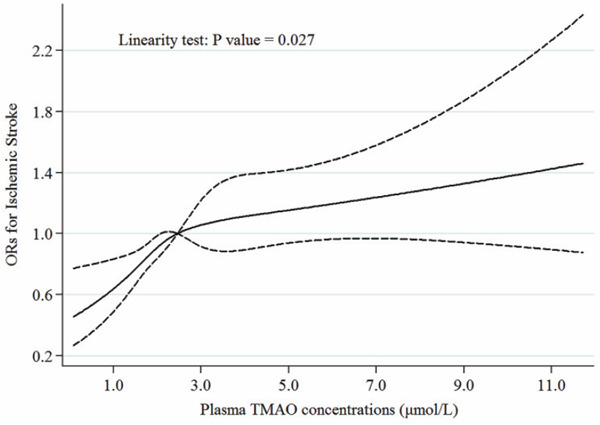
We found that plasma TMAO concentrations in patients with ischemic stroke were significantly higher than that in the control group (median: 2.85 µmol/L vs. 2.33 µmol/L, P<0.001). In multivariable conditional logistic regression models, higher plasma TMAO concentrations were associated with increased odds of ischemic stroke [fully adjusted OR for highest vs. lowest TMAO quartile: 1.81; 95% confidence interval (CI): 1.27, 2.59; P for trend <0.001]. The multivariable-adjusted OR for ischemic stroke per 1 µmol/L increment of plasma TMAO was 1.05 (95% CI: 1.02, 1.08). Additionally, the positive association also persisted in subgroups stratified by age, sex, body mass index, smoking status, alcohol habits, history of diabetes, and history of hypertension.
This study suggested a positive association between plasma TMAO and ischemic stroke. Further studies are required to explore the role of plasma TMAO concentrations in predicting stroke risk.
本研究旨在通过一项基于医院人群的大型病例对照研究,探讨三甲胺氮氧化物(TMAO)浓度与缺血性脑卒中的关系。
我们招募了 953 对病例对照性别和年龄匹配的个体,且本研究中的病例仅限于首次急性缺血性脑卒中。采用高效液相色谱-串联质谱法测定空腹血浆 TMAO 浓度。采用条件 logistic 回归分析计算血浆 TMAO 与缺血性脑卒中关联的比值比(OR)。
我们发现,缺血性脑卒中患者的血浆 TMAO 浓度明显高于对照组(中位数:2.85µmol/L 比 2.33µmol/L,P<0.001)。在多变量条件 logistic 回归模型中,较高的血浆 TMAO 浓度与缺血性脑卒中的发生风险增加相关[最高与最低 TMAO 四分位间距相比的校正比值比:1.81;95%置信区间(CI):1.27,2.59;P 趋势<0.001]。血浆 TMAO 每增加 1µmol/L,缺血性脑卒中的校正比值比为 1.05(95%CI:1.02,1.08)。此外,在按年龄、性别、体重指数、吸烟状况、饮酒习惯、糖尿病史和高血压史分层的亚组中,这种关联仍然存在。
本研究表明,血浆 TMAO 与缺血性脑卒中之间存在正相关。需要进一步的研究来探讨血浆 TMAO 浓度在预测卒中风险中的作用。