Rahman U, Gemperle-Mannion E, Qureshi A, Edwin C, Smith T O, Parsons H, Mason J, Underwood M, Eldridge J, Thompson P, Metcalfe A
Warwick Clinical Trials Unit, University of Warwick, Coventry, UK.
University Hospitals Coventry and Warwickshire NHS Trust, Coventry, UK.
Pilot Feasibility Stud. 2020 Jul 6;6:94. doi: 10.1186/s40814-020-00635-9. eCollection 2020.
Patellar instability is a relatively common condition that leads to disability and restriction of activities. People with recurrent instability may be given the option of physiotherapy or surgery though this is largely driven by clinician preference rather than by a strong evidence base. We sought to determine the feasibility of conducting a definitive trial comparing physiotherapy with surgical treatment for people with recurrent patellar instability.
This was a pragmatic, open-label, two-arm feasibility randomised control trial (RCT) with an embedded interview component recruiting across three NHS sites comparing surgical treatment to a package of best conservative care; 'Personalised Knee Therapy' (PKT). The primary feasibility outcome was the recruitment rate per centre (expected rate 1 to 1.5 participants recruited each month). Secondary outcomes included the rate of follow-up (over 80% expected at 12 months) and a series of participant-reported outcomes taken at 3, 6 and 12 months following randomisation, including the Norwich Patellar Instability Score (NPIS), the Kujala Patellofemoral Disorder Score (KPDS), EuroQol-5D-5L, self-reported global assessment of change, satisfaction at each time point and resources use.
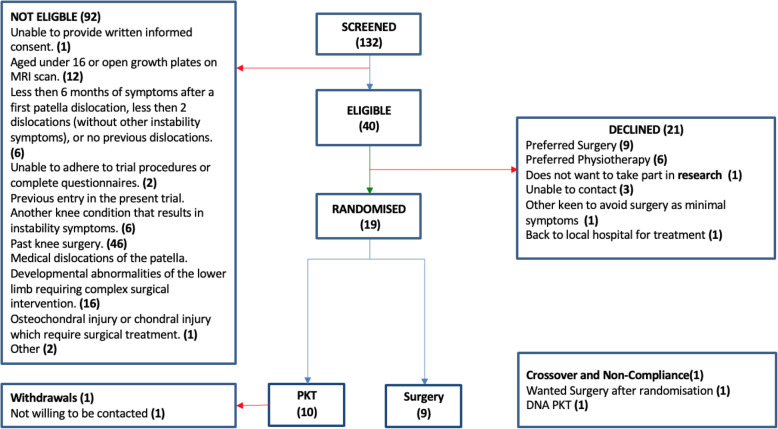
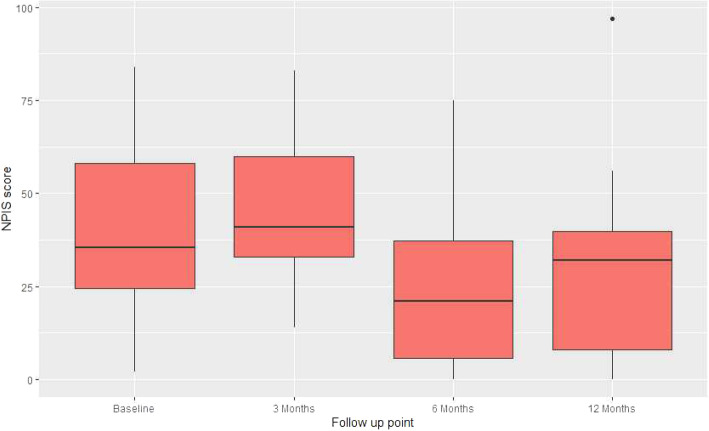
We recruited 19 participants. Of these, 18 participants (95%) were followed-up at 12 months and 1 (5%) withdrew. One centre recruited at just over one case per month, one centre was unable to recruit, and one centre recruited at over one case per month after a change in participant screening approach. Ten participants were allocated into the PKT arm, with nine to the surgical arm. Mean Norwich Patellar Instability Score improved from 40.6 (standard deviation 22.1) to 28.2 (SD 25.4) from baseline to 12 months.
This feasibility trial identified a number of challenges and required a series of changes to ensure adequate recruitment and follow-up. These changes helped achieve a sufficient recruitment and follow-up rate. The revised trial design is feasible to be conducted as a definitive trial to answer this important clinical question for people with chronic patellar instability.
The trial was prospectively registered on the International Standard Randomised Controlled Trial Number registry on the 22/12/2016 (reference number: ISRCTN14950321). http://www.isrctn.com/ISRCTN14950321.
髌骨不稳定是一种较为常见的病症,会导致残疾和活动受限。复发性不稳定患者可能会被给予物理治疗或手术的选择,不过这很大程度上取决于临床医生的偏好,而非强有力的证据基础。我们试图确定开展一项比较物理治疗与手术治疗复发性髌骨不稳定患者的确定性试验的可行性。
这是一项务实的、开放标签的双臂可行性随机对照试验(RCT),在三个国民保健服务(NHS)站点招募患者,设有嵌入式访谈环节,将手术治疗与一整套最佳保守治疗方案“个性化膝关节治疗”(PKT)进行比较。主要可行性结果是每个中心的招募率(预期每月招募1至1.5名参与者)。次要结果包括随访率(12个月时预期超过80%)以及随机分组后3个月、6个月和12个月时一系列患者报告的结果,包括诺维奇髌骨不稳定评分(NPIS)、库亚拉髌股关节紊乱评分(KPDS)、欧洲五维度健康量表-5D-5L、自我报告的整体变化评估、各时间点的满意度以及资源使用情况。
我们招募了19名参与者。其中,18名参与者(95%)在12个月时接受了随访,1名(5%)退出。一个中心每月招募略多于1例,一个中心无法招募,一个中心在改变参与者筛选方法后每月招募超过1例。10名参与者被分配到PKT组,9名被分配到手术组。从基线到12个月,诺维奇髌骨不稳定评分的平均值从40.6(标准差22.1)提高到28.2(标准差25.4)。
这项可行性试验发现了一些挑战,并需要一系列改变以确保足够的招募和随访。这些改变有助于实现足够的招募和随访率。修订后的试验设计作为一项确定性试验来回答慢性髌骨不稳定患者的这一重要临床问题是可行的。
该试验于2016年12月22日在国际标准随机对照试验编号注册中心进行前瞻性注册(参考编号:ISRCTN14950321)。http://www.isrctn.com/ISRCTN14950321