Nilsen Line Brennhaug, Digernes Ingrid, Grøvik Endre, Saxhaug Cathrine, Latysheva Anna, Geier Oliver, Breivik Birger, Sætre Dag Ottar, Jacobsen Kari Dolven, Helland Åslaug, Emblem Kyrre Eeg
Department of Diagnostic Physics, Oslo University Hospital, Oslo, Norway.
University of Oslo, Oslo, Norway.
Neurooncol Adv. 2020 Feb 28;2(1):vdaa028. doi: 10.1093/noajnl/vdaa028. eCollection 2020 Jan-Dec.
MRI may provide insights into longitudinal responses in the diffusivity and vascular function of the irradiated normal-appearing brain following stereotactic radiosurgery (SRS) of brain metastases.
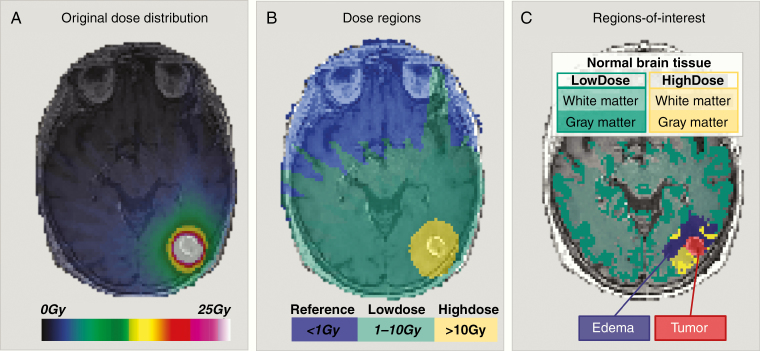
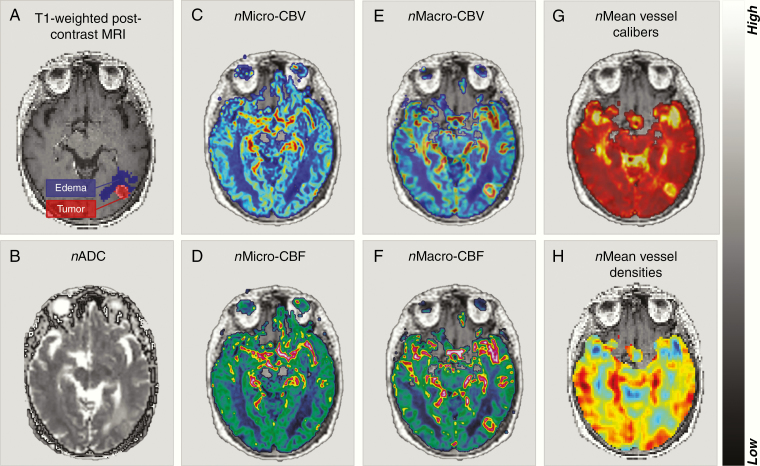
Forty patients with brain metastases from non-small cell lung cancer ( = 26) and malignant melanoma ( = 14) received SRS (15-25 Gy). Longitudinal MRI was performed pre-SRS and at 3, 6, 9, 12, and 18 months post-SRS. Measures of tissue diffusivity and vascularity were assessed by diffusion-weighted and perfusion MRI, respectively. All maps were normalized to white matter receiving less than 1 Gy. Longitudinal responses were assessed in normal-appearing brain, excluding tumor and edema, in the LowDose (1-10 Gy) and HighDose (>10 Gy) regions. The Eastern Cooperative Oncology Group (ECOG) performance status was recorded pre-SRS.
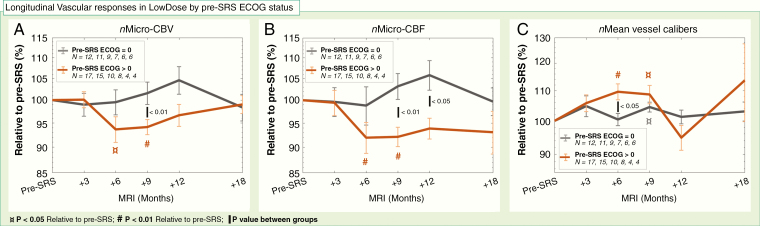
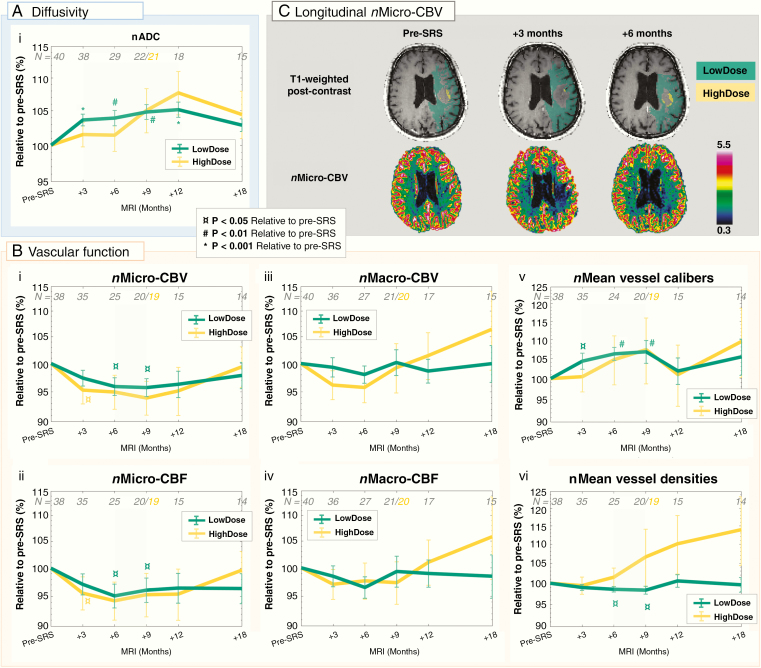
Following SRS, the diffusivity in the LowDose region increased continuously for 1 year (105.1% ± 6.2%; < .001), before reversing toward pre-SRS levels at 18 months. Transient reductions in microvascular cerebral blood volume ( < .05), blood flow ( < .05), and vessel densities ( < .05) were observed in LowDose at 6-9 months post-SRS. Correspondingly, vessel calibers in LowDose transiently increased at 3-9 months ( < .01). The responses in HighDose displayed similar trends as in LowDose, but with larger interpatient variations. Vascular responses followed pre-SRS ECOG status.
Our results imply that even low doses of radiation to normal-appearing brain following cerebral SRS induce increased diffusivity and reduced vascular function for up until 18 months. In particular, the vascular responses indicate the reduced ability of the normal-appearing brain tissue to form new capillaries. Assessing the potential long-term neurologic effects of SRS on the normal-appearing brain is warranted.
立体定向放射外科治疗(SRS)脑转移瘤后,MRI 可能有助于深入了解受照射的正常脑组织在扩散率和血管功能方面的纵向变化。
40 例非小细胞肺癌(n = 26)和恶性黑色素瘤(n = 14)脑转移患者接受了 SRS(15 - 25 Gy)。在 SRS 前以及 SRS 后 3、6、9、12 和 18 个月进行纵向 MRI 检查。分别通过扩散加权 MRI 和灌注 MRI 评估组织扩散率和血管情况。所有图像均标准化至接受剂量小于 1 Gy 的白质。在低剂量(1 - 10 Gy)和高剂量(>10 Gy)区域,对排除肿瘤和水肿的正常脑组织进行纵向反应评估。在 SRS 前记录东部肿瘤协作组(ECOG)体能状态。
SRS 后,低剂量区域的扩散率持续增加 1 年(105.1% ± 6.2%;P <.001),在 18 个月时恢复到 SRS 前水平。在 SRS 后 6 - 9 个月,低剂量区域观察到微血管脑血容量(P <.05)、血流(P <.05)和血管密度(P <.05)的短暂降低。相应地,低剂量区域的血管管径在 3 - 9 个月时短暂增加(P <.01)。高剂量区域的反应与低剂量区域相似,但患者间差异更大。血管反应与 SRS 前的 ECOG 状态相关。
我们的结果表明,即使是脑部 SRS 后对正常脑组织的低剂量辐射,在长达 18 个月内也会导致扩散率增加和血管功能降低。特别是,血管反应表明正常脑组织形成新毛细血管的能力降低。有必要评估 SRS 对正常脑组织潜在的长期神经学影响。