Saito Ryuta, Kanamori Masayuki, Sonoda Yukihiko, Yamashita Yoji, Nagamatsu Kenichi, Murata Takaki, Mugikura Shunji, Kumabe Toshihiro, Wembacher-Schröder Eva, Thomson Rowena, Tominaga Teiji
Department of Neurosurgery, Tohoku University Graduate School of Medicine, Sendai, Japan.
Department of Diagnostic Radiology, Tohoku University Graduate School of Medicine, Sendai, Japan.
Neurooncol Adv. 2020 Mar 26;2(1):vdaa033. doi: 10.1093/noajnl/vdaa033. eCollection 2020 Jan-Dec.
Treatment options for patients suffering brainstem gliomas are quite limited as surgery is not an option against intrinsic tumors at brainstem and chemotherapy generally failed to demonstrate its efficacy. Intracerebral convection-enhanced delivery (CED) is a novel approach for administering chemotherapy to patients with brain tumors. We present the results of phase I trial of CED of nimustine hydrochloride (ACNU), designed to determine the maximum tolerable concentration of ACNU, for patients with recurrent brainstem gliomas.
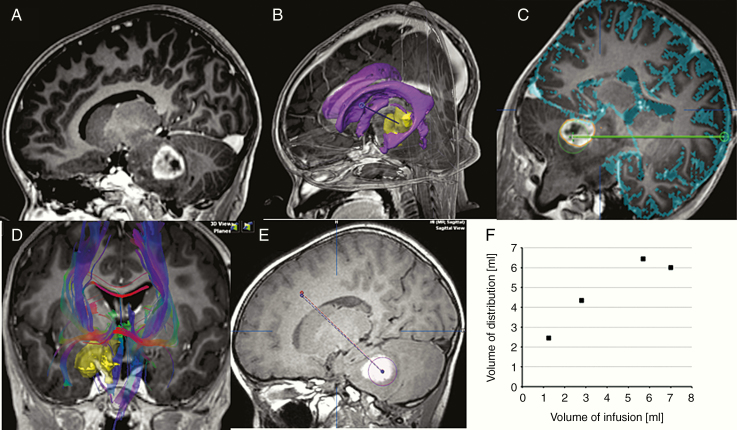
Sixteen patients, aged 3-81 years old, suffering from recurrent brainstem gliomas, including diffuse intrinsic pontine glioma patients as well as patients with recurrent gliomas that originated from non-brainstem sites, were enrolled in this trial between February 2011 and April 2016. The dose/concentration escalation trial included 3 dose/concentration groups (0.25, 0.5, and 0.75 mg/mL, all at 7 mL) to determine the safety and tolerability of CED of ACNU. Real-time monitoring of drug distribution was performed by mixing gadolinium-tetraazacyclododecanetetraacetic acid (Gd-DOTA) in the infusion solution. CED of ACNU was given in combination with oral or intravenous temozolomide chemotherapy.
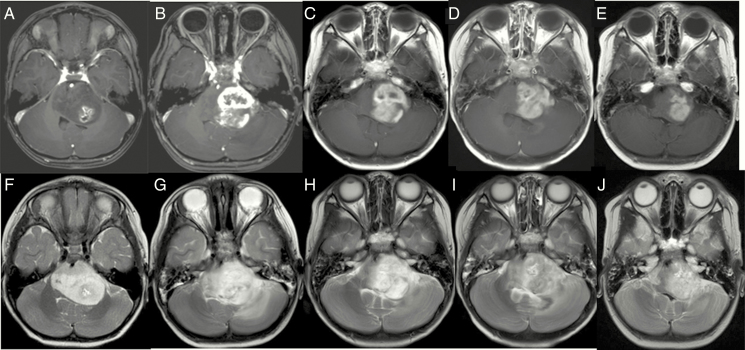
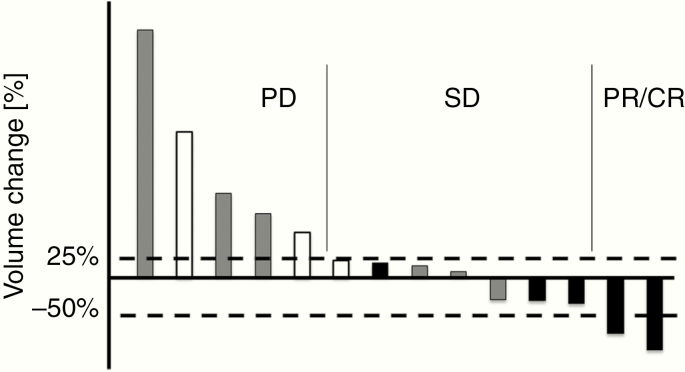
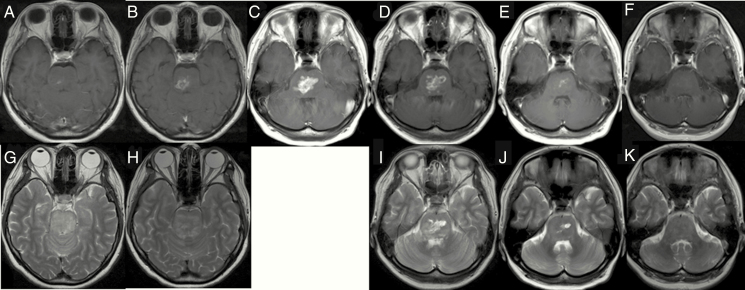
CED of ACNU demonstrated antitumor activity, as assessed by radiographic changes and prolonged overall survival. The recommended dosage was 0.75 mg/mL. Drug-associated toxicity was minimal.
Intracerebral CED of ACNU under real-time monitoring of drug distribution, in combination with systemic temozolomide, was well tolerated among patients with recurrent brainstem gliomas. The safety and efficacy observed suggest the clinical benefits of this strategy against this devastating disease. Based on this phase I study, further clinical development of ACNU is warranted.
脑干胶质瘤患者的治疗选择非常有限,因为手术不适用于脑干原发性肿瘤,且化疗通常未能显示出其疗效。脑内对流增强递送(CED)是一种向脑肿瘤患者施用化疗药物的新方法。我们展示了盐酸尼莫司汀(ACNU)的CED I期试验结果,该试验旨在确定复发性脑干胶质瘤患者的ACNU最大耐受浓度。
2011年2月至2016年4月期间,16名年龄在3至81岁之间的复发性脑干胶质瘤患者被纳入该试验,其中包括弥漫性脑桥内胶质瘤患者以及起源于非脑干部位的复发性胶质瘤患者。剂量/浓度递增试验包括3个剂量/浓度组(0.25、0.5和0.75mg/mL,均为7mL),以确定ACNU的CED安全性和耐受性。通过在输注溶液中混合钆-四氮杂环十二烷四乙酸(Gd-DOTA)对药物分布进行实时监测。ACNU的CED与口服或静脉注射替莫唑胺化疗联合使用。
通过影像学变化和总体生存期延长评估,ACNU的CED显示出抗肿瘤活性。推荐剂量为0.75mg/mL。药物相关毒性极小。
在药物分布实时监测下,ACNU的脑内CED与全身替莫唑胺联合使用,在复发性脑干胶质瘤患者中耐受性良好。观察到的安全性和有效性表明该策略对这种毁灭性疾病具有临床益处。基于这项I期研究,ACNU有必要进一步开展临床研究。