Department of Psychiatry, Université de Montreal, CHU Ste Justine Hospital, CHU Ste-Justine, Montreal, Canada.
Department of Psychiatry, Yale University School of Medicine, New Haven, Connecticut, USA.
Hum Brain Mapp. 2022 Jan;43(1):399-413. doi: 10.1002/hbm.25114. Epub 2020 Jul 9.
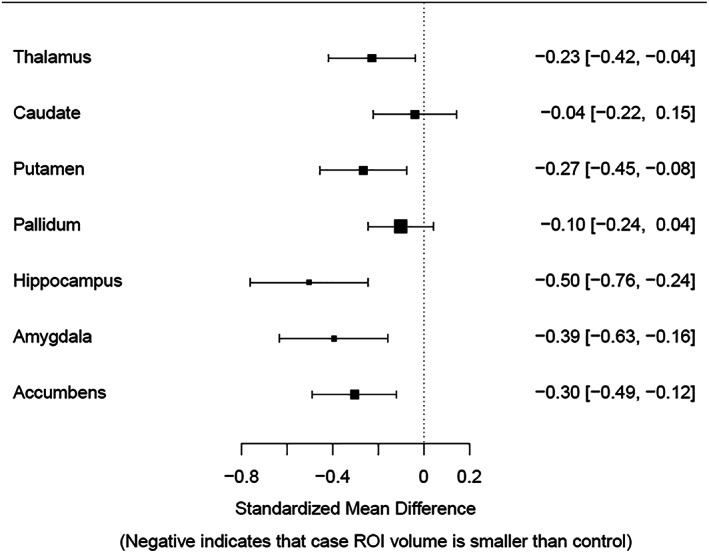
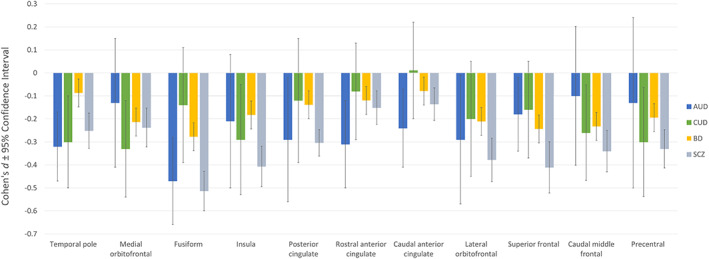
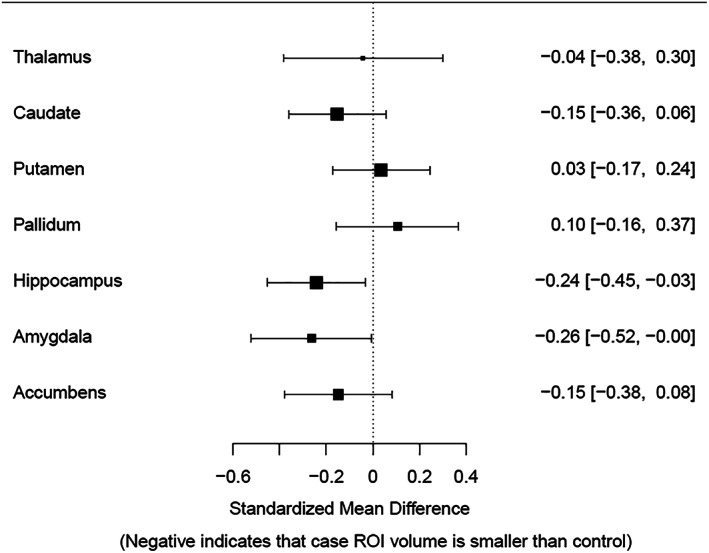
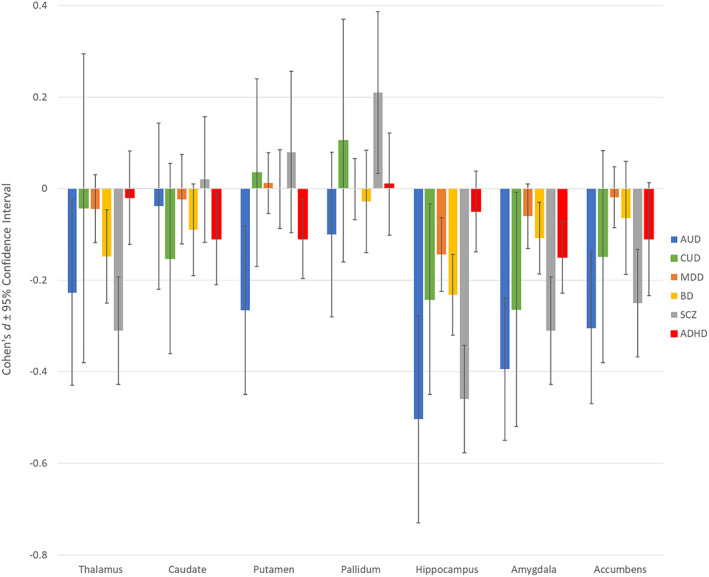
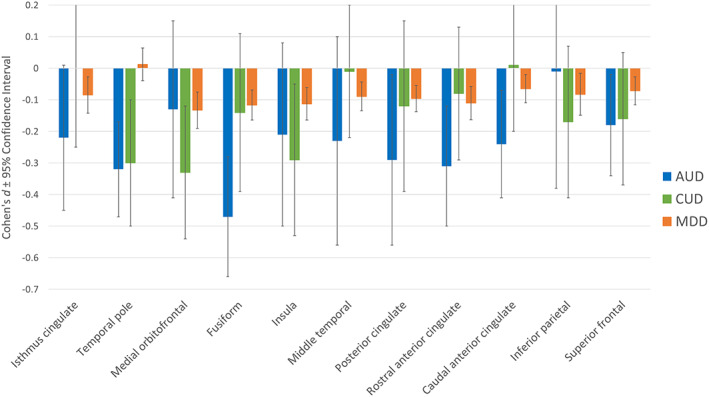
Alcohol use disorder (AUD) and cannabis use disorder (CUD) are associated with brain alterations particularly involving fronto-cerebellar and meso-cortico-limbic circuitry. However, such abnormalities have additionally been reported in other psychiatric conditions, and until recently there has been few large-scale investigations to compare such findings. The current study uses the Enhancing Neuroimaging Genetics through Meta-Analysis (ENIGMA) consortium method of standardising structural brain measures to quantify case-control differences and to compare brain-correlates of substance use disorders with those published in relation to other psychiatric disorders. Using the ENIGMA protocols, we report effect sizes derived from a meta-analysis of alcohol (seven studies, N = 798, 54% are cases) and cannabis (seven studies, N = 447, 45% are cases) dependent cases and age- and sex-matched controls. We conduct linear analyses using harmonised methods to process and parcellate brain data identical to those reported in the literature for ENIGMA case-control studies of major depression disorder (MDD), schizophrenia (SCZ) and bipolar disorder so that effect sizes are optimally comparable across disorders. R elationships between substance use disorder diagnosis and subcortical grey matter volumes and cortical thickness were assessed with intracranial volume, age and sex as co-variates . After correcting for multiple comparisons, AUD case-control meta-analysis of subcortical regions indicated significant differences in the thalamus, hippocampus, amygdala and accumbens, with effect sizes (0.23) generally equivalent to, or larger than |0.23| those previously reported for other psychiatric disorders (except for the pallidum and putamen). On measures of cortical thickness, AUD was associated with significant differences bilaterally in the fusiform gyrus, inferior temporal gyrus, temporal pole, superior frontal gyrus, and rostral and caudal anterior cingulate gyri. Meta-analysis of CUD case-control studies indicated reliable reductions in amygdala, accumbens and hippocampus volumes, with the former effect size comparable to, and the latter effect size around half of that reported for alcohol and SCZ. CUD was associated with lower cortical thickness in the frontal regions, particularly the medial orbitofrontal region, but this effect was not significant after correcting for multiple testing. This study allowed for an unbiased cross-disorder comparison of brain correlates of substance use disorders and showed alcohol-related brain anomalies equivalent in effect size to that found in SCZ in several subcortical and cortical regions and significantly greater alterations than those found in MDD in several subcortical and cortical regions. Although modest, CUD results overlapped with findings reported for AUD and other psychiatric conditions, but appear to be most robustly related to reduce thickness of the medial orbitofrontal cortex.
酒精使用障碍(AUD)和大麻使用障碍(CUD)与大脑改变有关,特别是涉及额-小脑和中脑-边缘回路。然而,这些异常也在其他精神疾病中得到了报道,直到最近,很少有大规模的研究来比较这些发现。本研究使用增强神经影像学遗传学通过荟萃分析(ENIGMA)联盟的方法对结构脑测量进行标准化,以量化病例对照差异,并比较物质使用障碍的脑相关性与与其他精神障碍相关的脑相关性。使用 ENIGMA 方案,我们报告了来自酒精(七项研究,N=798,54%为病例)和大麻(七项研究,N=447,45%为病例)依赖病例的荟萃分析的效应大小,并与年龄和性别匹配的对照组进行比较。我们使用协调的方法进行线性分析,以处理和分割与 ENIGMA 病例对照研究重度抑郁症(MDD)、精神分裂症(SCZ)和双相情感障碍相同的大脑数据,以便跨障碍最佳比较效应大小。使用颅内体积、年龄和性别作为协变量,评估物质使用障碍诊断与皮质下灰质体积和皮质厚度之间的关系。在进行多次比较校正后,AUD 病例对照荟萃分析的皮质下区域表明,在丘脑、海马体、杏仁核和伏隔核中存在显著差异,效应大小(0.23)通常与以前报告的其他精神障碍(除了苍白球和壳核)的效应大小相等或更大。在皮质厚度测量方面,AUD 与双侧梭状回、颞下回、颞极、额上回以及额前扣带回的腹侧和背侧前部的显著差异相关。CUD 病例对照研究的荟萃分析表明,杏仁核、伏隔核和海马体体积可靠减小,前者的效应大小与酒精和 SCZ 相似,后者的效应大小约为前者的一半。CUD 与额叶区域,特别是内侧眶额区域的皮质厚度降低有关,但在进行多次测试校正后,这种效应并不显著。本研究允许对物质使用障碍的脑相关性进行无偏跨障碍比较,并显示与酒精相关的脑异常在多个皮质下和皮质区域的效应大小与 SCZ 相当,在多个皮质下和皮质区域的异常明显大于 MDD。虽然适度,但 CUD 的结果与 AUD 和其他精神疾病的发现重叠,但似乎与内侧眶额皮质厚度的减少最密切相关。