Zhao Qing, Zhang Yun, Qin Qianqing, Luo Bin
The State Key Laboratory of Information Engineering in Surveying, Mapping and Remote Sensing, Wuhan University, Wuhan 430072, China.
Sensors (Basel). 2020 Jul 7;20(13):3806. doi: 10.3390/s20133806.
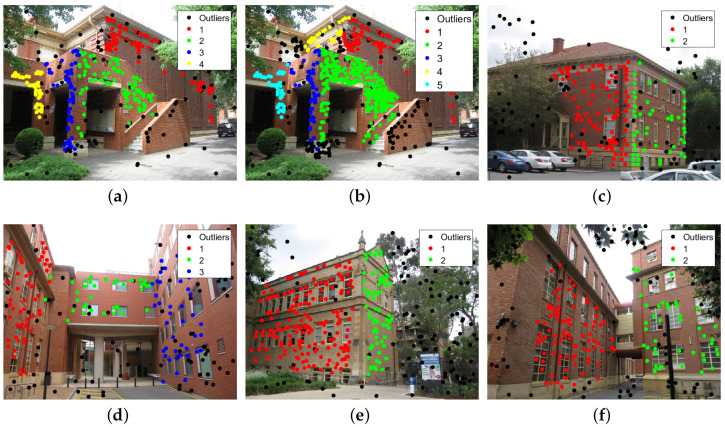
In this paper, quantized residual preference is proposed to represent the hypotheses and the points for model selection and inlier segmentation in multi-structure geometric model fitting. First, a quantized residual preference is proposed to represent the hypotheses. Through a weighted similarity measurement and linkage clustering, similar hypotheses are put into one cluster, and hypotheses with good quality are selected from the clusters as the model selection results. After this, the quantized residual preference is also used to present the data points, and through the linkage clustering, the inliers belonging to the same model can be separated from the outliers. To exclude outliers as many as possible, an iterative sampling and clustering process is performed within the clustering process until the clusters are stable. The experiments undertake indicate that the proposed method performs even better on real data than the some state-of-the-art methods.
本文提出了量化残差偏好,用于多结构几何模型拟合中的假设表示以及模型选择和内点分割。首先,提出量化残差偏好来表示假设。通过加权相似性度量和层次聚类,将相似的假设归为一类,并从这些类中选择质量好的假设作为模型选择结果。在此之后,量化残差偏好还用于表示数据点,并通过层次聚类将属于同一模型的内点与离群点分开。为了尽可能多地排除离群点,在聚类过程中执行迭代采样和聚类过程,直到聚类稳定。进行的实验表明,所提出的方法在真实数据上的表现优于一些现有最先进的方法。