Lasco Gideon, Mendoza Jhaki, Renedo Alicia, Seguin Maureen L, Palafox Benjamin, Palileo-Villanueva Lia M, Amit Arianna Maever L, Dans Antonio L, Balabanova Dina, McKee Martin
Department of Anthropology, University of the Philippines Diliman, Quezon City, Metro Manila, Philippines
Development Studies Program, Ateneo de Manila University, Quezon City, Philippines.
BMJ Glob Health. 2020 Jul;5(7). doi: 10.1136/bmjgh-2020-002295.
Understanding explanatory models is important for hypertension, a leading risk factor for cardiovascular disease and stroke. This article aims to determine what adult patients with hypertension in the Philippines attribute their condition to, how these views might be explained and what the implications are for hypertension management.
This is a qualitative study drawing on 71 semistructured interviews (40 initial and 31 follow-up) and four focus group discussions with patients diagnosed with hypertension. The setting was urban and rural low-income communities in the Philippines.
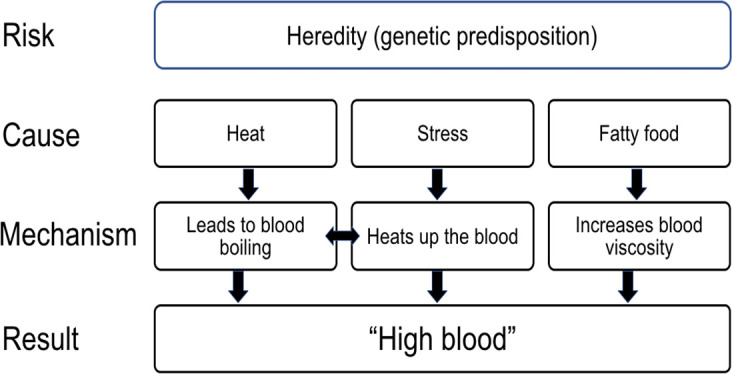
Four prominent perceived causes were identified-genetics, heat, stress and diet-for what patients refer to as 'high blood'. We propose a 'folk physiology' that rests on local understandings of blood and blood flow, draws from broader cultural notions of illness causation and accounts for a dynamic, non-chronic view of hypertension that in turn informs the health behaviours of those affected.
By understanding that hypertension is frequently seen not as a chronic constant condition but rather as an episodic one triggered by external influences, although in those genetically predisposed to it, it may be possible to address patient's beliefs and thus adherence to treatment.
了解解释模型对于高血压(心血管疾病和中风的主要危险因素)至关重要。本文旨在确定菲律宾成年高血压患者将其病情归因于什么,这些观点如何解释以及对高血压管理有何影响。
这是一项定性研究,采用了71次半结构化访谈(40次初次访谈和31次后续访谈)以及与确诊为高血压的患者进行的四次焦点小组讨论。研究地点是菲律宾的城乡低收入社区。
确定了四个主要的感知病因——遗传、炎热、压力和饮食,患者将其称为“高血压”。我们提出一种“民间生理学”,它基于当地对血液和血流的理解,借鉴了更广泛的疾病因果文化观念,并解释了一种动态的、非慢性的高血压观点,这反过来又影响了患者的健康行为。
认识到高血压通常不被视为一种慢性固定疾病,而是一种由外部影响引发的发作性疾病,尽管对于那些有遗传易感性的人来说,有可能解决患者的信念问题,从而提高治疗依从性。