Department of Biochemistry and Molecular Genetics, University of Virginia, Charlottesville, VA, 22908, USA.
Archaeal Virology Unit, Department of Microbiology Institut Pasteur, 25 rue du Dr. Roux, Paris, 75015, France.
Nat Commun. 2020 Jul 9;11(1):3424. doi: 10.1038/s41467-020-17268-4.
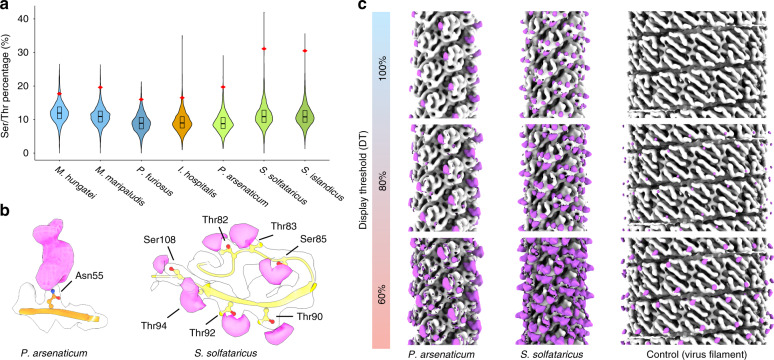
We have determined the cryo-electron microscopic (cryo-EM) structures of two archaeal type IV pili (T4P), from Pyrobaculum arsenaticum and Saccharolobus solfataricus, at 3.8 Å and 3.4 Å resolution, respectively. This triples the number of high resolution archaeal T4P structures, and allows us to pinpoint the evolutionary divergence of bacterial T4P, archaeal T4P and archaeal flagellar filaments. We suggest that extensive glycosylation previously observed in T4P of Sulfolobus islandicus is a response to an acidic environment, as at even higher temperatures in a neutral environment much less glycosylation is present for Pyrobaculum than for Sulfolobus and Saccharolobus pili. Consequently, the Pyrobaculum filaments do not display the remarkable stability of the Sulfolobus filaments in vitro. We identify the Saccharolobus and Pyrobaculum T4P as host receptors recognized by rudivirus SSRV1 and tristromavirus PFV2, respectively. Our results illuminate the evolutionary relationships among bacterial and archaeal T4P filaments and provide insights into archaeal virus-host interactions.
我们分别解析了来自硫矿硫化叶菌和热球菌 Pyrobaculum arsenaticum 的两种古菌 IV 型菌毛(T4P)的冷冻电镜结构,分辨率分别为 3.8Å 和 3.4Å。这将高分辨率古菌 T4P 结构的数量增加了两倍,并使我们能够确定细菌 T4P、古菌 T4P 和古菌鞭毛丝的进化分歧。我们认为,先前在 Sulfolobus islandicus 的 T4P 中观察到的广泛糖基化是对酸性环境的一种反应,因为在中性环境中,即使温度更高,Pyrobaculum 的糖基化程度也远低于 Sulfolobus 和 Saccharolobus 的菌毛。因此,与 Sulfolobus 菌毛相比,Pyrobaculum 菌毛在体外并不表现出显著的稳定性。我们鉴定出 Saccharolobus 和 Pyrobaculum 的 T4P 分别是 rudivirus SSRV1 和 tristromavirus PFV2 识别的宿主受体。我们的研究结果阐明了细菌和古菌 T4P 丝之间的进化关系,并为古菌病毒-宿主相互作用提供了新的见解。