Patehebieke Yeersen
School of Chemistry and Chemical Engineering, Nanjing University, Nanjing, 210023, China.
Beilstein J Org Chem. 2020 Jun 23;16:1418-1435. doi: 10.3762/bjoc.16.118. eCollection 2020.
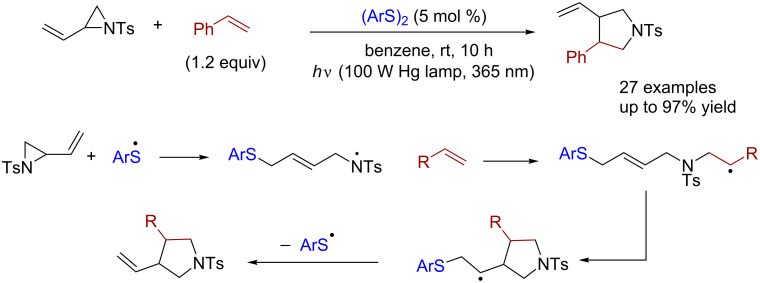
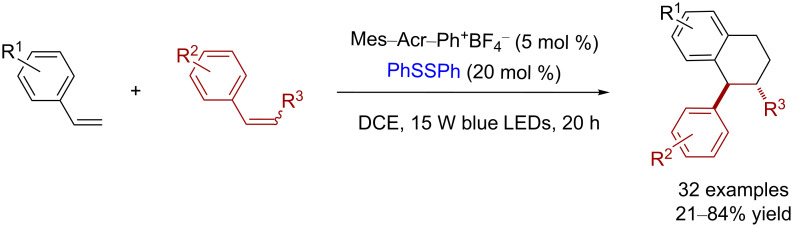
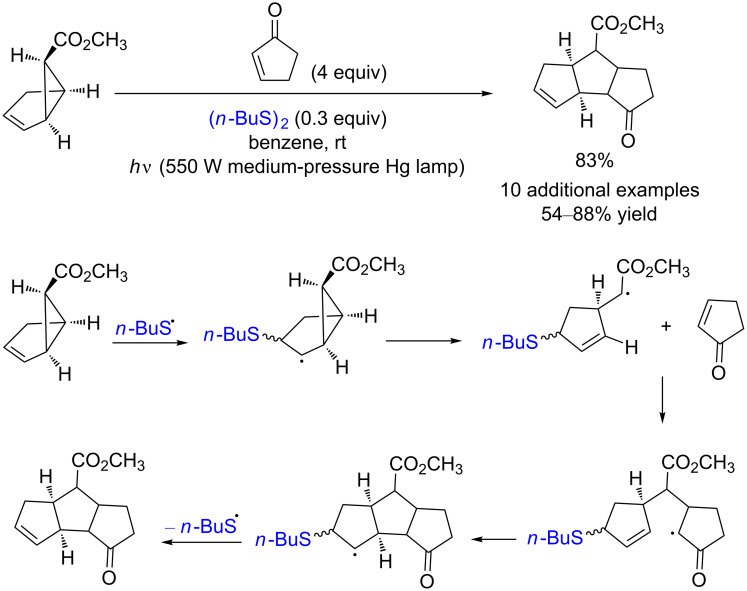
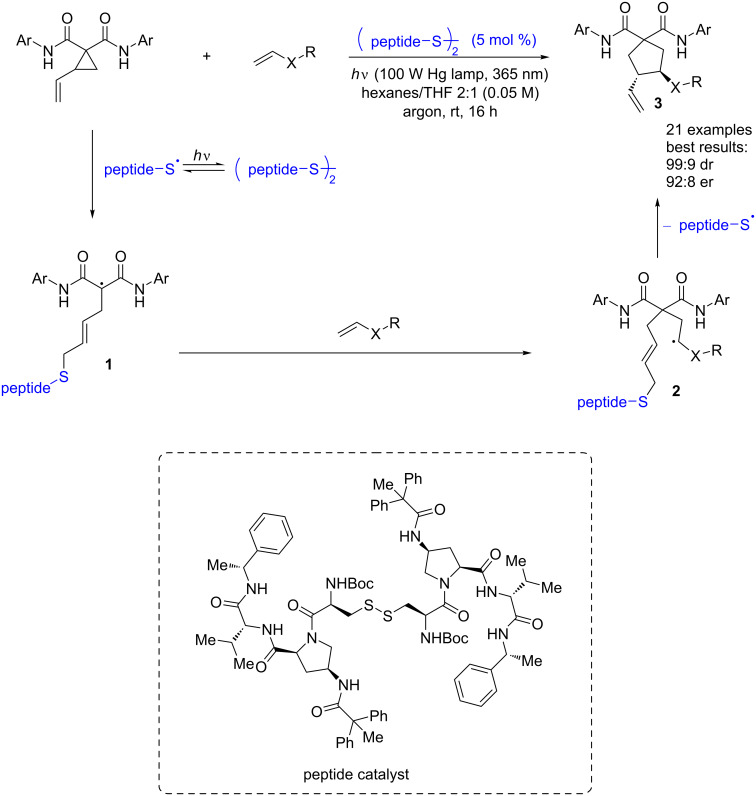
Disulfides are versatile catalysts. They can be photocatalysts, hydrogen atom transfer (HAT) catalysts, cocatalysts, or initiators in photocatalytic reactions. Under photoirradiation, organic disulfides can be easily cleaved into free thiyl radicals (RS) and can reversibly add to unsaturated multiple bonds to catalyze a variety of functionalization reactions under mild conditions. In photoredox catalysis reactions, an excellent electron transfer ability and excellent radical properties also made these thiyl radicals powerful HAT catalysts. They have increasingly been proven useful in various types of organic photoreactions, such as cyclizations, anti-Markovnikov additions, aromatic olefin carbonylations, isomerizations, etc. They are a class of green, economic, mild, and chemoselective radical catalysts that deserve more attention. The present review highlights the recent progress in the field of disulfide-catalyzed and -cocatalyzed photocatalytic reactions for different reaction types.
二硫化物是用途广泛的催化剂。它们可以是光催化剂、氢原子转移(HAT)催化剂、助催化剂或光催化反应中的引发剂。在光照射下,有机二硫化物可轻易裂解为游离硫自由基(RS),并能可逆地加成到不饱和多重键上,在温和条件下催化各种官能化反应。在光氧化还原催化反应中,出色的电子转移能力和优异的自由基性质也使这些硫自由基成为强大的氢原子转移催化剂。它们已越来越多地被证明在各类有机光反应中有用,如环化反应、反马氏加成反应、芳族烯烃羰基化反应、异构化反应等。它们是一类绿色、经济、温和且具有化学选择性的自由基催化剂,值得更多关注。本综述重点介绍了二硫化物催化和共催化的光催化反应在不同反应类型领域的最新进展。