Roderburg Christoph, Özdirik Burcin, Wree Alexander, Demir Münevver, Tacke Frank
Department of Hepatology & Gastroenterology, Charité - University Medicine Berlin, Campus Virchow Klinikum & Charité Campus Mitte, Berlin, 13353, Germany.
Hepat Oncol. 2020 May 28;7(2):HEP20. doi: 10.2217/hep-2020-0004.
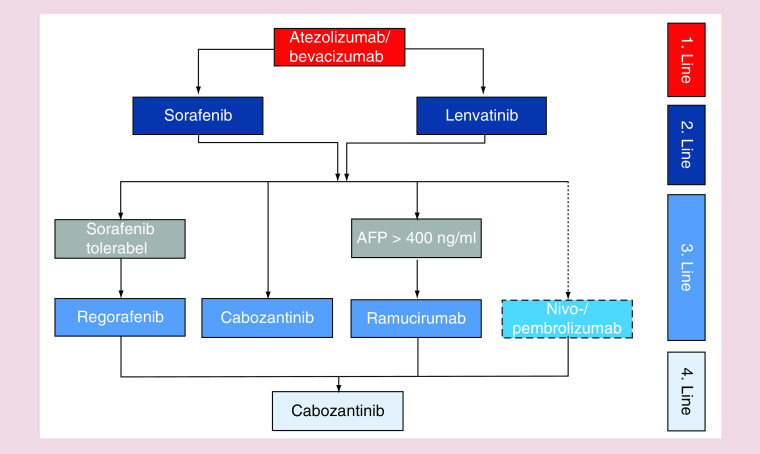
For almost a decade, systemic therapy of advanced hepatocellular carcinoma (HCC) was limited to the tyrosine kinase inhibitor (TKI) sorafenib. Different agents including checkpoint inhibitors, TKIs and anti-VEGFR antibodies demonstrated efficacy in treatment. For the first time, the combination of atezolizumab and bevacizumab, a first-line treatment that is superior to the current standard was identified, potentially changing the way we treat HCC. In this review, we summarize current data on systemic treatment of patients with advanced HCC, focusing on combination therapies comprising immune checkpoint inhibitors, TKIs and locoregional therapies. We elucidate findings from recent trials and discuss such challenges as the lack of predictive biomarkers for identification of subgroups that will benefit from novel treatment strategies.
近十年来,晚期肝细胞癌(HCC)的系统治疗仅限于酪氨酸激酶抑制剂(TKI)索拉非尼。包括检查点抑制剂、酪氨酸激酶抑制剂和抗血管内皮生长因子受体(VEGFR)抗体在内的不同药物在治疗中均显示出疗效。首次发现阿替利珠单抗和贝伐单抗联合使用作为一线治疗优于当前标准,这可能会改变我们治疗肝癌的方式。在本综述中,我们总结了晚期肝癌患者系统治疗的当前数据,重点关注包括免疫检查点抑制剂、酪氨酸激酶抑制剂和局部区域治疗在内的联合疗法。我们阐述了近期试验的结果,并讨论了诸如缺乏预测生物标志物以识别将从新治疗策略中获益的亚组等挑战。