Bychkov Maxim, Shulepko Mikhail, Osmakov Dmitry, Andreev Yaroslav, Sudarikova Anastasia, Vasileva Valeria, Pavlyukov Marat S, Latyshev Yaroslav A, Potapov Alexander A, Kirpichnikov Mikhail, Shenkarev Zakhar O, Lyukmanova Ekaterina
Shemyakin-Ovchinnikov Institute of Bioorganic Chemistry, Russian Academy of Sciences, 119997 Moscow, Russia.
Institute of Molecular Medicine, Sechenov First Moscow State Medical University, 119991 Moscow, Russia.
Cancers (Basel). 2020 Jul 8;12(7):1837. doi: 10.3390/cancers12071837.
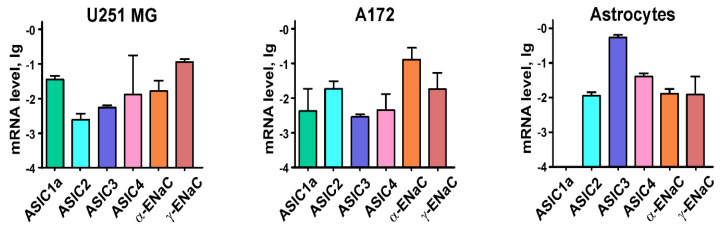
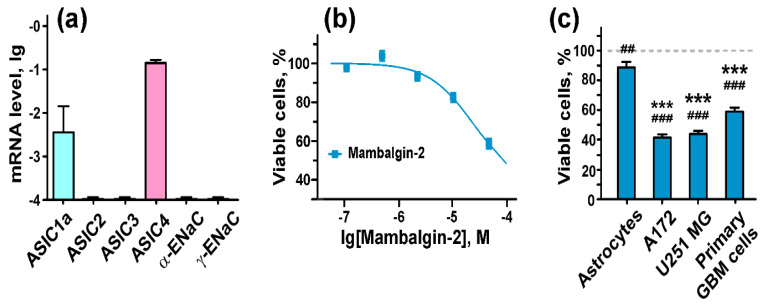
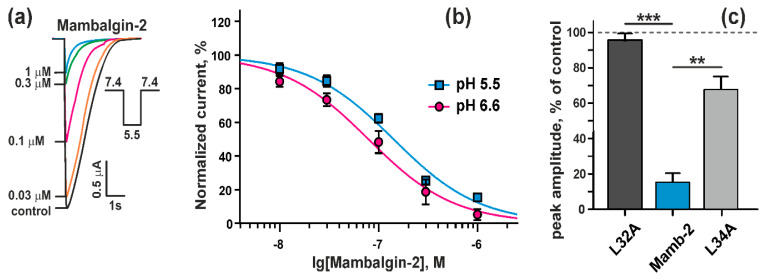
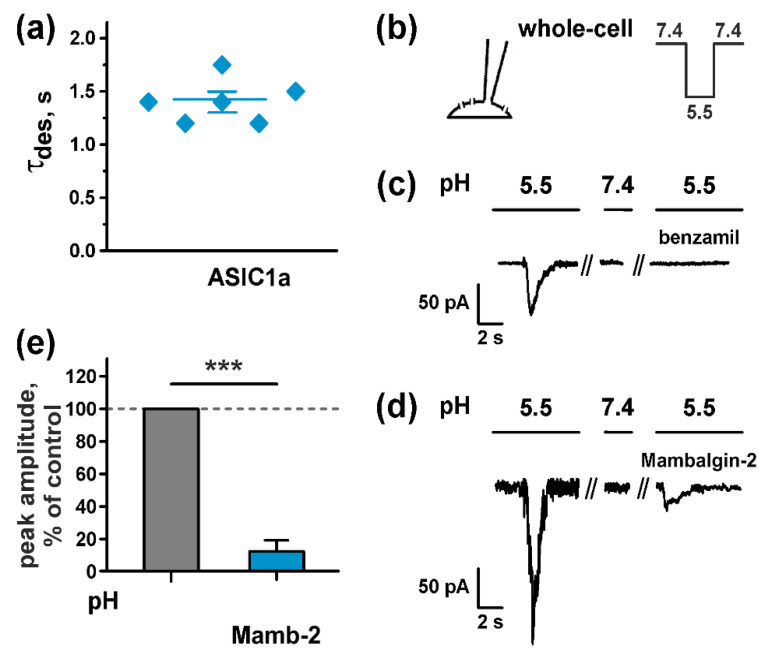
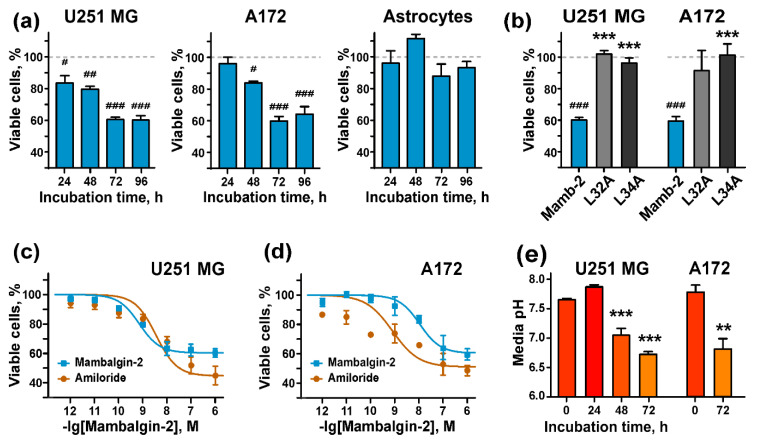
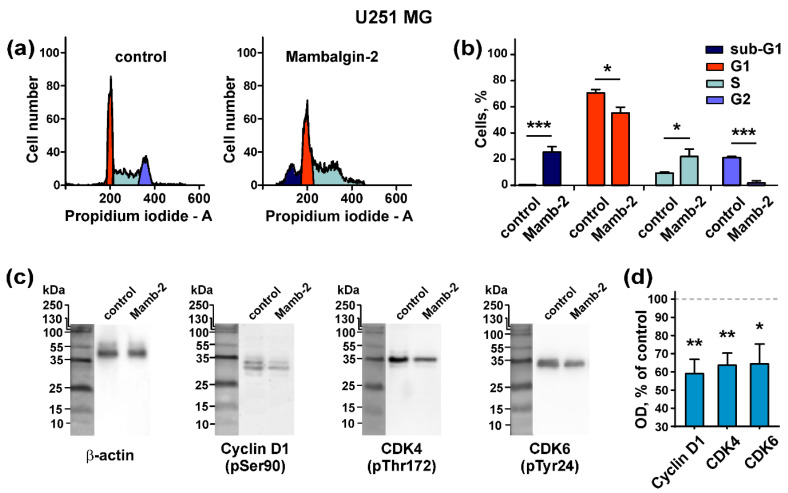
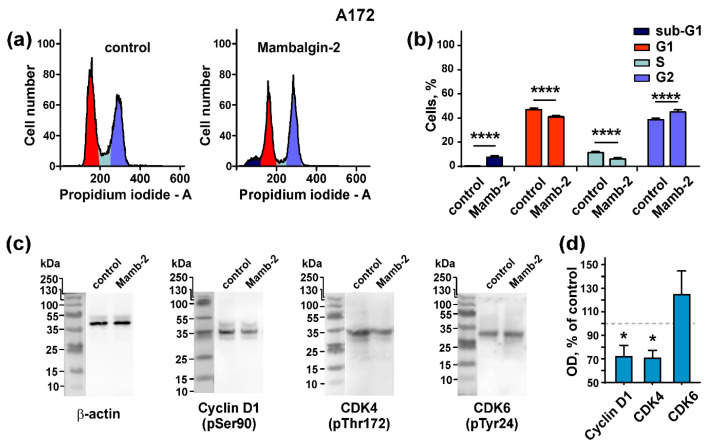
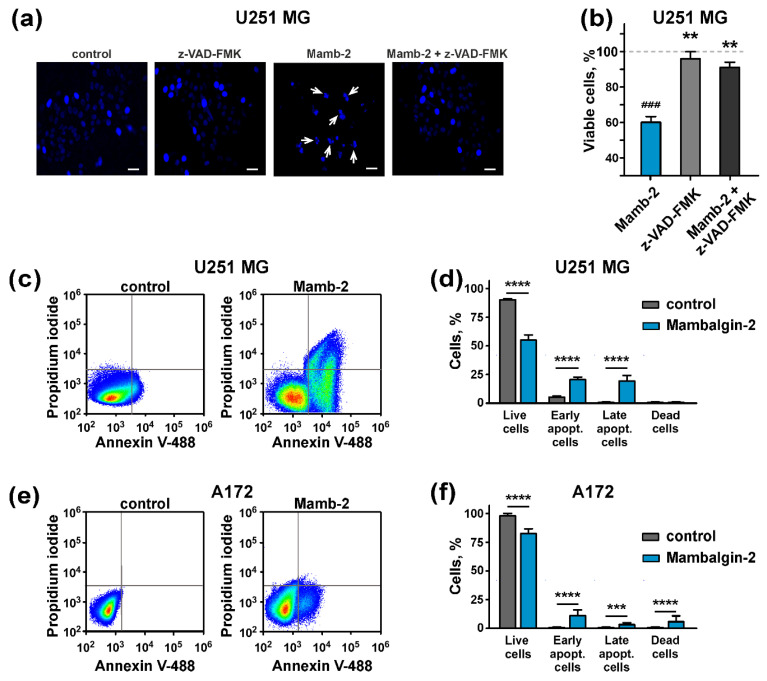
Gliomas are fast growing and highly invasive brain tumors, characterized by tumor microenvironment acidification that drives glioma cell growth and migration. Channels containing Acid-sensing Ion Channel 1a subunit (ASIC1a) mediate amiloride-sensitive cation influx in late stage glioma cells, but not in normal astrocytes. Thus, selective targeting of ASIC1a can be a perspective strategy for glioma treatment. Here, ASIC1a expression in U251 MG and A172 glioma cells, but not in normal astrocytes, was demonstrated. Recombinant analog of mambalgin-2 from black mamba inhibited amiloride-sensitive currents at ASIC1a both in oocytes and in U251 MG cells, while its mutants with impaired activity towards this channel did not. Mambalgin-2 inhibited U251 MG and A172 glioma cells growth with EC in the nanomolar range without affecting the proliferation of normal astrocytes. Notably, mambalgin-2 mutants did not affect glioma cell proliferation, pointing on ASIC1a as the main molecular target of mambalgin-2 in U251 MG and A172 cells. Mambalgin-2 induced a cell cycle arrest, inhibited Cyclin D1 and cyclin-dependent kinases (CDK) phosphorylation and caused apoptosis in U251 MG and A172 cells. Moreover, mambalgin-2 inhibited the growth of low-passage primary cells from a patient with glioblastoma. Altogether, our data point to mambalgin-2 as a useful hit for the development of new drugs for glioma treatment.
神经胶质瘤是快速生长且具有高度侵袭性的脑肿瘤,其特征在于肿瘤微环境酸化,这种酸化会驱动神经胶质瘤细胞的生长和迁移。含有酸敏感离子通道1a亚基(ASIC1a)的通道介导晚期神经胶质瘤细胞中amiloride敏感的阳离子内流,但在正常星形胶质细胞中则不然。因此,选择性靶向ASIC1a可能是一种治疗神经胶质瘤的潜在策略。在这里,我们证明了ASIC1a在U251 MG和A172神经胶质瘤细胞中表达,但在正常星形胶质细胞中不表达。来自黑曼巴蛇的曼巴肽-2重组类似物在卵母细胞和U251 MG细胞中均抑制了ASIC1a上amiloride敏感的电流,而对该通道活性受损的其突变体则没有。曼巴肽-2在纳摩尔范围内抑制U251 MG和A172神经胶质瘤细胞的生长,而不影响正常星形胶质细胞的增殖。值得注意的是,曼巴肽-2突变体不影响神经胶质瘤细胞的增殖,这表明ASIC1a是曼巴肽-2在U251 MG和A172细胞中的主要分子靶点。曼巴肽-2诱导细胞周期停滞,抑制细胞周期蛋白D1和细胞周期蛋白依赖性激酶(CDK)磷酸化,并导致U251 MG和A172细胞凋亡。此外,曼巴肽-2抑制了胶质母细胞瘤患者低传代原代细胞的生长。总之,我们的数据表明曼巴肽-2是开发神经胶质瘤治疗新药的一个有用的起始点。