Department of Ultrasound, Shengjing Hospital of China Medical University, 36 Sanhao St, Heping District, Shenyang, 110001, Liaoning Province, China.
Cardiovasc Ultrasound. 2020 Jul 10;18(1):26. doi: 10.1186/s12947-020-00209-y.
Duchenne muscular dystrophy (DMD) is the most common form of inherited muscle disease in children. The incidence of cardiomyopathy induced by DMD increases with age. Left ventricular ejection fraction usually fails to reflect the subclinical left ventricular dysfunction. Several studies have assessed this dysfunction using myocardial strain measured by speckle-tracking echocardiography (STE). However, the results were inconsistent and incomplete.
Several databases were searched from their inception to February 5, 2020. The summarized weighted mean difference (WMD) with 95% confidence intervals (CIs) were estimated for myocardial strain between DMD and healthy controls and a meta-analysis was conducted. Trial sequential analysis estimated whether the resulting evidence was sufficient.
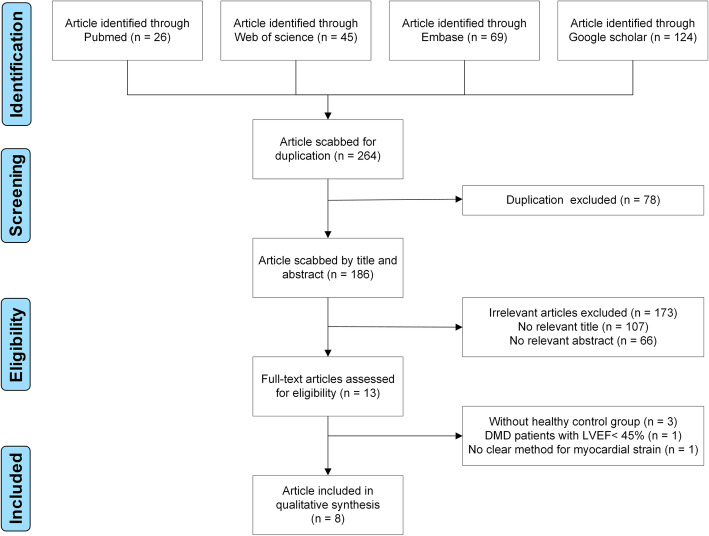
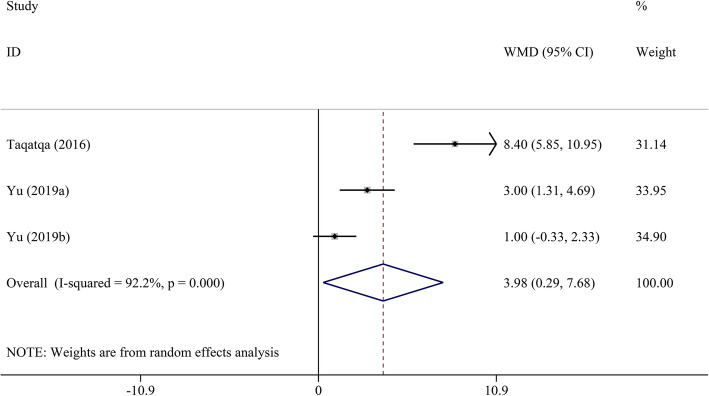
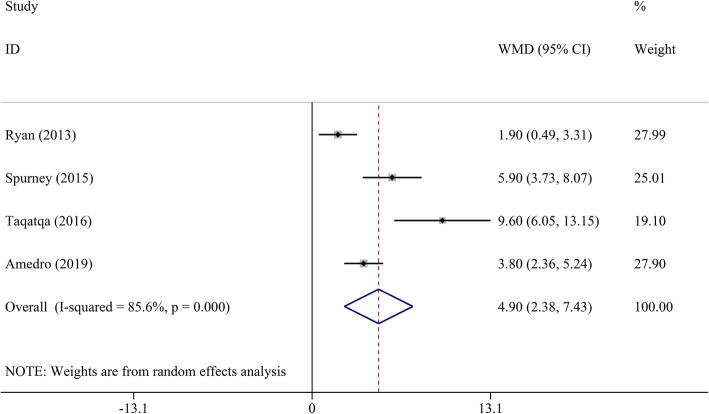
Eight studies with a total of 269 DMD children and 299 healthy participants were included. STE revealed that global longitudinal strain (GLS), global circumferential strain, average longitudinal strain (measured by two-dimensional STE at the apical four-chamber view), and average circumferential strain (measured by two-dimensional STE at the papillary muscle short-axis level) decreased (WMD = 4.17, 95% CI: 3.03-5.32; WMD = 3.98, 95% CI: 0.29-7.68; WMD = 4.18, 95% CI: 2.75-5.62; and WMD = 4.90, 95% CI: 2.38-7.43, respectively; all P < 0.05) compared with the controls and global radial strain was unchanged in the DMD group (WMD = - 4.33, 95% CI: - 9.53-0.87, P = 0.103). Trial sequential analysis indicated that available GLS samples were sufficient and confirmed that adequate evidence was accumulated. The credibility of other myocardial strains was questioned due to insufficiently involved studies.
GLS can be useful for early detection of left ventricle myocardial dysfunction in children with DMD.
杜氏肌营养不良症(DMD)是儿童中最常见的遗传性肌肉疾病。由 DMD 引起的心肌病的发病率随年龄增长而增加。左心室射血分数通常无法反映亚临床左心室功能障碍。几项研究已经使用斑点追踪超声心动图(STE)测量的心肌应变评估了这种功能障碍。然而,结果不一致且不完整。
从成立到 2020 年 2 月 5 日,我们在多个数据库中进行了搜索。对 DMD 患儿与健康对照组之间的心肌应变进行汇总加权均数差(WMD)及其 95%置信区间(CI)的估计,并进行荟萃分析。试验序贯分析估计得出的证据是否充分。
纳入了 8 项研究,共计 269 名 DMD 患儿和 299 名健康参与者。STE 显示,整体纵向应变(GLS)、整体周向应变、平均纵向应变(通过心尖四腔观二维 STE 测量)和平均周向应变(通过乳头肌短轴水平二维 STE 测量)均降低(WMD=4.17,95%CI:3.03-5.32;WMD=3.98,95%CI:0.29-7.68;WMD=4.18,95%CI:2.75-5.62;WMD=4.90,95%CI:2.38-7.43,均 P<0.05),与对照组相比,而 DMD 组的整体径向应变无变化(WMD=-4.33,95%CI:-9.53-0.87,P=0.103)。试验序贯分析表明,现有的 GLS 样本足够充分,并证实了足够的证据积累。由于参与研究不足,其他心肌应变的可信度受到质疑。
GLS 可用于早期检测 DMD 患儿的左心室心肌功能障碍。