The Rockefeller University, 1230 York Avenue, New York, NY, 10065, USA.
J Neuroinflammation. 2020 Jul 10;17(1):207. doi: 10.1186/s12974-020-01875-5.
Clinical and animal studies show that alcohol consumption during pregnancy produces lasting behavioral disturbances in offspring, including increased alcohol drinking, which are linked to inflammation in the brain and disturbances in neurochemical systems that promote these behaviors. These include the neuropeptide, melanin-concentrating hormone (MCH), which is mostly expressed in the lateral hypothalamus (LH). Maternal ethanol administration at low-to-moderate doses, while stimulating MCH neurons without affecting apoptosis or gliogenesis, increases in LH the density of neurons expressing the inflammatory chemokine C-C motif ligand 2 (CCL2) and its receptor CCR2 and their colocalization with MCH. These neural effects associated with behavioral changes are reproduced by maternal CCL2 administration, reversed by a CCR2 antagonist, and consistently stronger in females than males. The present study investigates in the embryo the developmental origins of this CCL2/CCR2-mediated stimulatory effect of maternal ethanol exposure on MCH neurons.
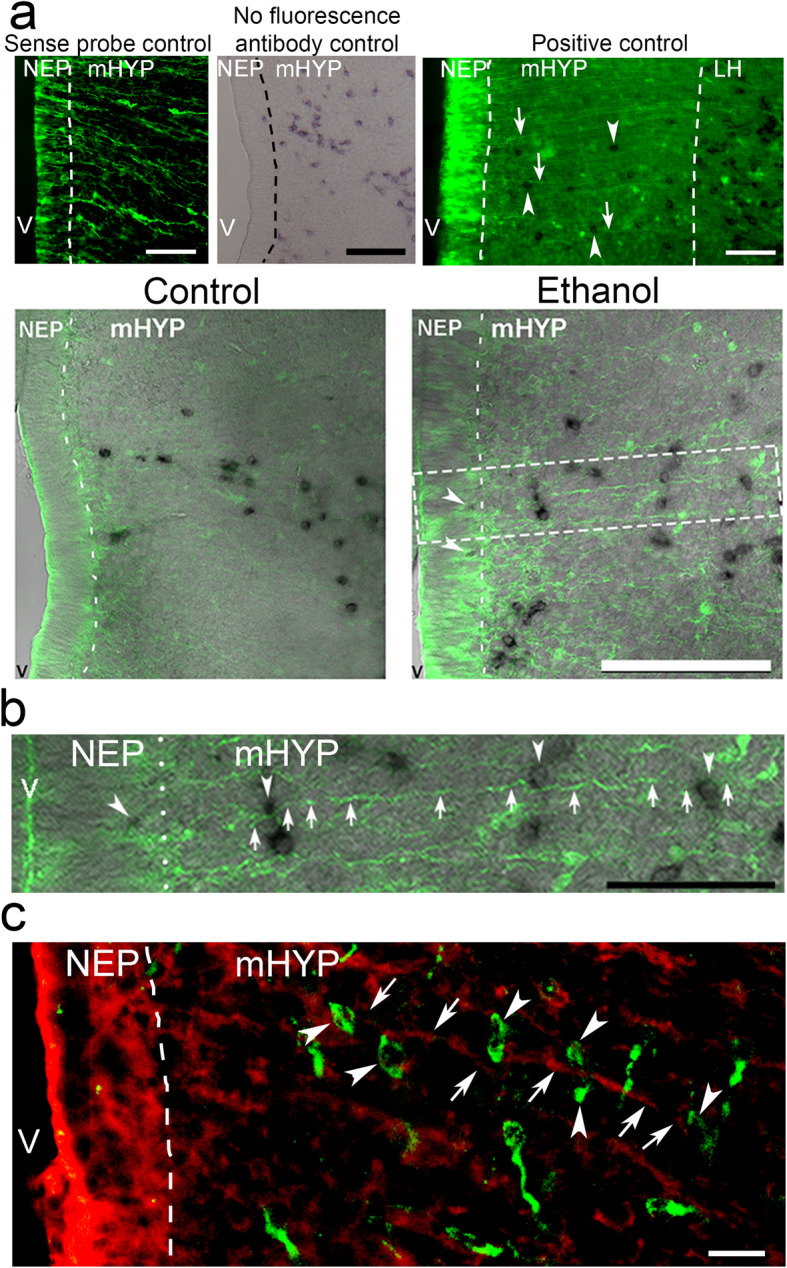
Pregnant rats from embryonic day 10 (E10) to E15 during peak neurogenesis were orally administered ethanol at a moderate dose (2 g/kg/day) or peripherally injected with CCL2 or CCR2 antagonist to test this neuroimmune system's role in ethanol's actions. Using real-time quantitative PCR, immunofluorescence histochemistry, in situ hybridization, and confocal microscopy, we examined in embryos at E19 the CCL2/CCR2 system and MCH neurons in relation to radial glia progenitor cells in the hypothalamic neuroepithelium where neurons are born and radial glia processes projecting laterally through the medial hypothalamus that provide scaffolds for neuronal migration into LH.
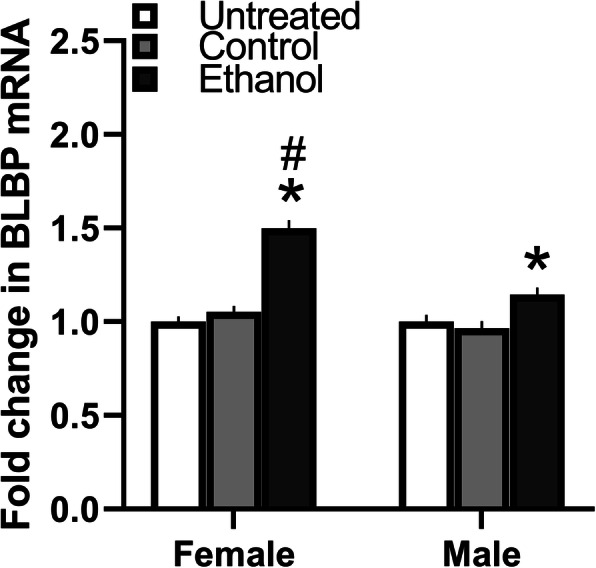
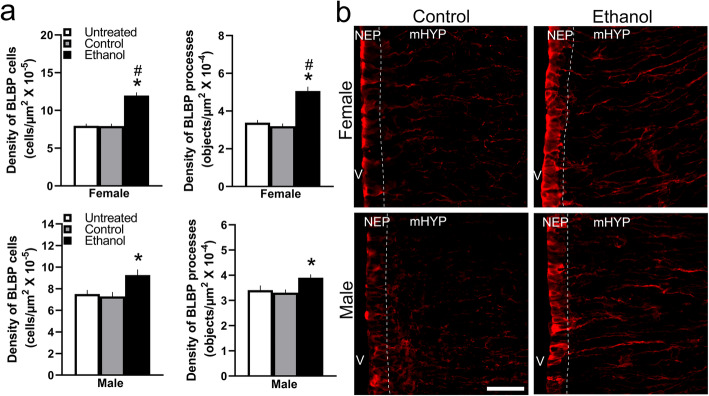
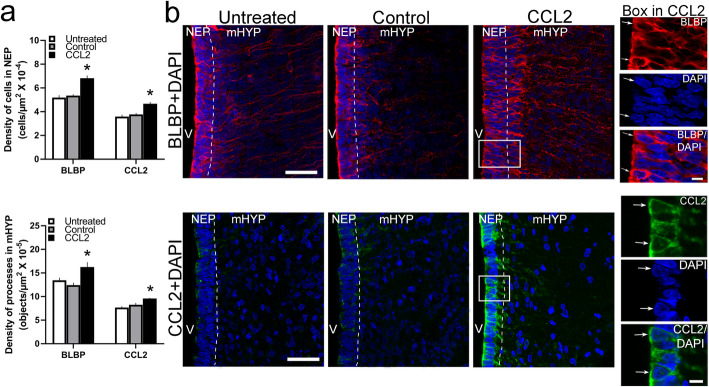
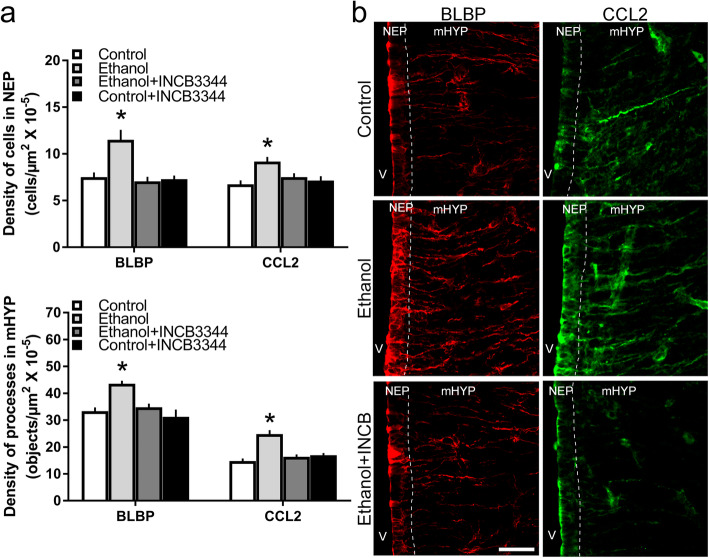
We demonstrate that maternal ethanol increases radial glia cell density and their processes while stimulating the CCL2/CCR2 system and these effects are mimicked by maternal administration of CCL2 and blocked by a CCR2 antagonist. While stimulating CCL2 colocalization with radial glia and neurons but not microglia, ethanol increases MCH neuronal number near radial glia cells and making contact along their processes projecting into LH. Further tests identify the CCL2/CCR2 system in NEP as a primary source of ethanol's sexually dimorphic actions.
These findings provide new evidence for how an inflammatory chemokine pathway functions within neuroprogenitor cells to mediate ethanol's long-lasting, stimulatory effects on peptide neurons linked to adolescent drinking behavior.
临床和动物研究表明,怀孕期间饮酒会导致后代出现持久的行为障碍,包括饮酒量增加,这与大脑炎症和促进这些行为的神经化学系统紊乱有关。其中包括神经肽黑素浓缩激素(MCH),它主要在外侧下丘脑(LH)表达。低至中等剂量的母体乙醇给药会刺激 MCH 神经元而不影响细胞凋亡或神经胶质发生,增加 LH 中表达炎症趋化因子 C-C 基序配体 2(CCL2)及其受体 CCR2 的神经元密度,并与 MCH 共定位。这些与行为变化相关的神经效应可通过母体 CCL2 给药再现,被 CCR2 拮抗剂逆转,且在雌性中比雄性更强。本研究在胚胎中探讨了母体乙醇暴露对 MCH 神经元的这种 CCL2/CCR2 介导的刺激作用的发育起源。
在神经发生高峰期(胚胎第 10 天[E10]至 E15),对怀孕大鼠进行中等剂量(2g/kg/天)的口服乙醇给药或外周注射 CCL2 或 CCR2 拮抗剂,以测试神经免疫系统在乙醇作用中的作用。使用实时定量 PCR、免疫荧光组织化学、原位杂交和共聚焦显微镜,我们在 E19 胚胎中检查了下丘脑神经上皮中与放射状胶质祖细胞相关的 CCL2/CCR2 系统和 MCH 神经元,神经元在此处产生,放射状胶质细胞过程通过内侧下丘脑侧向投射,为神经元迁移到 LH 提供支架。
我们证明母体乙醇增加了放射状胶质细胞密度及其过程,同时刺激了 CCL2/CCR2 系统,这些作用可被母体 CCL2 给药模拟,并被 CCR2 拮抗剂阻断。虽然刺激 CCL2 与放射状胶质细胞和神经元共定位,但不与小胶质细胞共定位,但乙醇增加了靠近放射状胶质细胞的 MCH 神经元数量,并沿着其投射到 LH 的过程进行接触。进一步的测试确定 NEP 中的 CCL2/CCR2 系统是乙醇性别二态作用的主要来源。
这些发现为炎症趋化因子途径在神经祖细胞内发挥作用,介导与青少年饮酒行为相关的肽神经元的持久刺激作用提供了新的证据。