The Bertha Centre for Social Innovation and Entrepreneurship, University of Cape Town Graduate School of Business, Cape Town, South Africa.
London School of Hygiene and Tropical Medicine, London, UK.
Infect Dis Poverty. 2020 Jul 11;9(1):90. doi: 10.1186/s40249-020-00684-5.
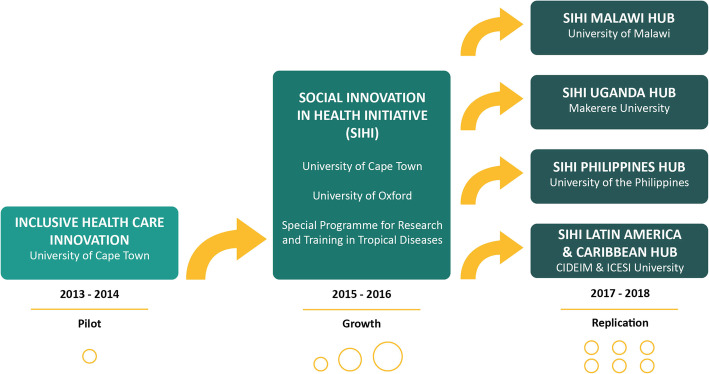
Social innovation (SI) in health holds potential to contribute to health systems strengthening and universal health coverage (UHC). The role of universities in SI has been well described in the context of high-income countries. An evidence gap exits on SI in healthcare delivery in the context of low- and middle-income countries (LMICs) as well as on the engagement of universities from these contexts. There is thus a need to build capacity for research and engagement in SI in healthcare delivery within these universities. The aim of this study was to examine the adoption and implementation of network of university hubs focused on SI in healthcare delivery within five countries across Africa, Asia and Latin America. The objectives were to describe the model, components and implementation process of the hubs; identify the enablers and barriers experienced and draw implications that could be relevant to other LMIC universities interested in SI.
A case study design was adopted to study the implementation process of a network of university hubs. Data from documentation, team discussions and post-implementation surveys were collected from 2013 to 2018 and analysed with aid of a modified policy analysis framework.
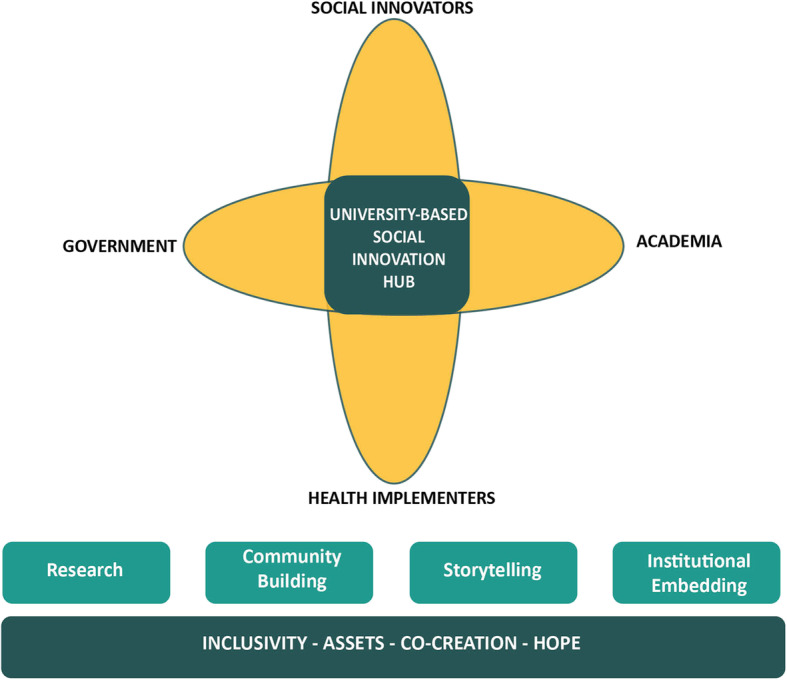
RESULTS/DISCUSSION: SI university-based hubs serve as cross-disciplinary and cross-sectoral platforms, established to catalyse SI within the local health system through four core activities: research, community-building, storytelling and institutional embedding, and adhering to values of inclusion, assets, co-creation and hope. Hubs were implemented as informal structures, managed by a small core team, in existing department. Enablers of hub implementation and functioning were the availability of strong in-country social networks, legitimacy attained from being part of a global network on SI in health and receiving a capacity building package in the initial stages. Barriers encountered were internal institutional resistance, administrative challenges associated with university bureaucracy and annual funding cycles.
This case study shows the opportunity that reside within LMIC universities to act as eco-system enablers of SI in healthcare delivery in order to fill the evidence gap on SI and enhance cross-sectoral participation in support of achieving UHC.
社会创新(SI)在卫生领域具有为加强卫生系统和实现全民健康覆盖(UHC)做出贡献的潜力。在高收入国家的背景下,大学在 SI 中的作用已经得到了很好的描述。在中低收入国家(LMICs)的医疗保健提供方面的 SI 以及这些背景下的大学参与方面,存在着证据差距。因此,需要在这些大学中建立医疗保健提供方面的 SI 研究和参与能力。本研究的目的是研究在非洲、亚洲和拉丁美洲的五个国家中,以 SI 为重点的大学网络在医疗保健提供方面的采用和实施情况。目的是描述该网络的模式、组成部分和实施过程;确定所经历的促进因素和障碍,并得出对其他对 SI 感兴趣的 LMIC 大学可能相关的启示。
采用案例研究设计来研究大学网络的实施过程。从 2013 年至 2018 年,从文件、团队讨论和实施后调查中收集数据,并使用经过修改的政策分析框架进行分析。
结果/讨论:基于大学的 SI 中心作为跨学科和跨部门的平台,通过四项核心活动(研究、社区建设、讲故事和机构嵌入),并遵循包容、资产、共同创造和希望的价值观,在当地卫生系统内促进 SI。中心以非正式结构实施,由一个小的核心团队管理,位于现有部门内。中心实施和运作的促进因素是在国内拥有强大的社会网络、作为全球卫生领域 SI 网络的一部分获得的合法性以及在初始阶段获得的能力建设一揽子计划。遇到的障碍包括内部机构的抵制、与大学官僚机构相关的行政挑战以及年度资金周期。
本案例研究表明,LMIC 大学有机会成为医疗保健提供方面 SI 的生态系统推动者,以填补 SI 方面的证据差距,并增强跨部门参与,以支持实现 UHC。