National Institute of Parasitic Diseases, Chinese Center for Disease Control and Prevention, Chinese Center for Tropical Diseases Research, WHO Collaborating Center for Tropical Diseases, National Centre for International Research on Tropical Diseases, Ministry of Science and Technology, Key Laboratory of Parasite and Vector Biology, Ministry of Health, Shanghai, 200025, People's Republic of China.
National Institute of Parasitic Diseases, Chinese Center for Disease Control and Prevention⁃Shenzhen Center for Disease Control and Prevention Joint Laboratory for Imported Tropical Disease Control, Shanghai, 200025, People's Republic of China.
Infect Dis Poverty. 2020 Jul 11;9(1):91. doi: 10.1186/s40249-020-00712-4.
Plasmodium falciparum-resistance to sulphadoxine-pyrimethamine (SP) has been largely reported among pregnant women. However, the profile of resistance markers to SP dihydrofolate reductase (dhfr) and dihydropteroate synthase (dhps) in the general population are varied and not frequently monitored. Currently, SP is used as partner drug for artemisinin combination therapy (SP-artesunate) in some sub-Saharan African countries or as a prophylactic drug in intermittent preventive treatment of malaria during pregnancy and infants and in seasonal malaria chemoprevention (SMC). Profiling of P. falciparum-resistant genotypes to SP is dynamic and critical in providing data that would be useful for malaria control programmes. This study assessed the profile of dhfr and dhps genes genotypes among individuals with malaria in Lagos, Nigeria.
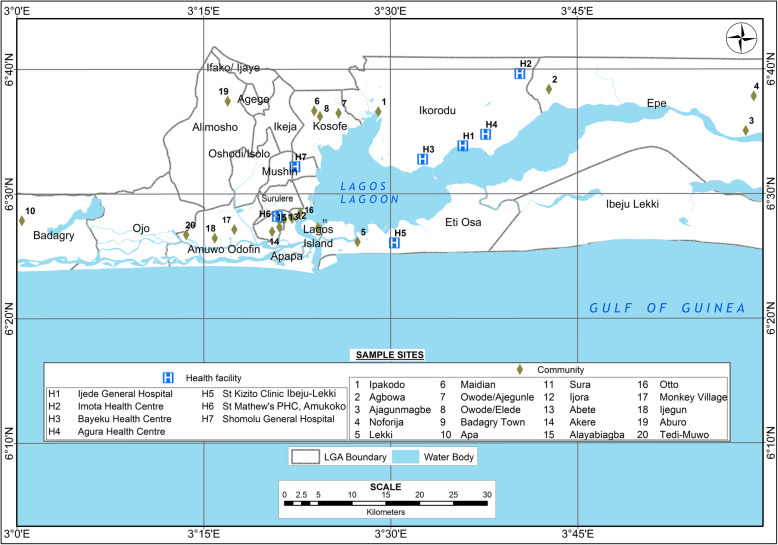
Molecular markers of SP resistance were identified by nested PCR and sequenced among malaria positive dried blood spots (DBS) that were collected from individuals attending health facilities from January 2013 to February 2014 and during community surveys from October 2010 to September 2011 across different Local Government Areas of Lagos State, Nigeria.
A total of 242 and 167 samples were sequenced for dhfr and dhps, respectively. Sequence analysis of dhfr showed that 95.5% (231/242), 96.3% (233/242) and 96.7% (234/242) of the samples had N51I, C59R and S108N mutant alleles, respectively. The prevalence of dhps mutation at codons A437G, A613S, S436A, A581G, I431V and K540E were 95.8% (160/167), 41.9% (70/167), 41.3% (69/167), 31.1% (52/167), 25.1% (42/167), and 1.2% (2/167) respectively. The prevalence of triple mutations (CIRNI) in dhfr was 93.8% and 44.3% for the single dhps haplotype mutation (SGKAA). Partial SP-resistance due to quadruple dhfr-dhps haplotype mutations (CIRNI-SGKAA) and octuple haplotype mutations (CIRNI-VAGKGS) with rate of 42.6% and 22.0%, respectively has been reported.
There was increased prevalence in dhfr triple haplotype mutations when compared with previous reports in the same environment but aligned with high prevalence in other locations in Nigeria and other countries in Africa. Also, high prevalence of dhfr and dhps mutant alleles occurred in the study areas in Lagos, Nigeria five to eight years after the introduction of artemisinin combination therapy underscores the need for continuous monitoring.
恶性疟原虫对磺胺多辛-乙胺嘧啶(SP)的耐药性在孕妇中已被大量报道。然而,在普通人群中,SP 二氢叶酸还原酶(dhfr)和二氢蝶酸合成酶(dhps)的耐药标志物的情况各不相同,且并未经常监测。目前,SP 已在撒哈拉以南非洲的一些国家被用作青蒿素联合疗法(SP-青蒿琥酯)的联合用药,或在孕妇和婴儿的间歇性预防治疗疟疾以及季节性疟疾化学预防(SMC)中用作预防用药。对 SP 耐药的恶性疟原虫基因型的分析是动态的,对于提供有用的疟疾控制规划数据至关重要。本研究评估了尼日利亚拉各斯的疟疾患者中 SP 耐药基因的 dhfr 和 dhps 基因型。
2013 年 1 月至 2014 年 2 月和 2010 年 10 月至 2011 年 9 月,从不同拉各斯州地方政府区的医疗机构就诊者和社区调查中采集了感染疟疾的个体的干血斑(DBS)样本,采用巢式 PCR 鉴定 SP 耐药的分子标志物,并对其进行测序。
对 dhfr 和 dhps 分别进行了 242 和 167 个样本的测序。dhfr 序列分析显示,95.5%(231/242)、96.3%(233/242)和 96.7%(234/242)的样本分别具有 N51I、C59R 和 S108N 突变等位基因。dhps 突变在密码子 A437G、A613S、S436A、A581G、I431V 和 K540E 的发生率分别为 95.8%(160/167)、41.9%(70/167)、41.3%(69/167)、31.1%(52/167)、25.1%(42/167)和 1.2%(2/167)。dhfr 中的三联突变(CIRNI)的发生率为 93.8%,而 dhps 单倍型突变(SGKAA)的发生率为 44.3%。部分 SP 耐药性归因于 dhfr-dhps 四重单倍型突变(CIRNI-SGKAA)和八重单倍型突变(CIRNI-VAGKGS),其发生率分别为 42.6%和 22.0%。
与同一环境下的先前报告相比,dhfr 三联突变的发生率有所增加,但与尼日利亚其他地区和非洲其他国家的高发生率一致。此外,在尼日利亚拉各斯的研究地区,在引入青蒿素联合疗法五年至八年后,dhfr 和 dhps 突变等位基因的高发生率突显了持续监测的必要性。