Department of Clinical Immunology and Rheumatology, Kalinga Institute of Medical Sciences (KIMS), KIIT University, Bhubaneswar, India.
Department of Internal Medicine No. 2, Danylo Halytsky Lviv National Medical University, Lviv, Ukraine.
Clin Rheumatol. 2020 Sep;39(9):2529-2543. doi: 10.1007/s10067-020-05275-1. Epub 2020 Jul 11.
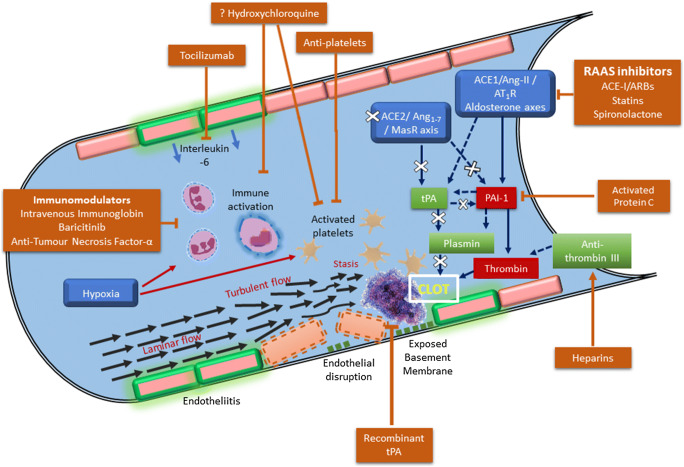
The pathogenesis of Coronavirus disease 2019 (COVID-19) is gradually being comprehended. A high number of thrombotic episodes are reported, along with the mortality benefits of heparin. COVID-19 can be viewed as a prothrombotic disease. We overviewed the available evidence to explore this possibility. We identified various histopathology reports and clinical case series reporting thromboses in COVID-19. Also, multiple coagulation markers support this. COVID-19 can be regarded as a risk factor for thrombosis. Applying the principles of Virchow's triad, we described abnormalities in the vascular endothelium, altered blood flow, and platelet function abnormalities that lead to venous and arterial thromboses in COVID-19. Endothelial dysfunction, activation of the renin-angiotensin-aldosterone system (RAAS) with the release of procoagulant plasminogen activator inhibitor (PAI-1), and hyperimmune response with activated platelets seem to be significant contributors to thrombogenesis in COVID-19. Stratifying risk of COVID-19 thromboses should be based on age, presence of comorbidities, D-dimer, CT scoring, and various blood cell ratios. Isolated heparin therapy may not be sufficient to combat thrombosis in this disease. There is an urgent need to explore newer avenues like activated protein C, PAI-1 antagonists, and tissue plasminogen activators (tPA). These should be augmented with therapies targeting RAAS, antiplatelet drugs, repurposed antiinflammatory, and antirheumatic drugs. Key Points • Venous and arterial thromboses in COVID-19 can be viewed through the prism of Virchow's triad. • Endothelial dysfunction, platelet activation, hyperviscosity, and blood flow abnormalities due to hypoxia, immune reactions, and hypercoagulability lead to thrombogenesis in COVID-19. • There is an urgent need to stratify COVID-19 patients at risk for thrombosis using age, comorbidities, D-dimer, and CT scoring. • Patients with COVID-19 at high risk for thrombosis should be put on high dose heparin therapy.
新型冠状病毒病 2019(COVID-19)的发病机制逐渐被理解。据报道,血栓形成事件数量众多,肝素具有治疗益处。COVID-19 可被视为一种促血栓形成疾病。我们综述了现有证据以探索这种可能性。我们确定了各种组织病理学报告和临床病例系列报告 COVID-19 中的血栓形成。此外,多种凝血标志物也支持这一观点。COVID-19 可被视为血栓形成的危险因素。应用 Virchow 三联征的原理,我们描述了 COVID-19 中血管内皮、血流改变和血小板功能异常导致静脉和动脉血栓形成的异常。内皮功能障碍、肾素-血管紧张素-醛固酮系统(RAAS)的激活导致促凝血纤溶酶原激活物抑制剂(PAI-1)的释放,以及伴有激活血小板的超免疫反应似乎是 COVID-19 中血栓形成的重要因素。COVID-19 血栓形成的风险分层应基于年龄、合并症、D-二聚体、CT 评分和各种血细胞比。单独使用肝素治疗可能不足以治疗这种疾病的血栓形成。迫切需要探索新型途径,如活化蛋白 C、PAI-1 拮抗剂和组织型纤溶酶原激活剂(tPA)。这些应与靶向 RAAS、抗血小板药物、重新利用的抗炎和抗风湿药物联合应用。重点 • COVID-19 中的静脉和动脉血栓形成可以通过 Virchow 三联征的视角来看待。 • 由于缺氧、免疫反应和高凝状态导致的内皮功能障碍、血小板激活、血液高黏度和血流异常导致 COVID-19 中的血栓形成。 • 迫切需要使用年龄、合并症、D-二聚体和 CT 评分对 COVID-19 患者进行血栓形成风险分层。 • 具有高血栓形成风险的 COVID-19 患者应接受高剂量肝素治疗。