Department of Pathology & Laboratory Medicine, King Abdulaziz Medical City, Ministry of National Guard Health Affairs, Riyadh, Saudi Arabia; King Abdullah International Medical Research Center, Ministry of National Guard Health Affairs, Riyadh, Saudi Arabia; King Saud bin Abdulaziz University for Health Sciences, Riyadh, Saudi Arabia.
The University of Sydney, Sydney, Austria.
J Infect Public Health. 2020 Oct;13(10):1544-1550. doi: 10.1016/j.jiph.2020.06.030. Epub 2020 Jul 1.
Middle East respiratory syndrome coronavirus (MERS-CoV) has continued to cause sporadic outbreaks of severe respiratory tract infection over the last 8 years.
Complete genome sequencing using next-generation sequencing was performed for MERS-CoV isolates from cases that occurred in Riyadh between 2015 and 2019. Phylogenetic analysis and molecular mutational analysis were carried out to investigate disease severity.
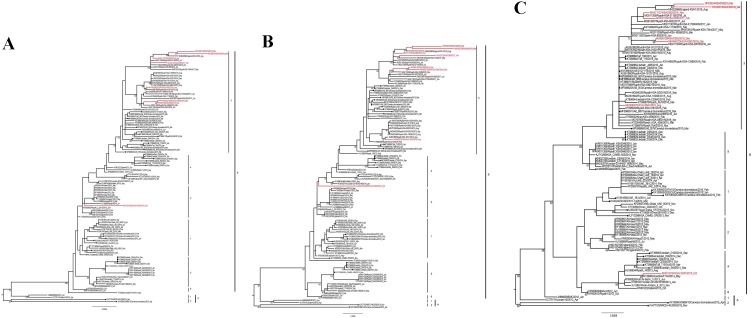
A total of eight MERS-CoV isolates were subjected to complete genome sequencing. Phylogenetic analysis resulted in the assembly of 7/8 sequences within lineage 3 and one sequence within lineage 4 showing complex genomic recombination. The isolates contained a variety of unique amino acid substitutions in ORF1ab (41), the N protein (10), the S protein (9) and ORF4b (5).
Our study shows that MERS-CoV is evolving. The emergence of new variants carries the potential for increased virulence and could impose a challenge to the global health system. We recommend the sequencing every new MERS-CoV isolate to observe the changes in the virus and relate them to clinical outcomes.
过去 8 年中,中东呼吸综合征冠状病毒(MERS-CoV)持续引发散发性严重呼吸道感染暴发。
对 2015 年至 2019 年期间在利雅得发生的病例中分离出的 MERS-CoV 进行基于下一代测序的全基因组测序。进行系统进化分析和分子突变分析,以调查疾病的严重程度。
对 8 株 MERS-CoV 进行了全基因组测序。系统进化分析将 7/8 个序列组装到第 3 谱系内,1 个序列组装到第 4 谱系内,显示出复杂的基因组重组。分离株在 ORF1ab(41)、N 蛋白(10)、S 蛋白(9)和 ORF4b(5)中含有多种独特的氨基酸取代。
我们的研究表明 MERS-CoV 正在进化。新变体的出现可能增加病毒的毒力,并对全球卫生系统构成挑战。我们建议对每一个新的 MERS-CoV 分离株进行测序,以观察病毒的变化,并将其与临床结果联系起来。