Wu Tingting, Hou Xiaorong, Zhang Fan, Sharma Manoj, Zhao Yong, Shi Zumin
School of Public Health and Health Management, Chongqing Medical University, Chongqing, China.
Research Center for Medicine and Social Development, Chongqing Medical University, Chongqing, China.
Front Psychol. 2020 Jun 3;11:1196. doi: 10.3389/fpsyg.2020.01196. eCollection 2020.
The purpose of this study was sought to assess the association between food preferences and Psychological well-being (PWB) in Chinese women undergoing perimenopause and whether the association is different between rural and urban areas.
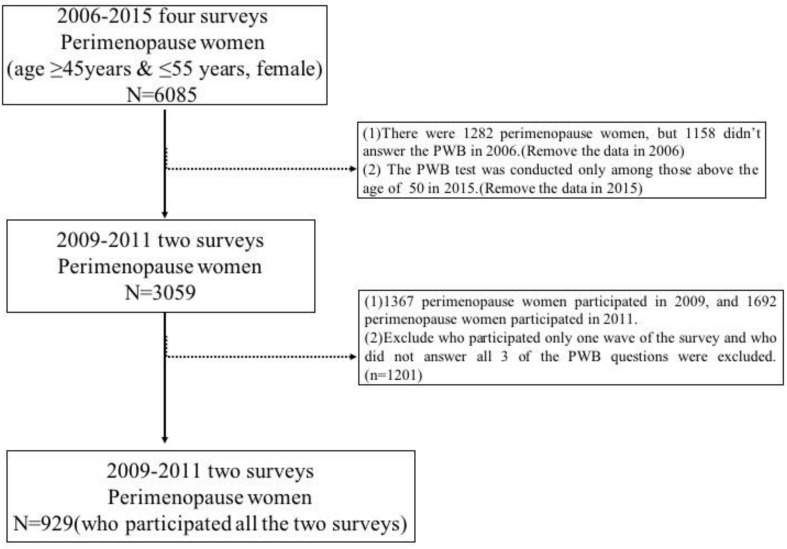
This is a longitudinal study of 929 women in perimenopausal period participating in the China Health and Nutrition Survey (CHNS) during 2009 and 2011. Preference for five kinds of food were assessed in face-to-face interviews and the PWB was measured by scoring three self-reported questions with a total score of 15. Multilevel mixed-effects linear regressions were used to estimate the longitudinal association between food preference and PWB scores. In fully adjusted models, dislike for fruits and like for sweetened beverages had regression coefficient (95% CI) for the PWB score of -1.26, (-2.21-0.321) and 0.66 (0.20-1.11), respectively. The above associations were only found among participants in urban areas, with corresponding regression coefficients of -2.61(95% CI = -4.83, -0.39) for dislike fruit and 1.02(95% CI = 0.09, 1.95) for like sweetened beverages.
In conclusion, PWB score was negatively associated with the dislike for fruit but positively associated with the preference for sweetened beverages, especially among participants from urban areas. The longitudinal data indicate that the PWB score of perimenopausal women might be improved by increasing the intake of fruit. Given the adverse effects of sweetened beverages, more research was need between PWB and the sweetened beverages.
本研究旨在评估中国处于围绝经期的女性食物偏好与心理健康之间的关联,以及农村和城市地区这种关联是否存在差异。
这是一项对929名处于围绝经期的女性进行的纵向研究,她们于2009年至2011年期间参与了中国健康与营养调查(CHNS)。通过面对面访谈评估对五种食物的偏好,并通过对三个自我报告问题进行评分来测量心理健康,总分15分。使用多水平混合效应线性回归来估计食物偏好与心理健康得分之间的纵向关联。在完全调整模型中,不喜欢水果和喜欢甜味饮料对心理健康得分的回归系数(95%置信区间)分别为-1.26(-2.21至-0.321)和0.66(0.20至1.11)。上述关联仅在城市地区的参与者中发现,不喜欢水果的相应回归系数为-2.61(95%置信区间 = -4.83,-0.39),喜欢甜味饮料的为1.02(95%置信区间 = 0.09,1.95)。
总之,心理健康得分与不喜欢水果呈负相关,但与喜欢甜味饮料呈正相关,尤其是在城市地区的参与者中。纵向数据表明,增加水果摄入量可能会改善围绝经期女性的心理健康得分。鉴于甜味饮料的不良影响,需要对心理健康与甜味饮料之间的关系进行更多研究。