Speech and Hearing Bioscience and Technology, Division of Medical Sciences, Harvard Medical School, Boston, MA.
Center for Laryngeal Surgery and Voice Rehabilitation, Massachusetts General Hospital, Boston.
Am J Speech Lang Pathol. 2020 Aug 4;29(3):1596-1607. doi: 10.1044/2020_AJSLP-20-00001. Epub 2020 Jul 13.
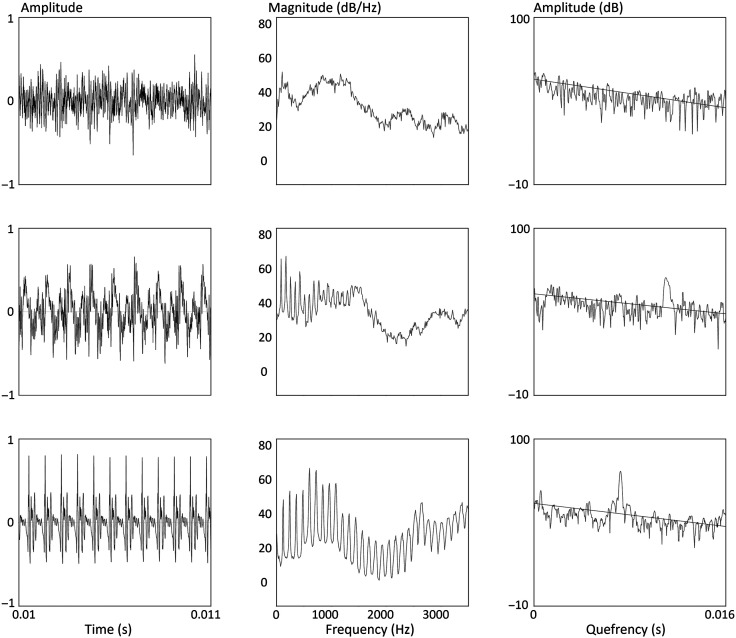
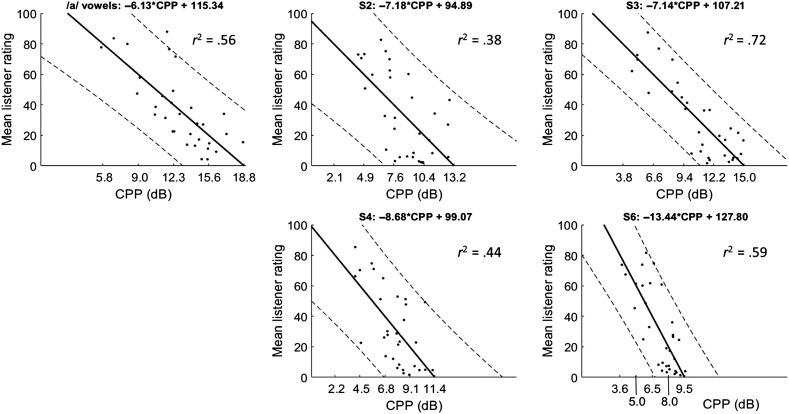
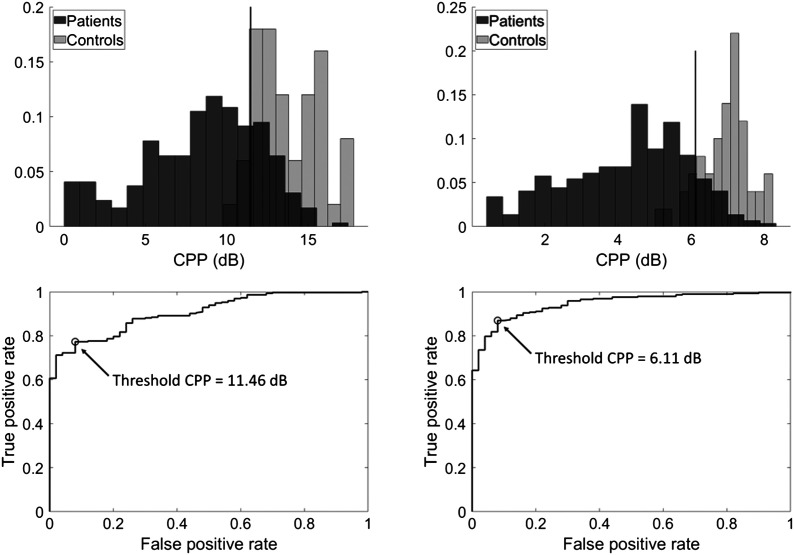
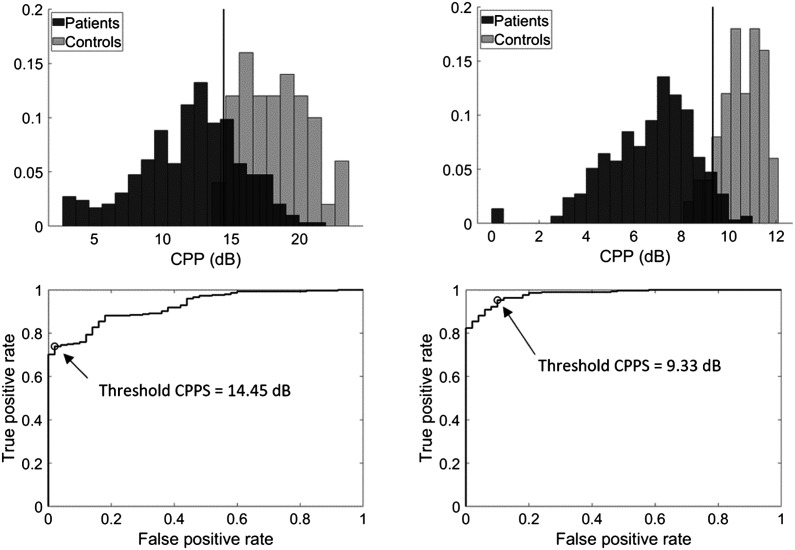
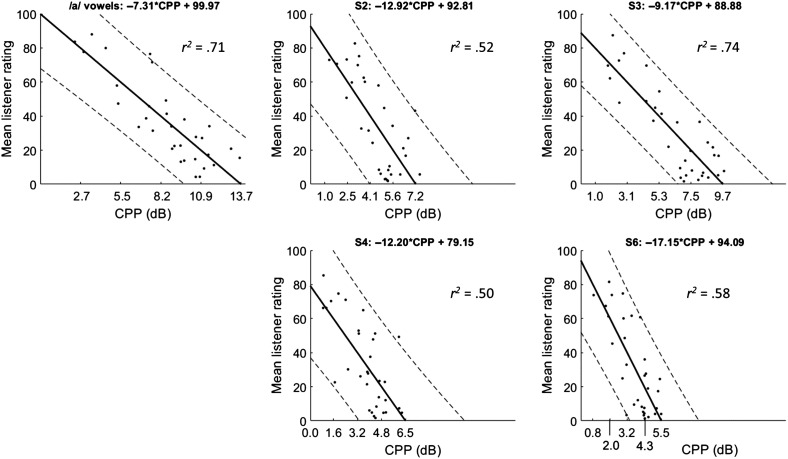
Purpose The goal of this study was to employ frequently used analysis methods and tasks to identify values for cepstral peak prominence (CPP) that can aid clinical voice evaluation. Experiment 1 identified CPP values to distinguish speakers with and without voice disorders. Experiment 2 was an initial attempt to estimate auditory-perceptual ratings of overall dysphonia severity using CPP values. Method CPP was computed using the Analysis of Dysphonia in Speech and Voice (ADSV) program and Praat. Experiment 1 included recordings from 295 patients with medically diagnosed voice disorders and 50 vocally healthy control speakers. Speakers produced sustained /a/ vowels and the English language Rainbow Passage. CPP cutoff values that best distinguished patient and control speakers were identified. Experiment 2 analyzed recordings from 32 English speakers with varying dysphonia severity and provided preliminary validation of the Experiment 1 cutoffs. Speakers sustained the /a/ vowel and read four sentences from the Consensus Auditory-Perceptual Evaluation of Voice protocol. Trained listeners provided auditory-perceptual ratings of overall dysphonia for the recordings, which were estimated using CPP values in a linear regression model whose performance was evaluated using the coefficient of determination ( ). Results Experiment 1 identified CPP cutoff values of 11.46 dB (ADSV) and 14.45 dB (Praat) for the sustained /a/ vowels and 6.11 dB (ADSV) and 9.33 dB (Praat) for the Rainbow Passage. CPP values below those thresholds indicated the presence of a voice disorder with up to 94.5% accuracy. In Experiment 2, CPP values estimated ratings of overall dysphonia with values up to .74. Conclusions The CPP cutoff values identified in Experiment 1 provide normative reference points for clinical voice evaluation based on sustained /a/ vowels and the Rainbow Passage. Experiment 2 provides an initial predictive framework that can be used to relate CPP values to the auditory perception of overall dysphonia severity based on sustained /a/ vowels and Consensus Auditory-Perceptual Evaluation of Voice sentences.
本研究旨在运用常用的分析方法和任务,确定有助于临床嗓音评估的声门谱峰突出值(CPP)值。实验 1 旨在确定 CPP 值,以区分患有和不患有嗓音障碍的说话者。实验 2 旨在初步尝试使用 CPP 值估计总体嗓音障碍严重程度的听觉感知评分。
使用语音和嗓音分析中的声门谱分析(ADSV)程序和 Praat 计算 CPP。实验 1 纳入了 295 名经医学诊断患有嗓音障碍的患者和 50 名嗓音健康的对照者的录音。说话者发出持续/a/元音和英语彩虹 passage。确定最佳区分患者和对照者的 CPP 截断值。实验 2 分析了 32 名具有不同嗓音障碍严重程度的英语说话者的录音,并初步验证了实验 1 的截断值。说话者发出/a/元音并朗读 Consensus Auditory-Perceptual Evaluation of Voice 协议中的四个句子。经过训练的听众对录音进行总体嗓音障碍的听觉感知评分,该评分使用 CPP 值在线性回归模型中进行估计,模型性能通过决定系数()进行评估。
实验 1 确定了用于持续/a/元音的 ADSV 为 11.46 dB 和 Praat 为 14.45 dB 的 CPP 截断值,以及用于 Rainbow Passage 的 ADSV 为 6.11 dB 和 Praat 为 9.33 dB 的 CPP 截断值。低于这些阈值的 CPP 值表明存在嗓音障碍,准确率高达 94.5%。在实验 2 中,CPP 值估计了基于持续/a/元音和 Consensus Auditory-Perceptual Evaluation of Voice 句子的总体嗓音障碍严重程度的评分,值高达 0.74。
实验 1 中确定的 CPP 截断值为基于持续/a/元音和 Rainbow Passage 的临床嗓音评估提供了正常参考点。实验 2 提供了一个初步的预测框架,可用于基于持续/a/元音和 Consensus Auditory-Perceptual Evaluation of Voice 句子将 CPP 值与总体嗓音障碍严重程度的听觉感知联系起来。