
冷热冲泡咖啡的物理化学特性:烘焙程度和冲泡温度对化合物萃取的影响。
Physiochemical Characteristics of Hot and Cold Brew Coffee Chemistry: The Effects of Roast Level and Brewing Temperature on Compound Extraction.
作者信息
Rao Niny Z, Fuller Megan, Grim Meghan D
机构信息
Department of Biological and Chemical Sciences, College of Life Sciences, Thomas Jefferson University, East Falls Campus, Philadelphia, PA 19144, USA.
出版信息
Foods. 2020 Jul 9;9(7):902. doi: 10.3390/foods9070902.
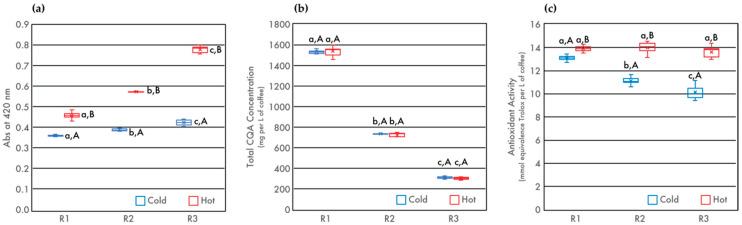
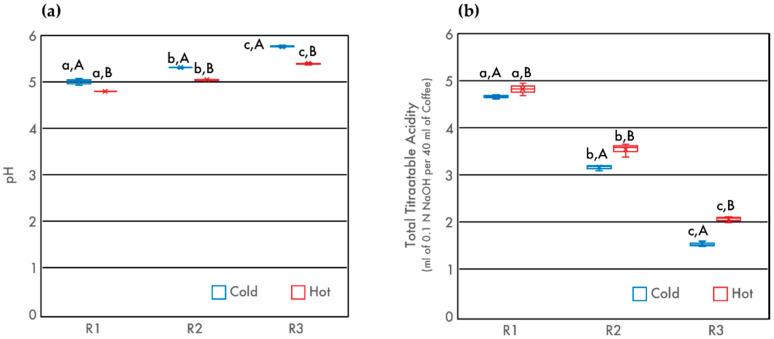
The role of roasting in cold brew coffee chemistry is poorly understood. The brewing temperature influences extraction processes and may have varying effects across the roast spectrum. To understand the relationship between brew temperature and roast temperature, hot and cold brew coffees were prepared from Arabica Columbian coffee beans roasted to light, medium, and dark levels. Chemical and physical parameters were measured to investigate the relationships among degree of roast, water temperature, and key characteristics of resulting coffees. Cold brew coffees showed differential extraction marked by decreased acidity, lower concentration of browned compounds, and fewer TDS indicating that cold water brewing extracts some compounds less effectively than hot water brewing. Compounds in coffee did exhibit sensitivity to degree of roast, with darker roasts resulting in decreased concentrations for both hot and cold brew coffees. Total antioxidant capacity (TAC) was only sensitive to degree of roast in cold brew coffees, while hot brew coffees had a constant TAC for all three roast levels. This indicates that the solid bean matrix and its chemical constituents interact with cold water differently than with hot water. Surface wetting, pore dynamics, and solubility all contribute to the extraction potential during brewing and are all functions of water temperature.
烘焙在冷萃咖啡化学中的作用尚未得到充分理解。冲泡温度会影响萃取过程,并且在整个烘焙范围内可能产生不同的影响。为了了解冲泡温度与烘焙温度之间的关系,我们用烘焙至浅度、中度和深度的哥伦比亚阿拉比卡咖啡豆制备了热萃咖啡和冷萃咖啡。通过测量化学和物理参数来研究烘焙程度、水温与所得咖啡关键特性之间的关系。冷萃咖啡表现出不同的萃取情况,其特点是酸度降低、褐色化合物浓度较低以及总溶解固体较少,这表明冷水冲泡比热水冲泡更难以有效地萃取出某些化合物。咖啡中的化合物确实对烘焙程度敏感,深度烘焙会导致热萃咖啡和冷萃咖啡中的化合物浓度均降低。总抗氧化能力(TAC)仅在冷萃咖啡中对烘焙程度敏感,而热萃咖啡在所有三种烘焙程度下的TAC均保持恒定。这表明咖啡豆的固体基质及其化学成分与冷水的相互作用方式不同于与热水的相互作用方式。表面湿润、孔隙动力学和溶解度都对冲泡过程中的萃取潜力有影响,并且都是水温的函数。
 Zotero 插件