Department of Medicinal and Biological Chemistry, University of Toledo, Toledo, OH 43606, USA.
Department of Chemistry & Biochemistry, University of Toledo, Toledo, OH 43606, USA.
Molecules. 2020 Jul 9;25(14):3137. doi: 10.3390/molecules25143137.
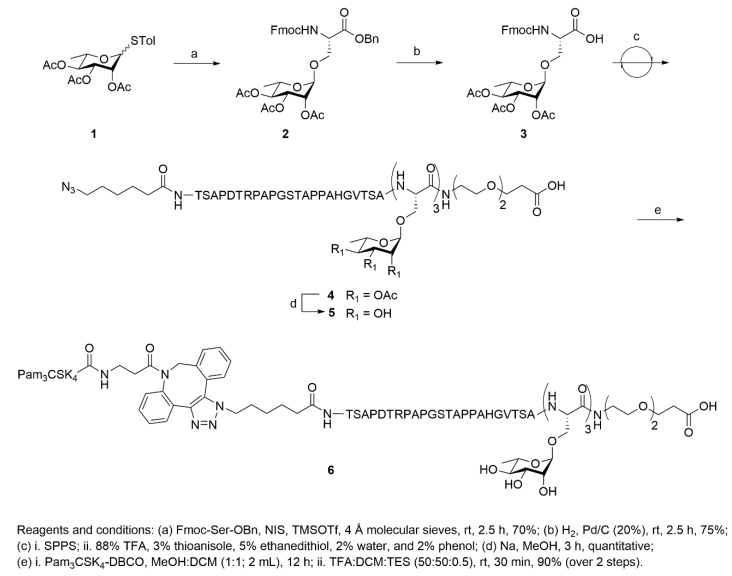
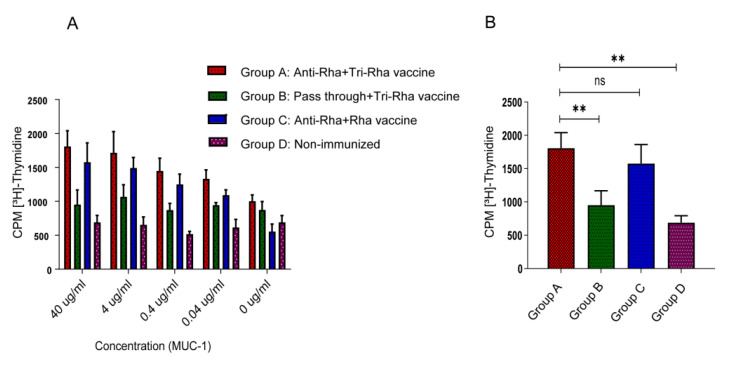
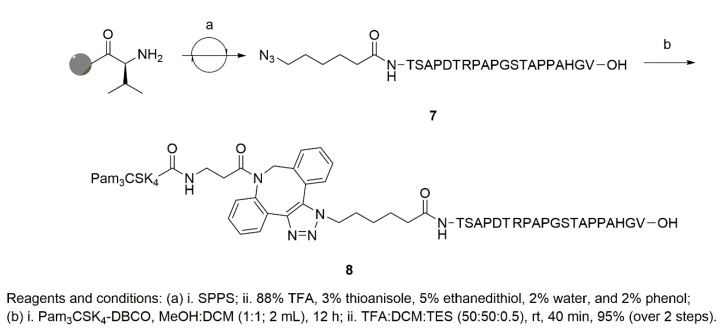
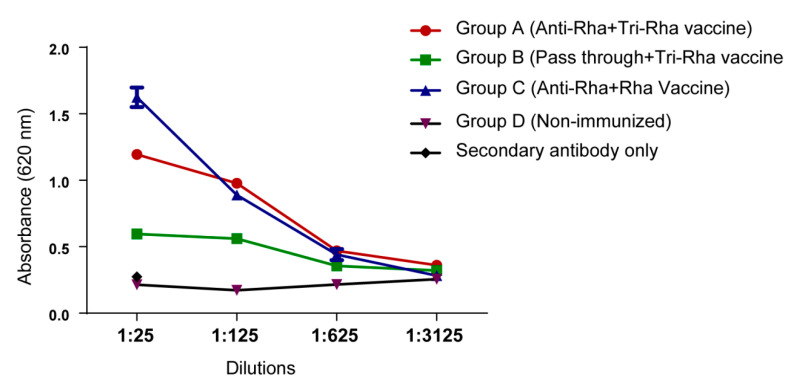
A rhamnose targeting strategy for generating effective anticancer vaccines was successful in our previous studies. We showed that by utilizing natural anti-rhamnose antibodies, a rhamnose-containing vaccine can be targeted to antigen-presenting cells, such as dendritic cells. In this case, rhamnose (Rha) was linked directly to the liposomes bearing the antigen. However, in the current approach, we conjugated a multivalent Tri-Rha ligand with the antigen itself, making it a single component vaccine construct, unlike the previous two-component vaccine construct where Rha cholesterol and Mucin1 (MUC1) antigen were both linked separately to the liposomes. Synthesis required the development of a linker for coupling of the Rha-Ser residues. We compared those two systems in a mouse model and found increased production of anti-MUC1 antibodies and more primed antigen-specific CD4+ T cells in both of the targeted approaches when compared to the control group, suggesting that this one-component vaccine construct could be a potential design used in our MUC1 targeting mechanisms.
在我们之前的研究中,一种岩藻糖靶向策略成功地用于生成有效的抗癌疫苗。我们表明,通过利用天然抗岩藻糖抗体,岩藻糖(Rha)可以与含有抗原的脂质体结合。在这种情况下,岩藻糖(Rha)直接与携带抗原的脂质体结合。然而,在当前的方法中,我们将多价三岩藻糖配体与抗原本身连接起来,使其成为一种单一成分的疫苗构建体,与之前的两种成分疫苗构建体不同,其中岩藻糖胆固醇和粘蛋白 1(MUC1)抗原分别与脂质体连接。合成需要开发一种用于连接岩藻糖-丝氨酸残基的接头。我们在小鼠模型中比较了这两种系统,发现与对照组相比,靶向方法中抗 MUC1 抗体的产生增加,抗原特异性 CD4+T 细胞的产生也增加,这表明这种单一成分的疫苗构建体可能是我们在 MUC1 靶向机制中使用的一种潜在设计。