Lakshminarayanan Vani, Supekar Nitin T, Wei Jie, McCurry Dustin B, Dueck Amylou C, Kosiorek Heidi E, Trivedi Priyanka P, Bradley Judy M, Madsen Cathy S, Pathangey Latha B, Hoelzinger Dominique B, Wolfert Margreet A, Boons Geert-Jan, Cohen Peter A, Gendler Sandra J
Department of Immunology, Mayo Clinic in Arizona, Scottsdale, AZ, United States of America.
Complex Carbohydrate Research Center, University of Georgia, Athens, GA, United States of America.
PLoS One. 2016 Jan 20;11(1):e0145920. doi: 10.1371/journal.pone.0145920. eCollection 2016.
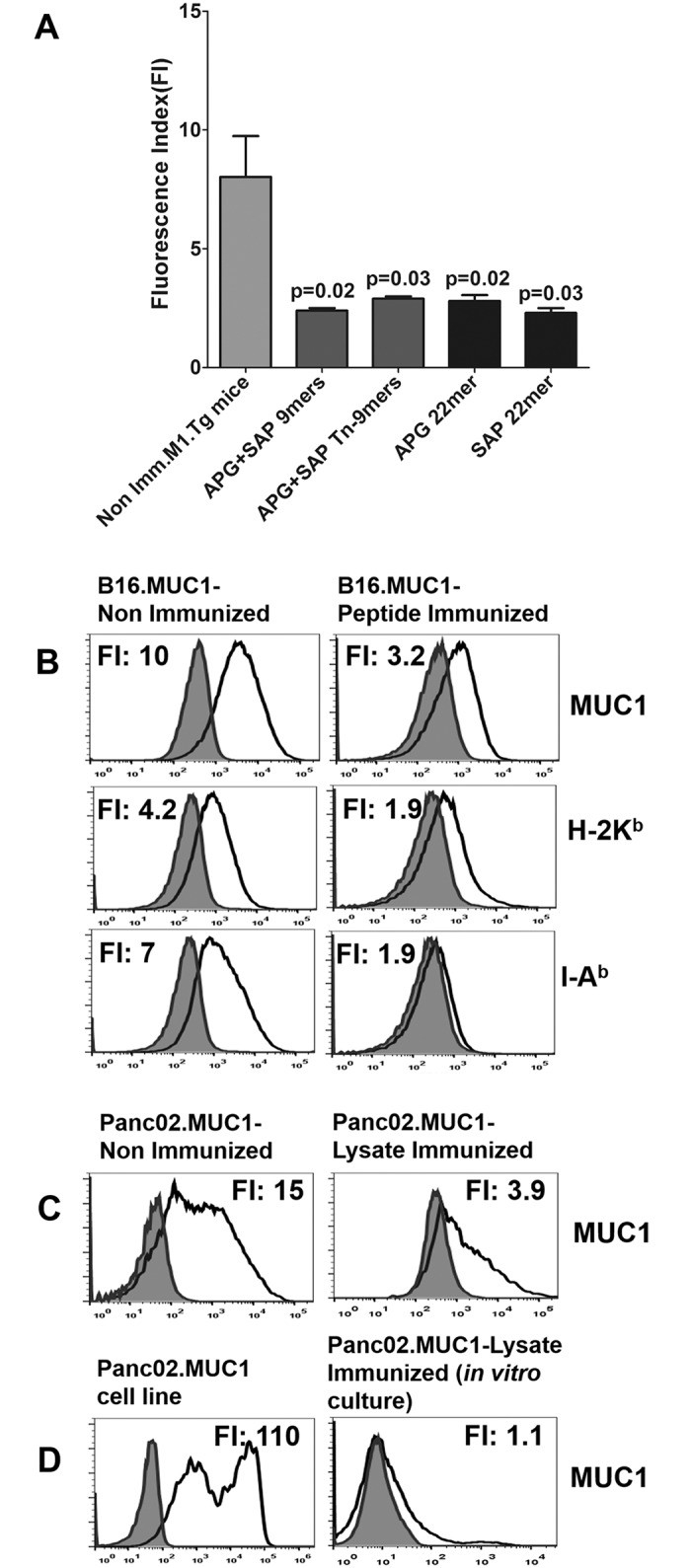
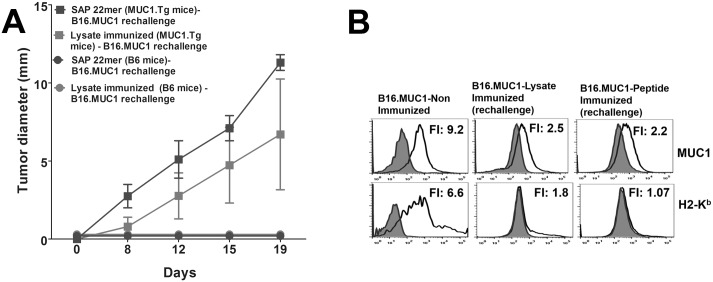
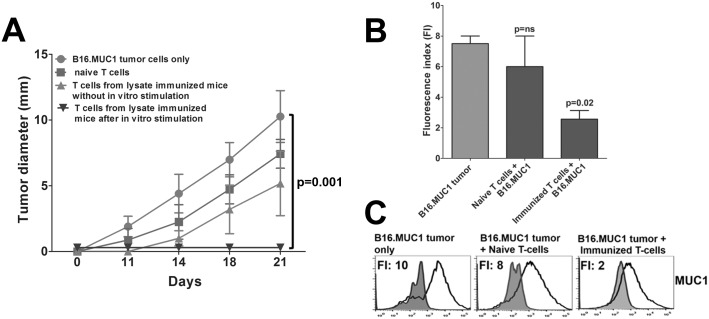
It remains challenging to produce decisive vaccines against MUC1, a tumor-associated antigen widely expressed by pancreas, breast and other tumors. Employing clinically relevant mouse models, we ruled out such causes as irreversible T-cell tolerance, inadequate avidity, and failure of T-cells to recognize aberrantly glycosylated tumor MUC1. Instead, every tested MUC1 preparation, even non-glycosylated synthetic 9mer peptides, induced interferon gamma-producing CD4(+) and CD8(+) T-cells that recognized glycosylated variants including tumor-associated MUC1. Vaccination with synthetic peptides conferred protection as long as vaccination was repeated post tumor challenge. Failure to revaccinate post challenge was associated with down-regulated tumor MUC1 and MHC molecules. Surprisingly, direct admixture of MUC1-expressing tumor with MUC1-hyperimmune T-cells could not prevent tumor outgrowth or MUC1 immunoediting, whereas ex vivo activation of the hyperimmune T-cells prior to tumor admixture rendered them curative. Therefore, surrogate T-cell preactivation outside the tumor bed, either in culture or by repetitive vaccination, can overcome tumor escape.
研发针对MUC1的决定性疫苗仍然具有挑战性,MUC1是一种在胰腺、乳腺和其他肿瘤中广泛表达的肿瘤相关抗原。利用临床相关的小鼠模型,我们排除了诸如不可逆的T细胞耐受性、亲和力不足以及T细胞无法识别异常糖基化的肿瘤MUC1等原因。相反,每一种经过测试的MUC1制剂,甚至是非糖基化的合成9聚体肽,都能诱导产生干扰素γ的CD4(+)和CD8(+) T细胞,这些T细胞能够识别包括肿瘤相关MUC1在内的糖基化变体。只要在肿瘤攻击后重复接种,用合成肽进行疫苗接种就能提供保护。攻击后未重新接种与肿瘤MUC1和MHC分子下调有关。令人惊讶的是,将表达MUC1的肿瘤与MUC1超免疫T细胞直接混合并不能阻止肿瘤生长或MUC1免疫编辑,而在肿瘤混合之前对超免疫T细胞进行体外激活则使其具有治愈性。因此,在肿瘤床外进行替代T细胞预激活,无论是在培养中还是通过重复接种,都可以克服肿瘤逃逸。