Department of Population Studies, School of Statistics and Planning, College of Business and Management Sciences, Makerere University, Kampala, Uganda.
BMC Womens Health. 2020 Jul 13;20(1):145. doi: 10.1186/s12905-020-01014-5.
The cervical cancer burden in Uganda is high amidst low uptake of HPV vaccination. Identification of individual and community factors associated with HPV vaccination are imperative for directed interventions. Conversely, in most Low and Middle Income Countries (LMICs) including Uganda this problem has not been sufficiently studied as the influence of individual and contextual determinants remains undetermined in spite of their substantial effect on HPV vaccine uptake. The aim of the study was to identify individual (school attendance status, age of girls, ethnicity, and amount of media exposure) and community (socioeconomic disadvantages) factors associated with HPV vaccination.
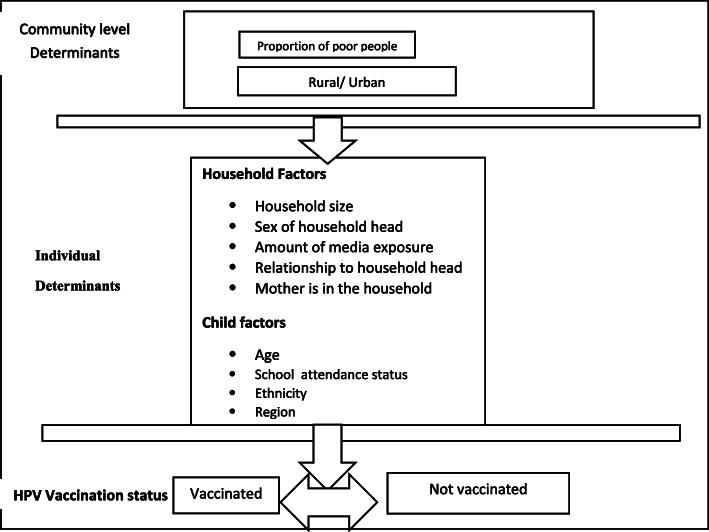
Based on a modified conceptual framework for health care utilization, hierarchical modelling was used to study 6093 girls, aged 10-14 years (level 1), nested within 686 communities (level 2) in Uganda by analyzing data from the 2016 Uganda Demographic and Health Survey.
Majority (78%) of the girls had not been vaccinated. A number of both individual and community factors were significantly associated with HPV vaccination. The Odds of HPV vaccination were higher among girls age; 11, 13, and 14 compared to girls age 10 years, attending school compared to girls not attending school, who were; foreigners, Iteso, Karamajong, Banyoro, Basoga, and other tribe compared to Baganda, living in families with 1-8 members compared to those living in families with 9 or more members and middle social economic status compared to poor wealth quintile.
Both individual and community factors show a noticeable effect on HPV vaccination. If higher vaccination rates are to be achieved in Uganda, these factors should be addressed. Strategies aimed at reaching younger girls, street children, out of school girls, and girls with lower SES should be embraced in order to achieve high vaccination uptake.
乌干达宫颈癌负担沉重,而 HPV 疫苗接种率却很低。确定与 HPV 疫苗接种相关的个体和社区因素对于有针对性的干预至关重要。然而,在包括乌干达在内的大多数低收入和中等收入国家(LMICs),尽管个体和环境决定因素对 HPV 疫苗接种率有很大影响,但尚未充分研究这一问题。本研究旨在确定与 HPV 疫苗接种相关的个体(学校出勤率、女孩年龄、族裔和媒体接触量)和社区(社会经济劣势)因素。
基于医疗保健利用的修改概念框架,使用分层模型对乌干达 6093 名 10-14 岁的女孩(第 1 层)进行研究,这些女孩嵌套在 686 个社区(第 2 层)中,分析了 2016 年乌干达人口与健康调查的数据。
大多数(78%)女孩未接种疫苗。一些个体和社区因素与 HPV 疫苗接种显著相关。与 10 岁女孩相比,11 岁、13 岁和 14 岁的女孩接种 HPV 疫苗的几率更高,与未上学的女孩相比,上学的女孩接种 HPV 疫苗的几率更高,与外国人、Iteso、Karamajong、Banyoro、Basoga 和其他部落相比,与巴干达人相比,与居住在有 1-8 名成员的家庭的女孩相比,与居住在有 9 名或更多成员的家庭的女孩相比,与中社会经济地位相比,与贫穷财富五分位数相比,接种 HPV 疫苗的几率更高。
个体和社区因素都对 HPV 疫苗接种有明显影响。如果要在乌干达实现更高的疫苗接种率,就应该解决这些因素。应该采取旨在接触到年龄较小的女孩、街头儿童、失学女孩和社会经济地位较低的女孩的战略,以实现高疫苗接种率。