Department of Pharmacology and Molecular Sciences, Johns Hopkins University School of Medicine, Baltimore, MD, United States of America.
PLoS One. 2020 Jul 14;15(7):e0235012. doi: 10.1371/journal.pone.0235012. eCollection 2020.
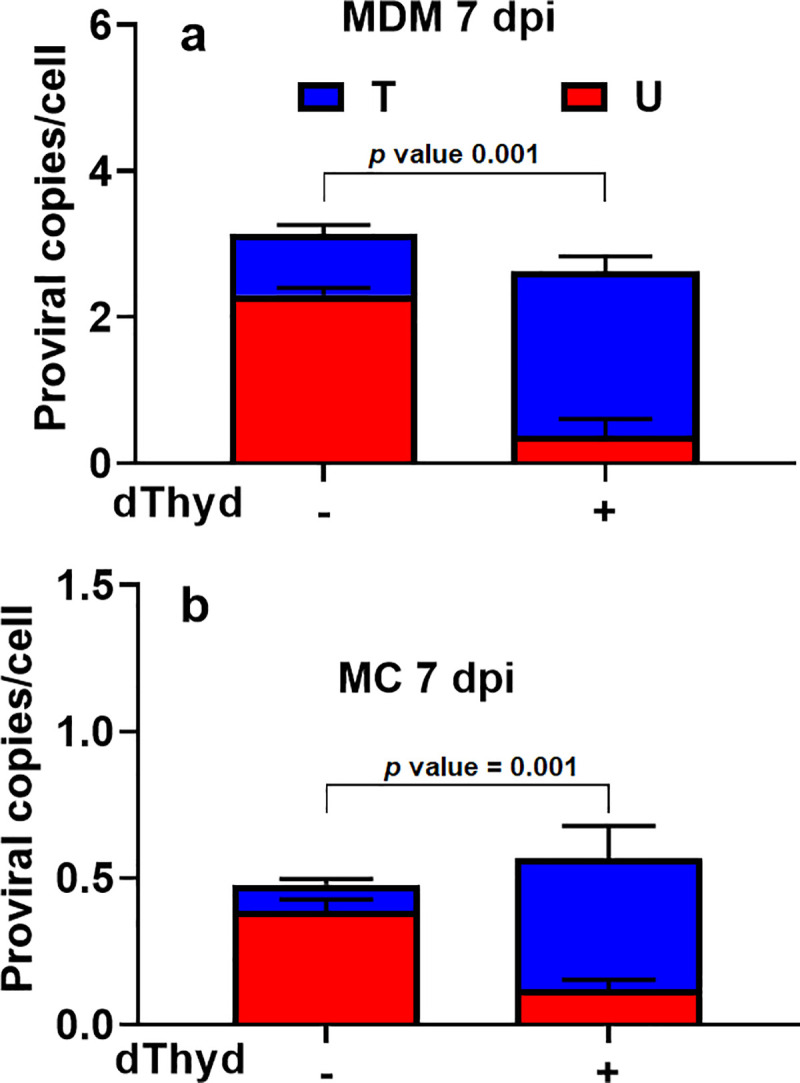
Non-dividing cells of the myeloid lineage such as monocytes and macrophages are target cells of HIV that have low dNTP pool concentrations and elevated levels of dUTP, which leads to frequent incorporation of dUMP opposite to A during reverse transcription ("uracilation"). One factor determining the fate of dUMP in proviral DNA is the host cell uracil base excision repair (UBER) system. Here we explore the relative UBER capacity of monocytes (MC) and monocyte-derived macrophages (MDM) and the fate of integrated uracilated viruses in both cell types to understand the implications of viral dUMP on HIV diversification and infectivity. We find that the kinetics for MC infection is compatible with their lifetime in vivo and their near absence of hUNG2 activity is consistent with the retention of viral dUMP at high levels at least until differentiation into macrophages, where UBER becomes possible. Overexpression of human uracil DNA glycosylase in MDM prior to infection resulted in rapid removal of dUMP from HIV cDNA and near complete depletion of dUMP-containing viral copies. This finding establishes that the low hUNG2 expression level in these cells limits UBER but that hUNG2 is restrictive against uracilated viruses. In contrast, overexpression of hUNG2 after viral integration did not accelerate the excision of uracils, suggesting that they may poorly accessible in the context of chromatin. We found that viral DNA molecules with incorporated dUMP contained unique (+) strand transversion mutations that were not observed when dUMP was absent (G→T, T→A, T→G, A→C). These observations and other considerations suggest that dUMP introduces errors predominantly during (-) strand synthesis when the template is RNA. Overall, the likelihood of producing a functional virus from in vitro infection of MC is about 50-fold and 300-fold reduced as compared to MDM and activated T cells. The results implicate viral dUMP incorporation in MC and MDM as a potential viral diversification and restriction pathway during human HIV infection.
髓系非分裂细胞,如单核细胞和巨噬细胞,是 HIV 的靶细胞,其 dNTP 池浓度低,dUTP 水平升高,这导致在逆转录过程中(“尿嘧啶化”)频繁地将 dUMP 掺入到与 A 相对的位置。决定前病毒 DNA 中 dUMP 命运的一个因素是宿主细胞尿嘧啶碱基切除修复(UBER)系统。在这里,我们探索单核细胞(MC)和单核细胞衍生的巨噬细胞(MDM)的相对 UBER 能力,以及两种细胞类型中整合的尿嘧啶化病毒的命运,以了解病毒 dUMP 对 HIV 多样化和感染性的影响。我们发现,MC 感染的动力学与其在体内的寿命兼容,并且其 hUNG2 活性几乎不存在与病毒 dUMP 至少在分化为巨噬细胞之前保持高水平一致,在巨噬细胞中 UBER 成为可能。在感染之前,在 MDM 中过表达人尿嘧啶 DNA 糖基化酶会导致 HIV cDNA 中迅速去除 dUMP,并几乎完全耗尽含有 dUMP 的病毒拷贝。这一发现表明,这些细胞中低水平的 hUNG2 表达限制了 UBER,但 hUNG2 对尿嘧啶化病毒有抑制作用。相比之下,病毒整合后过表达 hUNG2 并没有加速尿嘧啶的切除,这表明它们在染色质的背景下可能难以接近。我们发现,含有掺入的 dUMP 的病毒 DNA 分子包含独特的(+)链颠换突变,当不存在 dUMP 时没有观察到这些突变(G→T、T→A、T→G、A→C)。这些观察结果和其他考虑表明,dUMP 主要在模板为 RNA 时的(-)链合成过程中引入错误。总体而言,与 MDM 和活化的 T 细胞相比,从 MC 的体外感染产生功能性病毒的可能性降低了约 50 倍和 300 倍。这些结果表明,在人类 HIV 感染过程中,病毒 dUMP 掺入 MC 和 MDM 可能是一种潜在的病毒多样化和限制途径。