Reinstadler Sebastian J, Reindl Martin, Lechner Ivan, Holzknecht Magdalena, Tiller Christina, Roithinger Franz Xaver, Frick Matthias, Hoppe Uta C, Jirak Peter, Berger Rudolf, Delle-Karth Georg, Laßnig Elisabeth, Klug Gert, Bauer Axel, Binder Ronald, Metzler Bernhard
University Clinic of Internal Medicine III, Cardiology and Angiology, Medical University of Innsbruck, Anichstrasse 35, A-6020 Innsbruck, Austria.
Department of Cardiology, Wiener Neustadt Hospital, A-2700 Wiener Neustadt, Austria.
J Clin Med. 2020 Jul 10;9(7):2183. doi: 10.3390/jcm9072183.
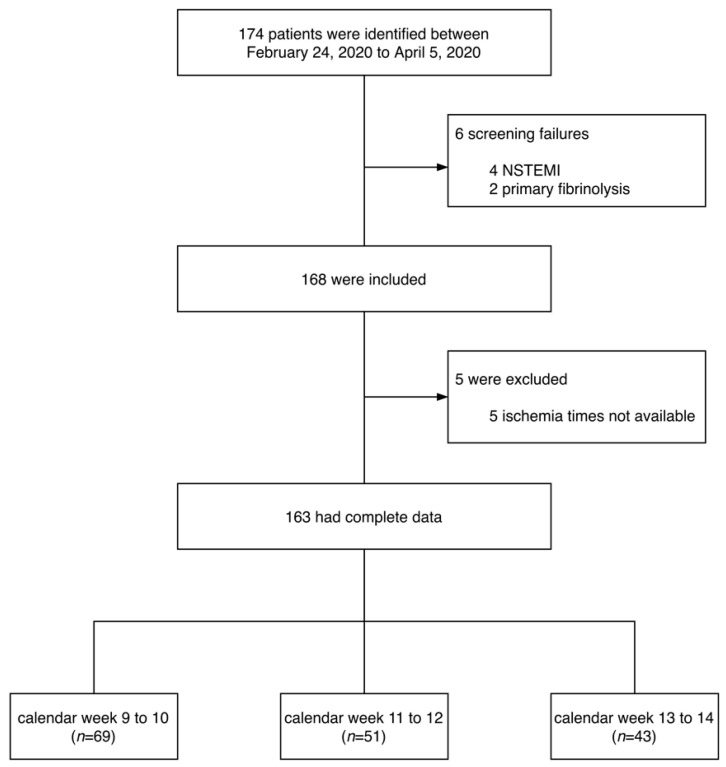
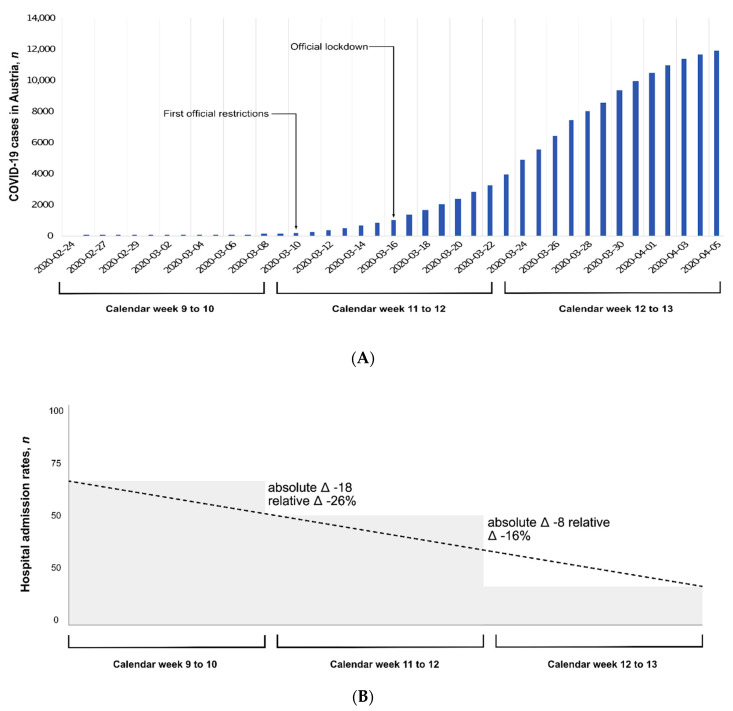
Coronavirus disease 19 (COVID-19) and its associated restrictions could affect ischemic times in patients with ST-segment elevation myocardial infarction (STEMI). The objective of this study was to investigate the influence of the COVID-19 outbreak on ischemic times in consecutive all-comer STEMI patients. We included consecutive STEMI patients ( = 163, median age: 61 years, 27% women) who were referred to seven tertiary care hospitals across Austria for primary percutaneous coronary intervention between 24 February 2020 (calendar week 9) and 5 April 2020 (calendar week 14). The number of patients, total ischemic times and door-to-balloon times in temporal relation to COVID-19-related restrictions and infection rates were analyzed. While rates of STEMI admissions decreased (calendar week 9/10 ( = 69, 42%); calendar week 11/12 ( = 51, 31%); calendar week 13/14 ( = 43, 26%)), total ischemic times increased from 164 (interquartile range (IQR): 107-281) min (calendar week 9/10) to 237 (IQR: 141-560) min (calendar week 11/12) and to 275 (IQR: 170-590) min (calendar week 13/14) ( = 0.006). Door-to-balloon times were constant ( = 0.60). There was a significant difference in post-interventional Thrombolysis in myocardial infarction (TIMI) flow grade 3 in patients treated during calendar week 9/10 (97%), 11/12 (84%) and 13/14 (81%; = 0.02). Rates of in-hospital death and re-infarction were similar between groups ( = 0.48). Results were comparable when dichotomizing data on 10 March and 16 March 2020, when official restrictions were executed. In this cohort of all-comer STEMI patients, we observed a 1.7-fold increase in ischemic time during the outbreak of COVID-19 in Austria. Patient-related factors likely explain most of this increase. Counteractive steps are needed to prevent further cardiac collateral damage during the ongoing COVID-19 pandemic.
新型冠状病毒肺炎(COVID-19)及其相关限制措施可能会影响ST段抬高型心肌梗死(STEMI)患者的缺血时间。本研究的目的是调查COVID-19疫情对连续纳入的所有STEMI患者缺血时间的影响。我们纳入了2020年2月24日(第9日历周)至2020年4月5日(第14日历周)期间因接受急诊经皮冠状动脉介入治疗而被转诊至奥地利七家三级护理医院的连续STEMI患者(n = 163,中位年龄:61岁,女性占27%)。分析了与COVID-19相关限制措施及感染率在时间上相关的患者数量、总缺血时间和门球时间。虽然STEMI入院率下降(第9/10日历周(n = 69,42%);第11/12日历周(n = 51,31%);第13/14日历周(n = 43,26%)),但总缺血时间从第9/10日历周的164(四分位间距(IQR):107 - 281)分钟增加到第11/12日历周的237(IQR:141 - 560)分钟以及第13/14日历周的275(IQR:170 - 590)分钟(P = 0.006)。门球时间保持不变(P = 0.60)。在第9/10日历周(97%)、11/12日历周(84%)和13/14日历周(81%;P = 0.02)接受治疗的患者中,心肌梗死溶栓(TIMI)血流3级的介入后情况存在显著差异。各组间住院死亡率和再梗死率相似(P = 0.48)。当对2020年3月10日和2020年3月16日实施官方限制措施时的数据进行二分法分析时,结果具有可比性。在这个所有STEMI患者队列中,我们观察到奥地利COVID-19疫情期间缺血时间增加了1.7倍。与患者相关的因素可能是这种增加的主要原因。在当前的COVID-19大流行期间,需要采取应对措施以防止进一步的心脏侧支损伤。