Department of Internal Medicine, University of Genoa, 16132 Genoa, Italy.
Nutritional Unit ASL-1 Imperiese, Giovanni Borea Civil Hospital, 18038 Sanremo, Italy.
Nutrients. 2020 Jul 10;12(7):2056. doi: 10.3390/nu12072056.
Dyslipidemias are a heterogeneous group of metabolic disorders mainly characterized by an increased risk of atherosclerotic cardiovascular disease (ASCVD) or other conditions, such as acute pancreatitis in hypertriglyceridemia. The aim of this study was to evaluate the effect of diet treatment and nutraceutical (NUTs) supplementation on the plasma lipid profile in outpatient dyslipidemic subjects, considering the influence of several factors (i.e., gender, age, body mass index, alcohol consumption, and smoking habits).
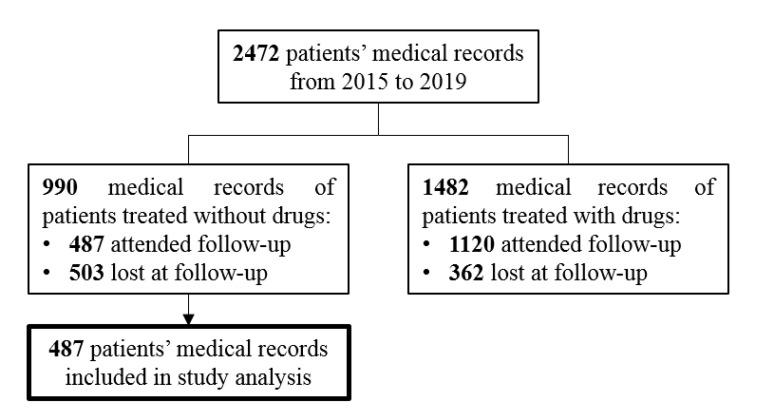
487 dyslipidemic patients spanning from 2015 to 2019 were treated with a Mediterranean diet or NUTs in a real-word setting and were retrospectively analyzed. General characteristics and lipid profile at baseline and after the follow-up period were evaluated.
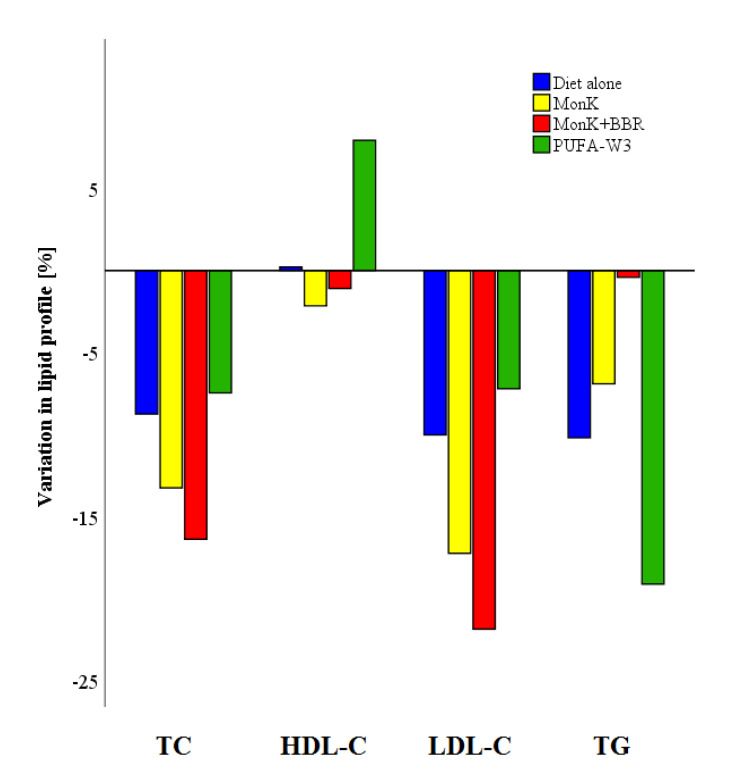
Diet alone reduced total cholesterol (-19 mg/dL, -7.7%), LDL cholesterol (-18 mg/dL, -10.1%), and triglycerides (-20 mg/dL, -16.7%). Triglycerides (TG) decreased more in men, while women were associated with higher reduction of LDL cholesterol (LDL-C). Different types of NUTs further ameliorate lipid profiles when associated with diet. Nevertheless, most patients at low ASCVD risk (222 out of 262, 81.6%) did not achieve the 2019 ESC/EAS guidelines recommended LDL-C goals (i.e., LDL-C < 116 mg/dL).
Lipid-lowering diet improves lipid profile, and NUTs can boost its efficacy, but taken together they are mainly unsatisfactory with respect to the targets imposed by 2019 EAS/ESC guidelines.
血脂异常是一组代谢紊乱,主要特征为动脉粥样硬化性心血管疾病(ASCVD)风险增加,或伴有其他病症,如高甘油三酯血症的急性胰腺炎。本研究旨在评估饮食治疗和营养补充剂(NUTs)对门诊血脂异常患者的血脂谱的影响,同时考虑了多种因素(即性别、年龄、体重指数、饮酒和吸烟习惯)的影响。
2015 年至 2019 年,487 名血脂异常患者接受了地中海饮食或 NUTs 的治疗,并进行了回顾性分析。评估了基线和随访期间的一般特征和血脂谱。
单独饮食可降低总胆固醇(-19mg/dL,-7.7%)、低密度脂蛋白胆固醇(-18mg/dL,-10.1%)和甘油三酯(-20mg/dL,-16.7%)。男性的甘油三酯(TG)降低更多,而女性与 LDL 胆固醇(LDL-C)的降低幅度更高有关。当与饮食联合使用时,不同类型的 NUTs 可进一步改善血脂谱。然而,大多数低 ASCVD 风险患者(262 例中的 222 例,81.6%)未能达到 2019 年 ESC/EAS 指南推荐的 LDL-C 目标(即 LDL-C < 116mg/dL)。
降脂饮食可改善血脂谱,NUTs 可增强其疗效,但总体而言,它们主要不能满足 2019 年 EAS/ESC 指南的目标。