Awan Samrah Afzal, Ilyas Noshin, Khan Imran, Raza Muhammad Ali, Rehman Abd Ur, Rizwan Muhammad, Rastogi Anshu, Tariq Rezwan, Brestic Marian
Department of Grassland Science, Animal Science and Technology College, Sichuan Agricultural University, Chengdu 611130, China.
Department of Botany, Arid Agriculture University, Rawalpindi 46000, Pakistan.
Plants (Basel). 2020 Jul 11;9(7):878. doi: 10.3390/plants9070878.
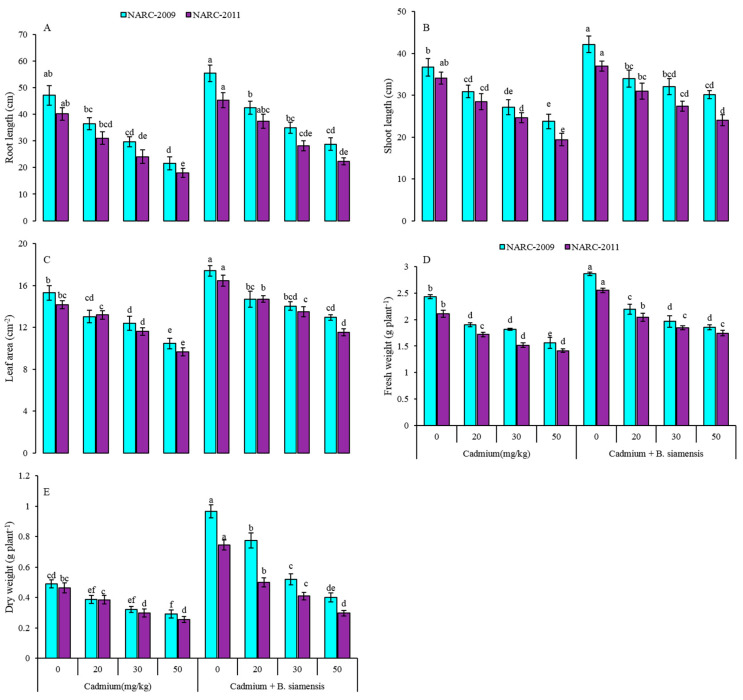
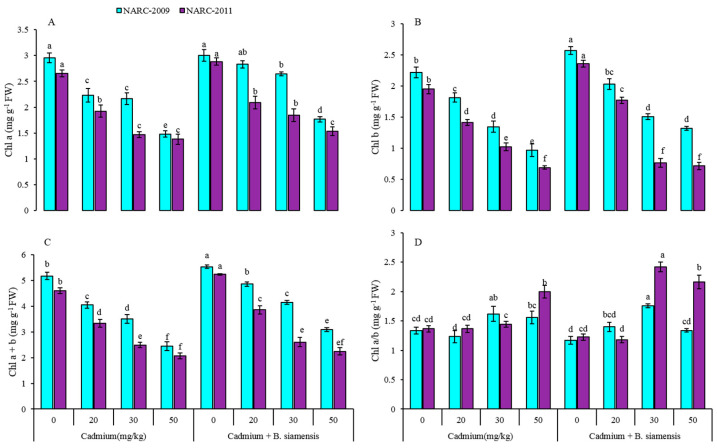
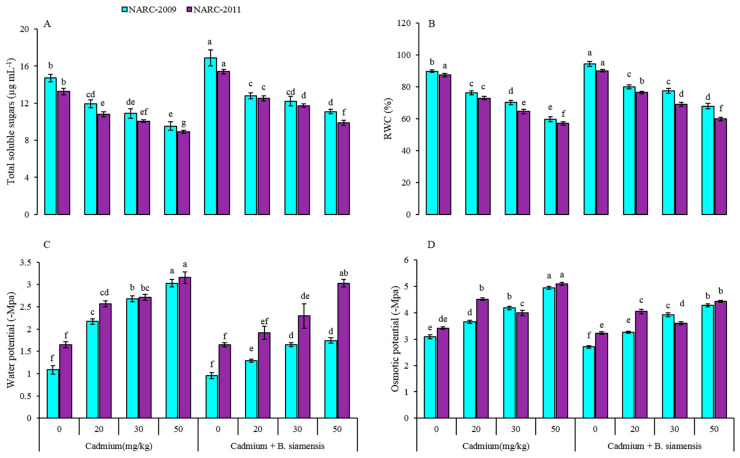
Bioavailability of cadmium (Cd) metal in the soils due to the scarcity of good quality water and industrial waste could be the major limiting factor for the growth and yield of crops. Therefore, there is a need for a prompt solution to the Cd toxicity, to fulfill increasing food demand resulting from growing world population. Today, a variable range of plant growth promoting rhizobacteria (PGPR) is being used at a large scale in agriculture, to reduce the risk of abiotic stresses on plants and increase crop productivity. The objective of this study was to evaluate the efficacy of in relieving the Cd induced damage in two wheat varieties (i.e., NARC-2009 and NARC-2011) grown in Cd spiked soil at different concentrations (0, 20, 30, 50 mg/kg). The plants under Cd stress accumulated more Cd in the roots and shoots, resulting in severe oxidative stress, evident by an increase in malondialdehyde (MDA) content. Moreover, a decrease in cell osmotic status, and alteration in antioxidant enzymes such as superoxide dismutase (SOD), catalase (CAT), and ascorbate peroxidase (APX) were also observed in wheat plants under Cd stress. As a result, the Cd exposed plants showed a reduction in growth, tissue biomass, photosynthetic pigments, membrane stability, total soluble sugars, and amino acids, in comparison to control plants. The extent of damage was observed to be higher with an increase in Cd concentration. However, the inoculation of wheat with improved plant growth, reduced oxidative stress, and enhanced the activities of antioxidant enzymes in both wheat varieties. amendment brought a considerable improvement in every parameter determined with respect to Cd stress. The response of both wheat varieties on exposure to was positively enhanced, whereas NARC-2009 accumulated less Cd compared to NARC-2011, which indicated a higher tolerance to Cd stress mediated by inoculation. Overall, the reduced the Cd toxicity in wheat plants through the augmentation of the antioxidant defense system and sugars production.
由于优质水稀缺和工业废弃物排放,土壤中镉(Cd)金属的生物有效性可能是作物生长和产量的主要限制因素。因此,需要迅速解决镉毒性问题,以满足不断增长的世界人口对粮食的需求。如今,各种各样的植物促生根际细菌(PGPR)正在农业中大规模使用,以降低植物遭受非生物胁迫的风险并提高作物产量。本研究的目的是评估[具体细菌名称未给出]在缓解不同浓度(0、20、30、50毫克/千克)镉污染土壤中生长的两个小麦品种(即NARC - 2009和NARC - 2011)镉诱导损伤方面的功效。镉胁迫下的植物在根和地上部分积累了更多的镉,导致严重的氧化应激,丙二醛(MDA)含量增加证明了这一点。此外,在镉胁迫下的小麦植株中还观察到细胞渗透状态下降,以及超氧化物歧化酶(SOD)、过氧化氢酶(CAT)和抗坏血酸过氧化物酶(APX)等抗氧化酶的变化。结果,与对照植株相比,暴露于镉的植株在生长、组织生物量、光合色素、膜稳定性、总可溶性糖和氨基酸方面均有所降低。随着镉浓度的增加,损伤程度更高。然而,用[具体细菌名称未给出]接种小麦可改善植物生长、降低氧化应激并增强两个小麦品种的抗氧化酶活性。[具体细菌名称未给出]改良剂在与镉胁迫相关的每个测定参数方面都带来了显著改善。两个小麦品种对[具体细菌名称未给出]暴露的反应均得到积极增强,而与NARC - 2011相比,NARC - 2009积累的镉较少,这表明其对[具体细菌名称未给出]接种介导的镉胁迫具有更高的耐受性。总体而言,[具体细菌名称未给出]通过增强抗氧化防御系统和糖类生产降低了小麦植株中的镉毒性。