Barretto Luke A F, Fowler Casey C
Department of Biological Sciences, University of Alberta, Edmonton, AB T6G2E9, Canada.
Pathogens. 2020 Jul 11;9(7):559. doi: 10.3390/pathogens9070559.
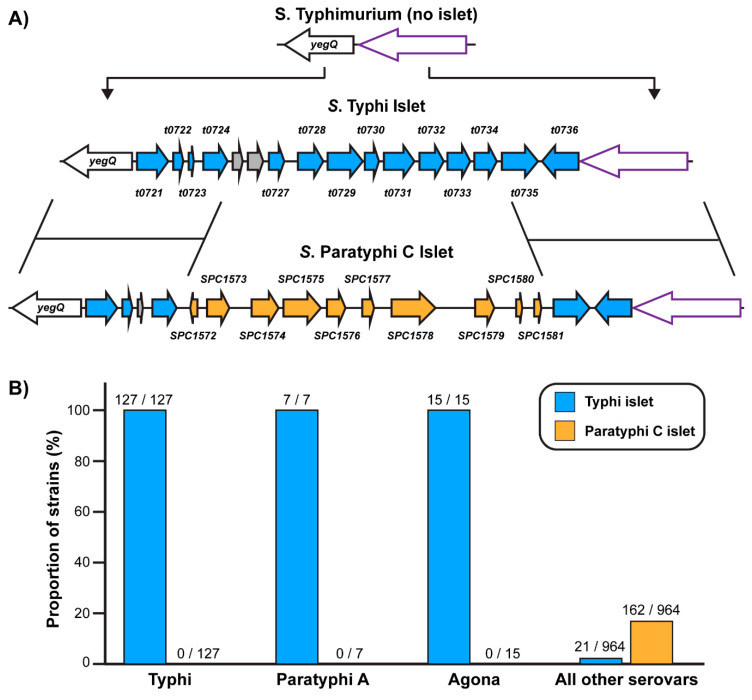
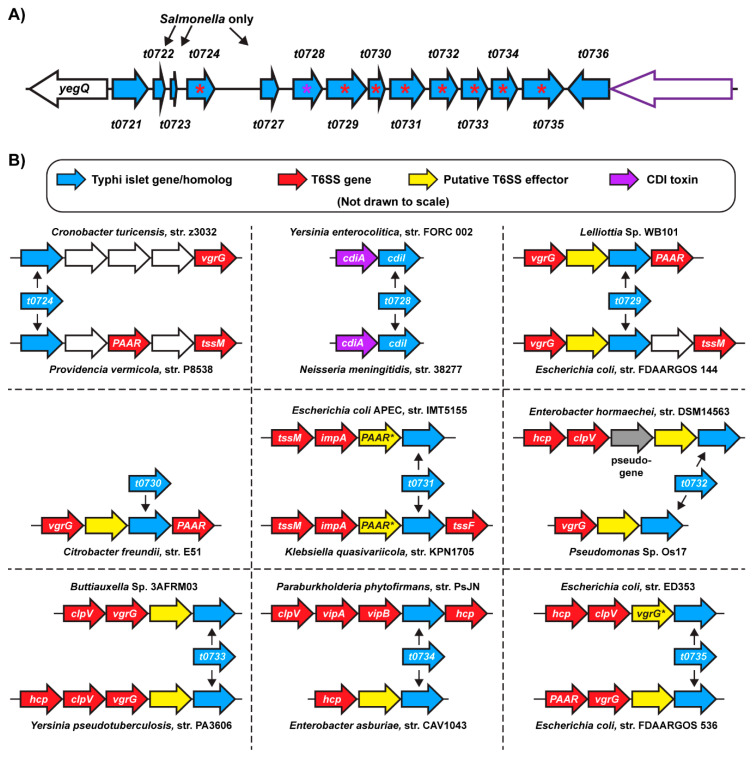
Typhoid fever is a major global health problem and is the result of systemic infections caused by the human-adapted bacterial pathogen serovar Typhi (. Typhi). The pathology underlying . Typhi infections significantly differ from infections caused by broad host range serovars of the same species, which are a common cause of gastroenteritis. Accordingly, identifying . Typhi genetic factors that impart functionality absent from broad host range serovars offers insights into its unique biology. Here, we used an in-silico approach to explore the function of an uncharacterized 14-gene . Typhi genomic islet. Our results indicated that this islet was specific to the species, where it was encoded by the Typhi and Paratyphi A serovars, but was generally absent from non-typhoidal serovars. Evidence was gathered using comparative genomics and sequence analysis tools, and indicated that this islet was comprised of Type VI secretion system (T6SS) and contact-dependent growth inhibition (CDI) genes, the majority of which appeared to encode orphan immunity proteins that protected against the activities of effectors and toxins absent from the . Typhi genome. We herein propose that this islet represents an immune system that protects . Typhi against competing bacteria within the human gut.
伤寒热是一个重大的全球健康问题,是由适应人类的细菌病原体伤寒杆菌血清型 Typhi(. Typhi)引起的全身感染的结果。. Typhi 感染的病理学与同一物种的广泛宿主范围血清型引起的感染显著不同,后者是肠胃炎的常见病因。因此,鉴定出广泛宿主范围血清型中不存在的赋予. Typhi 功能的遗传因素,有助于深入了解其独特的生物学特性。在这里,我们使用计算机模拟方法来探索一个未表征的 14 基因. Typhi 基因组岛的功能。我们的结果表明,这个基因岛是该物种特有的,由 Typhi 和甲型副伤寒杆菌血清型编码,但在非伤寒血清型中通常不存在。我们使用比较基因组学和序列分析工具收集了证据,表明这个基因岛由 VI 型分泌系统(T6SS)和接触依赖性生长抑制(CDI)基因组成,其中大多数似乎编码孤儿免疫蛋白,可抵御. Typhi 基因组中不存在的效应物和毒素的活性。我们在此提出,这个基因岛代表了一种免疫系统,可保护. Typhi 免受人类肠道内竞争性细菌的侵害。