Postgraduate Program, University of Fortaleza (Unifor), Fortaleza, Brazil.
Federal University of Ceará, Fortaleza, Ceará, Brazil.
Sci Rep. 2020 Jul 14;10(1):11580. doi: 10.1038/s41598-020-68456-7.
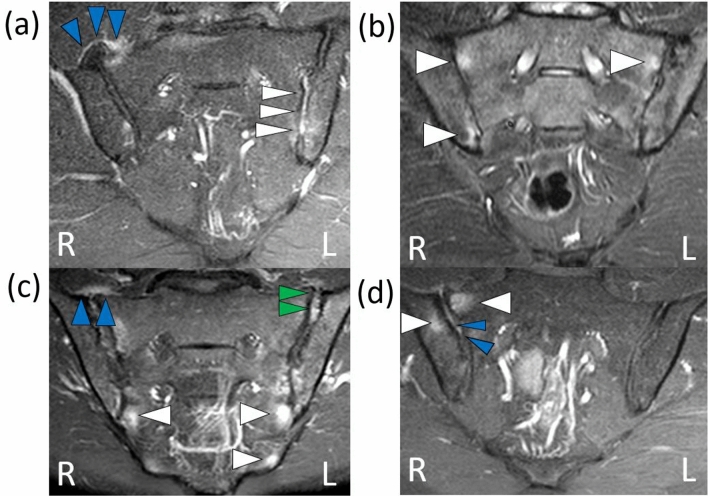
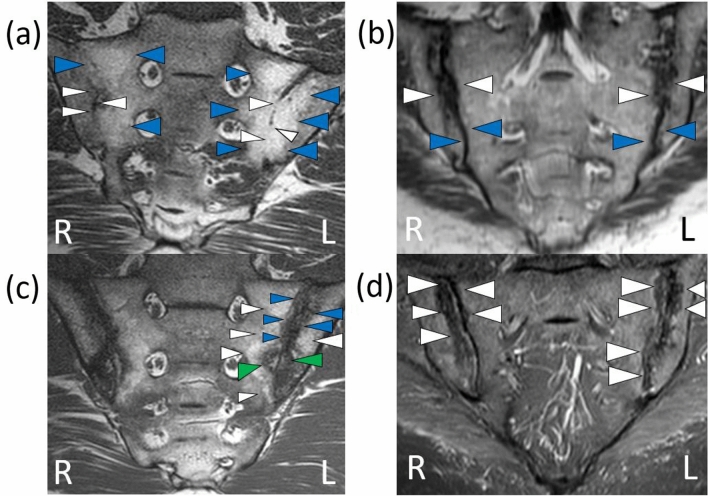
Sacroiliac joint involvement is one of the earliest manifestations of psoriatic arthritis (PsA). Magnetic resonance imaging (MRI) is a useful tool in the early diagnosis of axial disease due to its sensitivity for detecting acute and chronic changes associated with sacroiliitis. In this study, we evaluated the prevalence of sacroiliitis, acute and structural image changes on MRI in PsA patients and identified predictive clinical, laboratory and disease activity factors. Cross-sectional study on PsA patients submitted to MRI of the sacroiliac joints. The scans were evaluated by two blinded radiologists and the level of agreement was calculated (kappa). Clinical, disease activity and quality-of-life indices (DAS28, BASDAI, PASI, MASES, HAQ, CRP, ESR) were estimated. The sample consisted of 45 PsA patients with a mean age of 50.1 ± 11.5 years. The prevalence of sacroiliitis was 37.8% (n = 17), 47% of which was unilateral. The kappa coefficient was 0.64. Only 5 (29.4%) of the 17 patients with sacroiliitis on MRI had back pain. The most prevalent acute and chronic changes on MRI were, respectively, subchondral bone edema (26.7%) and enthesitis (20%), periarticular erosions (26.7%) and fat metaplasia (13.3%). CRP levels were higher among sacroiliitis patients (p = 0.028), and time of psoriasis was positively associated with chronic lesions (p = 0.006). Sacroiliitis on MRI was highly prevalent in our sample of PsA patients. Raised CRP levels were significantly associated with sacroiliitis, and longer time of psoriasis was predictive of chronic sacroiliitis lesions. Most sacroiliitis patients displayed no clinical symptoms.
骶髂关节受累是银屑病关节炎(PsA)的最早表现之一。磁共振成像(MRI)是一种有用的工具,可用于早期诊断轴性疾病,因为它对检测与骶髂关节炎相关的急性和慢性变化具有敏感性。在这项研究中,我们评估了 PsA 患者骶髂关节炎的患病率、MRI 上的急性和结构影像学变化,并确定了预测性的临床、实验室和疾病活动因素。对接受骶髂关节 MRI 的 PsA 患者进行横断面研究。由两位盲法放射科医生评估扫描结果,并计算一致性(kappa)。评估临床、疾病活动和生活质量指数(DAS28、BASDAI、PASI、MASES、HAQ、CRP、ESR)。样本包括 45 名平均年龄为 50.1±11.5 岁的 PsA 患者。骶髂关节炎的患病率为 37.8%(n=17),其中 47%为单侧。kappa 系数为 0.64。仅在 MRI 上有骶髂关节炎的 17 名患者中有 5 名(29.4%)有背痛。MRI 上最常见的急性和慢性变化分别为软骨下骨水肿(26.7%)和附着点炎(20%)、关节周围侵蚀(26.7%)和脂肪化生(13.3%)。骶髂关节炎患者的 CRP 水平较高(p=0.028),且银屑病发病时间与慢性病变呈正相关(p=0.006)。在我们的 PsA 患者样本中,MRI 上的骶髂关节炎患病率很高。CRP 水平升高与骶髂关节炎显著相关,银屑病发病时间较长与慢性骶髂关节炎病变有关。大多数骶髂关节炎患者没有临床症状。