Luchetti Gentiloni Michele Maria, Paci Valentino, Cimaroli Ilaria, Agostinelli Alice, Giannoni Melania, Campanati Anna, Diotallevi Federico, Carotti Marina, Sessa Francesco, Sordillo Raffaella, Macchini Cristina, Fiorini Federico, Massaccesi Leonardo, Ciferri Monia, Gigli Marco, Marconi Valentina, Perini Lucia, Marani Andrea, Giovagnoni Andrea, Polonara Gabriele, Offidani Anna Maria, Benfaremo Devis, Proft Fabian, Poddubnyy Denis, Moroncini Gianluca
Medical Clinic, Department of Clinical and Molecular Sciences, Marche Polytechnic University, Ancona, Italy.
Internal Medicine Residency Programme, Department of Clinical and Molecular Sciences, Marche Polytechnic University, Ancona, Italy.
Rheumatology (Oxford). 2024 Aug 1;63(8):2152-2161. doi: 10.1093/rheumatology/kead566.
There is growing interest in the early identification of patients with axial PsA (axPsA). We aimed to evaluate whether a dermatology-based screening strategy could help to identify axPsA patients.
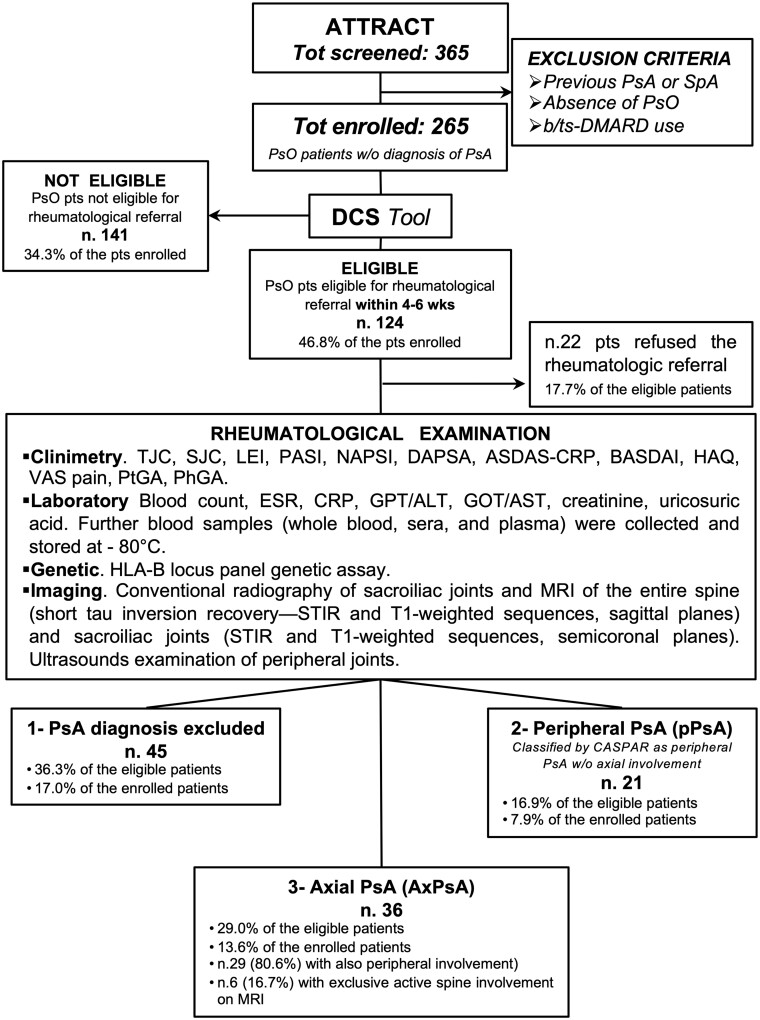
The dermatologist-centred screening (DCS) questionnaire was administrated by dermatologists to consecutive patients fulfilling the inclusion criteria [(i) age ≥18 years and (ii) clinical diagnosis of psoriasis made by a dermatologist] to identify patients eligible (affirmative answers 1-3c of the DCS) for rheumatological evaluation. Clinical, laboratory, genetic and imaging data were collected from all referred patients.
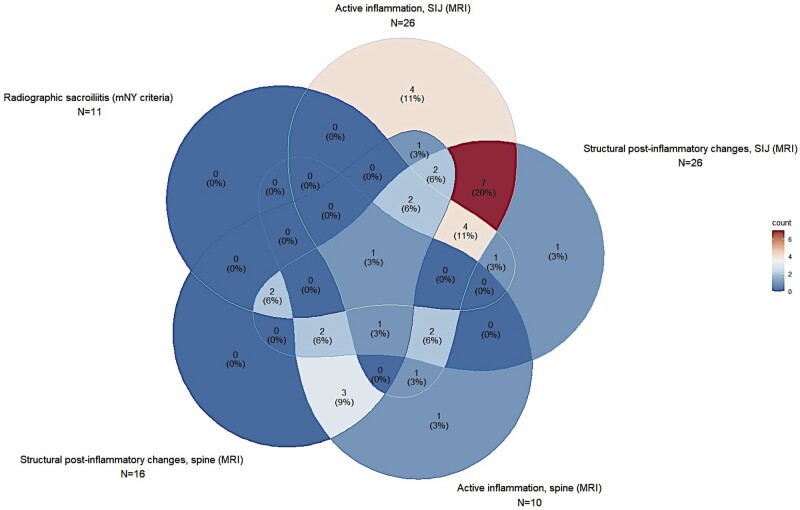
Among the 365 patients screened, 265 fulfilled the inclusion criteria and 124/265 (46.8%) were eligible for rheumatological referral. Diagnosis of axPsA, with or without peripheral PsA (pPsA), was made in 36/124 (29.0%) patients; pPsA without axial involvement was found in 21/124 (16.9%) patients. Back pain at screening was recorded in 174 (66%) patients, with 158 (60%) reporting a back pain duration longer than 3 months and 140 (53%) reporting back pain onset before the age of 45 years. Active inflammatory and/or structural post-inflammatory changes in the sacroiliac joints and/or spine were observed in all axPsA patients. Patients with PsA showed a numerically longer duration of back pain and higher CRP levels in comparison with patients with psoriasis without PsA.
The DCS tool proved to be a valuable screening strategy for detecting and characterizing patients with axPsA in a real-life cohort of psoriasis patients in a dermatological setting and helped to identify a substantial number of patients affected by undiagnosed pPsA.
对轴向性银屑病关节炎(axPsA)患者的早期识别兴趣日增。我们旨在评估基于皮肤科的筛查策略是否有助于识别axPsA患者。
皮肤科医生以连续符合纳入标准的患者((i)年龄≥18岁且(ii)由皮肤科医生做出银屑病临床诊断)为对象实施以皮肤科医生为中心的筛查(DCS)问卷,以识别符合风湿病评估条件(DCS问卷中1 - 3c为肯定回答)的患者。收集所有转诊患者的临床、实验室、基因和影像学数据。
在筛查的365例患者中,265例符合纳入标准,其中124/265(46.8%)符合风湿病转诊条件。36/124(29.0%)例患者被诊断为axPsA,伴或不伴外周性银屑病关节炎(pPsA);21/124(16.9%)例患者发现有不伴轴向受累的pPsA。筛查时174(66%)例患者记录有背痛,其中158(60%)例报告背痛持续时间超过3个月,140(53%)例报告背痛发病于45岁之前。所有axPsA患者均观察到骶髂关节和/或脊柱有活动性炎症和/或结构性炎症后改变。与无PsA的银屑病患者相比,PsA患者的背痛持续时间在数值上更长,CRP水平更高。
在皮肤科环境下的银屑病患者真实队列中,DCS工具被证明是检测和表征axPsA患者的一种有价值的筛查策略,并有助于识别大量未被诊断的pPsA患者。